

Nazimuddin Siddique
On 27 January, Union Home Minister Amit Shah, the Assam government, factions of the terrorist organisation National Democratic Front of Bodoland (NDFB), and the All Bodo Students Union (ABSU) signed the new Bodo Agreement. The accord calls for renaming the Bodoland Territorial Area Districts (BTAD) to the Bodoland Territorial Region (BTR), and increase in the number of seats of the BTAD council from 40 to 60.
The government will set up a commission to study about the inclusion of the Bodo-majority villages into the BTR, and the exclusion of the non-tribal majority villages from it. The NDFB will be given amnesty and efforts will be taken to rehabilitate its members. Subsequently, 1,615 NDFB members surrendered before the Indian government. .
The Bodos make up about 5 percent of the total population of Assam. Their demand for a separate homeland commenced in 1967 through the Plain Tribals Council of Assam (PTCA), but the demand did not materialise. Bodo leaders actively participated in the Assam Movement, but the Assam Accord did not recognise the interests of the Bodo masses and its elites This, compounded with the historical alienation of the Bodos by the Aomiya political elites, created a sense of deep despair among the Bodo political elites. It finally led to the start of the Bodo Movement, which demanded Assam be split into two with the new state being Bodoland.
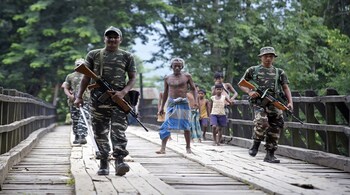
The Bodo Movement brought forth unprecedented violence in Assam, especially in the western Assam. Several terror groups came out of this movement and the most prominent among them were the Bodo Security Force (BSF), which later became the NDFB, and the Bodo Liberation Tigers (BLT).
The NDFB has several factions, and four of them engaged in the recent peace talk. While the Ministry of Home affairs records that over 4,000 lives have been lost to the Bodo movement, many experts feel that the figure is north of 20,000. Terrorists, claiming to represent the Bodo people, were responsible for these lives lost to ethnic cleansing.
The recently-signed accord is the third accord the government has signed with the Bodo political elites and with the extremists.
The first Bodo accord was signed on February 20, 1993, which paved the way for the formation of the Bodoland Autonomous Council (BAC). The accord, inked by the central and state governments and the leaders of the Bodo movement, ultimately failed.
The second accord, signed on February 10, 2003, was between the central and state governments and the BLT.. This Memorandum of Settlement (MoS) gave birth of the Bodoland Territorial Council (BTC), which was much celebrated by the Bodos, in the same manner most of the Bodos are jubilant about the latest accord. The BTC included four districts — Baksa, Chirang, Kokrajhar, and Udalguri. These four districts, together known as the BTAD, have about 70 percent non-Bodos, who do not enjoy any significant political rights.
For the 2003 accord, the government did not consult non-Bodo representatives, and the MoS left out the NDFB, which was operating in a ruthless manner in Assam before and after the accord. Given these factors it was doomed to fail.
In the years following this, the movement continued mainly by the ABSU politically and by the NDFB through violent terrorist activities. Killings and bomb blasts became normal in the western Assam.
This has led to the third and current accord. After signing the accord Assam Chief Minister Sarbananda Sonowal said that the territory of Assam will not get divided, but the development over the decades clearly indicates that the BTR is increasingly moving towards a separate state.
The Bodo movement in western Assam is an example of an ethnocracy-inspired movement. Only 27 percent of the total populations in the BTAD are Bodos.
In the line of previous two accords, this one too completely dismisses the interest and rights of no less than 70 percent non-Bodo population in the BTAD. Thousands of people belonging to the Adivasi, the Koch-Rajbanshis, the Muslims, the Gorkhas, etc. were forcibly displaced from their homes, in the series of internecine violence.
Thousands of these people still remain displaced, and while the government has talked about the rehabilitation of the factions of the NDFB, it has surprisingly maintained a silence on the rehabilitation of these citizens who have been victims of the Bodo movement.
In the midst of all these deep intricacies, this peace accord has brought cheer to thousands of Bodos, while an uneasy silence is observed among the non-Bodos, who constitute the majority of the region.
Nazimuddin Siddique is an Assam-based independent researcher. Views are personal.
Discover the latest Business News, Sensex, and Nifty updates. Obtain Personal Finance insights, tax queries, and expert opinions on Moneycontrol or download the Moneycontrol App to stay updated!





