

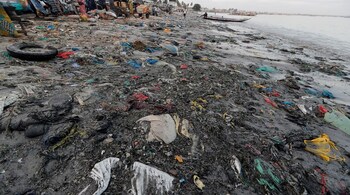
Prime Minister Narendra Modi’s announcement of a ban on the use of single-use plastics by Gandhi Jayanti in 2022 is good in intention but not so much in terms of its scope for implementation. The proposed ban covers plastic bags, cups, plates, small bottles, straws, and certain types of sachets.
India may not be the world’s worst offender in contributing to plastics pollution — that dubious distinction going to China and the United States — but the life of an average Indian is inextricably intertwined with plastics, so much so that it has become part of daily life. Given things as it stand, it is virtually impossible to imagine life without plastic any time in the foreseeable future.
While declaring India’s commitment to completely ban single-use plastics by the target date at the 14th session of the United Nations Conference of Parties or COP 14 against desertification, Modi also urged the world to say goodbye to plastics. Thankfully, Modi is not on the same page on this as US President Donald Trump, who considers the crucial climate issue merely as a Chinese hoax, making the world pay for the intemperance of a poorly-informed person.
That should not make us feel complacent about the grave danger that the prodigal use of plastics is bringing to our lives. We have been manufacturing plastics for several decades and much of what has been produced still remains intact in some form or the other. Most of it lies in landfills, a part of which seeps into the river waters, and then gets carried to the sea. That people may be living far away from these water bodies is no consolation as traces of it are present — disturbingly — in our bloodstream. So serious is the problem that the toxic effect is present in the water we drink, the food we eat and the air we breathe.
Obviously, the mess that we have created over the past three decades or so cannot be undone in a matter of three years, which is what Modi’s proposed ban strives to do. It needs the inculcation of a new culture and a change to our practices and routines and a ban by law in one single stroke cannot do this. Awareness and commitment are the key and getting the message across effectively is indeed a Herculean task.
The biggest challenge is to overcome the convenience factor that has made plastic ubiquitous in our lives. Unless the suggested alternative can take care of this aspect, acceptability will remain a serious problem. The solution suggested is a return to the old-fashioned methods of carrying environment-friendly bags, glass bottles and even own cutlery for personal use. This is easier said than done.
There is, of course, the option of stopping the production of single-use plastics altogether, but this will lead to other problems. Already voices of dissent are trying to build up resistance to the idea, saying it is bad for the economy and that it will cause massive job losses. The All India Plastics Manufacturers Association has even called for the rejection of the UN definition of single-use plastics as it covers most items of daily use.
Former environment minister Jairam Ramesh fired the opening salvo, asserting that he had opposed the ban on the use of plastics when he was minister because it would have led to lakhs of people being thrown out of employment and has even urged the Modi government not to push ahead with its proposed ban. Ramesh may have joined the issue for the public consumption of his party colleagues, who had taken umbrage at his most unlikely act of supporting some of Modi’s programmes.
The job loss argument is a dangerous line to take. By the same logic, millions who make a living by way of illegal activities, including smuggling and drug peddling, would suddenly come above board. This will give even thieves a justification for carrying on their trade.
The trouble with disposable plastic is that brings a certain convenience at an individual level, but the society at large is made to suffer a greater inconvenience. It costs the nation dearly in terms of health costs and productivity loss, apart from the heavy toll it takes of the lives of its citizens.
K Raveendran is a senior journalist. Views are personal.
Discover the latest Business News, Sensex, and Nifty updates. Obtain Personal Finance insights, tax queries, and expert opinions on Moneycontrol or download the Moneycontrol App to stay updated!





