

Article 21 of the Indian Constitution guarantees every individual the right to life and personal liberty. Over the years, the Supreme Court has, through a series of landmark judgments, expanded the scope of this right far beyond mere physical existence or survival. It has consistently emphasised that the right to life is not limited to just living, but to living with human dignity, encompassing all those conditions and elements that make life meaningful, complete, and worth living.
In this way, dignity has become the touchstone for interpreting Article 21. The Court’s evolving jurisprudence has extended this concept to affirm that dignity is essential not only to live but also to die with respect and grace — thereby recognising the right to die with dignity as an extension of the right to life itself.
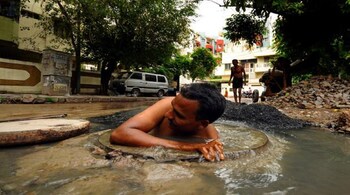
However, there remain instances where the State fails in its constitutional duty. And, it becomes glaringly evident when a ‘manual scavenger’ is forced to clean human excreta from latrines, open drains, or pits, in many cases with mere safety equipment, sometimes with bare hands. And die from inhaling toxic gases.
Two laws, no effect
The law prohibiting manual scavenging — the Employment of Manual Scavengers and Construction of Dry Latrines (Prohibition) Act, 1993 — was enacted to eradicate one of the most degrading and inhumane practices in Indian society. A decade later, a new act called ‘Prohibition of Employment as Manual Scavengers and their Rehabilitation Act, 2013’ was enacted.
However, even more than two decades after the first law prohibiting manual scavenging was enacted, manual scavenging continued to persist across the country. What is even more disturbing is that this illegal and dehumanising practice is not confined to remote villages or small towns, but is still being carried out openly in all major cities and even in the very heart of the national capital.
In September 2025, a 40-year-old man named Arvind died, and three others were hospitalised in critical condition after they fell unconscious while manually cleaning a sewer in Delhi’s Ashok Vihar Phase II. Arvind died after inhaling toxic fumes while cleaning a sewer.
A court that will “go to any extent possible”
It is important to recall that in December 2024, the Supreme Court had “vowed” to “go to any extent possible” to ensure that manual scavenging and the hazardous manual cleaning of sewers and septic tanks are completely eradicated from the country. The court, while acknowledging the fact that despite there being a law prohibiting manual scavenging, “both manual scavenging, unhygienic latrines and employment of manual labour in sewer lines, which is known as hazardous cleaning, were continuing in all parts of the country”.
The court issued several directions in this regard.
It is also important to note that in October 2023, the Supreme Court, in another significant judgment, issued several directions to ensure the effective enforcement of the ban on manual scavenging. However, as observed in the December 2024 judgment, the status report filed by the Union Government, detailing the extent to which those directives had been implemented, was not “encouraging” at all. The Court expressed concern that despite clear judicial mandates and repeated assurances, the ground reality reflected continuing violations and administrative apathy.
Undermining constitutional pillars
The Court also observed that the ideals of fraternity, equality, and dignity enshrined in the Constitution become nothing more than an illusion if a sizeable section of society is still compelled to enter sewers for their livelihood and die within them, even a decade after the enactment of the Prohibition of Employment as Manual Scavengers and their Rehabilitation Act, 2013.
Again, in January 2025, a writ petition was filed seeking the eradication of manual scavenging in India. The Supreme Court passed an order banning manual scavenging and manual sewer cleaning in six metropolitan cities, including Delhi.
It was a striking irony that in Delhi — where the Supreme Court’s own ban on manual scavenging is in force — the Court had to confront the reality of manual sewer cleaning taking place at its very gate this August.
Ignored even at its doorstep
The court issued notice to East Delhi Municipal Corporation [EDMC] and sought a reply explaining as to why manual scavenging and hazardous cleaning are still going on with manual labour, exposing such workers to the risk of their lives and that too, without proper gear to these workers, as shown in the photographs attached to the application.
In the order, the court noted, “ We are also constrained to observe that photographs have been shown to us that manual scavenging and hazardous cleaning are being done at Gate F of this Court as well. On September 18, the Supreme Court imposed a Rs 5 lakh fine on Delhi PWD officials for engaging manual sewer cleaners right outside its own premises — at Gate F — in blatant violation of the Court’s own judgment banning manual sewer cleaning.”
This disturbing irony — that the nation’s highest court, which has repeatedly upheld the right to live with dignity and banned manual scavenging, witnessed the violation of its own orders at its very doorstep — serves as a grim reminder of how far the promise of constitutional dignity remains from reality. Laws, judgments, and penalties can only go so far unless accompanied by a strong administrative will to eradicate this inhuman practice once and for all. The sight of a worker entering a sewer outside the Supreme Court is not just a failure of governance; it is a collective failure of conscience. True justice will only be realised when no Indian is forced to trade dignity for survival, and the ideals of equality, fraternity, and human dignity move from the pages of the Constitution to the lived experience of every citizen.
Discover the latest Business News, Sensex, and Nifty updates. Obtain Personal Finance insights, tax queries, and expert opinions on Moneycontrol or download the Moneycontrol App to stay updated!





