

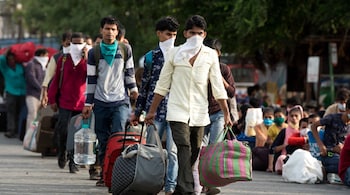
Concerns for the safety of interstate migrants in Tamil Nadu were raised after videos went viral on social media purportedly showing north Indian migrants being beaten up, which the state police promptly dismissed as fake news and rumours. A Bihar government team also visited TN and expressed satisfaction with the efforts of the TN government to allay the fears of migrant workers. However, the migratory identity turning into stigma, resulting in hate and violence, is not new in the case of interstate migrants. Recall the episodes in states such as Maharashtra and Delhi, which has even been normalised to an extent.
Migrants, in particular interstate migrants, play a critical role in the prosperity and economic development of both states of origin and destination. A 2016 survey commissioned on behalf of the TN government’s Labour department reported that the state is home to more than a million migrant workers. A majority of them are unskilled, informal and low-wage earners from West Bengal, Assam, Odisha, Bihar and Jharkhand.
Migration: Where’s The Data?
Among them, 27 percent are employed in the manufacturing sector, 14 percent in textile industries and another 11 percent in the construction sector. However, there needs to be more surveys to estimate the conditions of inter-state migrants, similar to that of the Kerala model of migration surveys. The ongoing migration surveys in Odisha and Jharkhand, with which the senior author of this article is associated, have helped in generating a more nuanced understanding of migrants and have also aided in better policy-making in both the states of origin and destination.
Other origin states such as Bihar, Assam, West Bengal, Rajasthan and Uttar Pradesh could also benefit by emulating the model of both Odisha and Jharkhand and doing a large-scale migration survey to examine the various contributions made by low-skilled migrants for the improvement of their households, economy and society.
Various trade associations in TN such as the Chennai District Small Industries Association and the Chennai Hotels Associations to name a few have expressed worries about a potential exodus of north Indian migrants from the state in the wake of the recent events. The Chennai Hotels Association in their letter dated March 1 to the TN chief minister had requested the protection of migrants from northern states after reports of instances of human rights violations were circulating among the general public.
Politics Of Stigmatisation
There are two major sides to the construction of migratory identity and the process of othering:
* The first is socio-political
* The second is economic
Stigmatising migrants as ‘outsiders’ and creating politics around them is a most potent and convenient polarisation device, which has been frequently and skilfully used by political parties, primarily regional outfits, to please the nativist groups.
They have criminalised migrants and blamed them for several problems such as economic deprivation, stealing jobs, unemployment among youth, encroachment and increasing slums, crime, overcrowding, etc and used this issue for their political advantage.
Due to the fear of losing their cultural and ethnic identity, and employment opportunity, the locals resist migrants resulting in hostile attitudes and violent attacks against the latter by the locals. This is a violation of Articles 19(1)(d) and 19(1)(e) of the Indian Constitution that guarantees every citizen the right to move freely to any part of its national territory, either for employment or settling down.
In reality, the dominant beneficiary groups control the mobility of the precariously placed migrants by creating an unfavourable and hostile situation for them in the host cities. During the Covid-19 nationwide lockdown, the stranded interstate migrants were branded as “carriers of infection”, humiliated and portrayed as “unwanted” in the host cities and even at their place of origin.
Profiting From Migrants’ Stigma
The second side of their stigma stems from the capitalist urban informal labour market, where migrants’ identities are constructed, and labourers are recruited based on their region, caste and ethnicity. Along with this prevalent practice, employers have profit-making interests in stigmatising and labelling migrants and perpetuating hierarchies in the labour market to keep migrant labour under their control.
Usually, in cities, the wage rate of native labour is much higher than migrants, pulling employers towards preferring and recruiting migrants. As a result, the migrants are ready to work on jobs that the locals reject.
Stigma and identity politics incite hostility, violence and hatred for interstate migrants, creating fear, xenophobia and deep psychological trauma among migrants. The perception of interstate migrants as ‘outsiders’ is deeply rooted in the dominant economic, political and cultural interests of some influential groups such as the manufacturer-employer lobby, local municipal corporators, politicians, their disciples and followers and eventually the state.
Safety Nets For Migrant Workers
It is in the informal sector in cities that most interstate migrants get absorbed. The informal nature of work brings multiple problems and intersectional vulnerabilities and keeps them critically marginalised. In the host cities, they work in precarious conditions with few or no social entitlements and social security framework. Stigmatising them under such conditions aggravates their miseries.
Stigmatising is a form of structural-invisible violence and creates a long-lasting impact on migrants. The migrants in the urban informal sector are the voiceless, highly fragmented, sometimes undocumented and precarious groups. Therefore, it is easier for the dominant political and employer groups to control and exploit them by stigmatising them.
Several cases of violence against migrants are not even documented. Stigmatising migrants, spreading rumours or attacking them needs serious attention from the State and other development stakeholders. There is a significant challenge to the meaningful inclusion of migrant workers in both the destination and their native states.
Promoting the unionisation of migrants can be one of the major steps. Their precariousness must be understood within the broader perspective of social justice and human rights, and the State must frame a comprehensive, institutionalised policy to protect this critical human capital in the interest of development.
S Irudaya Rajan is Chair and Kuldeepsingh Rajput is Senior Research Fellow at the International Institute of Migration and Development (IIMAD). Views are personal and do not represent the stand of this publication.
Discover the latest Business News, Sensex, and Nifty updates. Obtain Personal Finance insights, tax queries, and expert opinions on Moneycontrol or download the Moneycontrol App to stay updated!





