

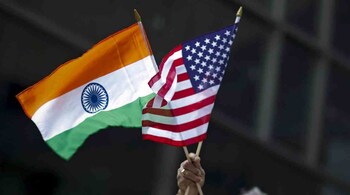
In the popular imagination the relationship between the world’s largest and oldest democracies, the India-US relationship, is recalled as having moved from bitter ‘estrangement’ over the nuclear nettle to one of cautious ‘engagement.’ The return of President Donald Trump to White House and his tariff crusade is scheduled to kick-in with respect to India on April 2. Astute negotiations will be called for to ensure that there is no return to a discordant phase leading to estrangement in the bilateral relationship.
The word estrangement is also derived in part from a comprehensive and rigorously researched book ‘Estranged Democracies’ by the highly regarded American scholar-diplomat Dennis Kux. However, the bilateral relationship is far more complex and nuanced and cannot be reduced to a simple binary, and the transmutation to substantive India-US engagement took place after India’s May 1998 nuclear tests.
Clinton address to Parliament was the turning point
The turning point was the March 2000 visit of US President Bill Clinton to India and the highlight was his address to the Indian parliament on March 22.
Prime Minister Atal Bihari Vajpayee took the decision to cross the nuclear Rubicon soon after assuming office in early 1998. India which had not signed the NPT (Nuclear Non-Proliferation Treaty) finally decided to exercise its option – to become a nuclear weapon power - and Delhi joined the nuclear club.
In the immediate aftermath of the ‘Shakti’ tests, the bilateral relations spiralled south rapidly and India was the target of unbridled US rage. The non-proliferation zealots in the US were livid. In the first few weeks it appeared as if India would be permanently ostracized. In an unprecedented step, the White House chose to make public a secret letter from Vajpayee to Clinton and this muddied the waters further.
The Vajpayee government remained resolute and was able to open a line of quiet communication with the Clinton team and then Foreign Minister Jaswant Singh entered into extended dialogue with then US Deputy Secretary of State Strobe Talbott.
Slowly but steadily the Indian rationale for deciding to acquire nuclear weapons was accepted by Washington. The feckless Pakistani misadventure of covertly launching the 1999 Kargil war and rattling the nuclear sabre versus the restraint shown by Delhi burnished India’s profile as a responsible nuclear power.
The March 22, 2000, Clinton address to the Indian parliament symbolized the definitive transmutation to cautious engagement and PM Vajpayee noted this shift when he received the US President in Delhi – the first such visit after 22 years. Vajpayee noted: "I think with President Clinton's visit and our meeting today (March 21, 2000) we have laid a firm foundation for the future."
A communicator par excellence, Clinton received a standing ovation after his address to the Indian parliamentarians and some of his deftly worded, seemingly self-deprecating observations on the nuclear issue were well received. He dwelt on the irony that he was speaking to them – elected representatives of a billion strong country -"on behalf of a nation that has possessed nuclear weapons for 55 years and more." He added with disarming candour: “Any country can say to us – particularly another democracy – oh, you are a hypocrite, you've got nuclear weapons, you don't want us to have any. Well, I am trying to reduce the store of nuclear weapons the US has, the store Russia has. The Russians have supported this."
This assertion regarding a reduction in the US arsenal was partially true but it served the purpose in Delhi and the joint vision statement was more explicit. It noted: “India and the United States share a commitment to reducing and ultimately eliminating nuclear weapons, but we have not always agreed on how to reach this common goal. The United States believes India should forgo nuclear weapons. India believes that it needs to maintain a credible minimum nuclear deterrent in keeping with its own assessment of its security needs."
Bush-Singh engagement brings forth a modus vivendi
It took another five years for the nuclear issue to be resolved and a modus-vivendi was evolved during the tenure of PM Manmohan Singh and President George W Bush beginning with the civilian nuclear accord in 2005. At the core was the squaring of the nuclear circle apropos India, namely, that even as a non-signatory to the NPT India would be accorded a distinctive status whereby it would retain its nuclear weapon capability while accepting certain self-regulating provisions.
The Bush team is to be commended for its patience and perspicacity despite some hesitation and political discord on the Indian side. China tried to play spoiler in the global arena but a resolute US President stayed the course on India being accorded an exceptional status and finally, on September 28, 2008, the US House of Representatives voted 298–117 to approve the Indo-US nuclear deal and later the US Senate voted 86–13 to remove the nuclear nettle that had bedevilled the bilateral relationship for decades.
US is now one of India’s major armament suppliers
Since 2009 (the Obama years) to the present period, the US has emerged as a major supplier of military inventory to India and this is expected to increase in the years ahead.
The Trump presidency has led to a palpable degree of disruption and uncertainty globally across all domains and India is no exception.
Having turned the page definitively in March 2000, the challenge for India in the years ahead to make the engagement with the US more robust will be to navigate two interrelated strands – trade and technology. The current orientation of the Trump team suggests that seat-belts will have to be fastened in Delhi even as it remains committed to an equitable engagement with Washington.
Discover the latest Business News, Sensex, and Nifty updates. Obtain Personal Finance insights, tax queries, and expert opinions on Moneycontrol or download the Moneycontrol App to stay updated!





