

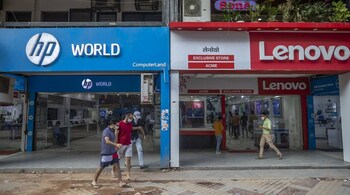
India’s sudden decision to restrict the import of computers and tablets looks more like bureaucratic desperation rather than a well-considered industrial policy. The move a day later to push back implementation until November only adds to the sense that New Delhi is making things up as it goes along.
The government’s Aug 3 announcement means businesses will need an import license to bring items like laptops into the country — a sign that earlier incentives designed to increase domestic production had failed to gain traction. Specifically, a 169 billion rupee ($2 billion) plan to hand cash back to makers of computer equipment doesn’t seem to be garnering the levels of interest received for an earlier policy aimed at smartphone makers.
Impetus for this sudden restriction and concession may date back to the government’s decision last year to implement the second incarnation of its production-linked incentive scheme. Introduced in 2020, it was part of Prime Minister Narendra Modi’s efforts to encourage increased manufacturing of goods ranging from chemicals and textiles to white goods and cars by giving cash back to companies based on how much their revenue grew. One upside to this approach is that the government only pays for positive outcomes: if investment doesn’t increase and local production doesn’t rise then no money is dished out.
The smartphone sector was a major beneficiary; businesses were offered a starting incentive of 6 percent of net incremental sales and 410 billion rupees was earmarked for the sector over five years. At least 32 applicants were approved and local manufacturing continued its upward trajectory, climbing 27 percent last fiscal year to 3.5 billion rupees.
This second version of the program is aimed at reprising that accomplishment for computers. The government’s reason is sound: India imported $10 billion of computing products last fiscal year, the majority from China. Much of the country’s industrial policy now revolves around two overlapping goals: boosting local employment and economic activity, and reducing reliance on its largest military and economic rival. Every smartphone, laptop or desktop PC made in India is a double-blow to China.
Whereas implementation of the first set of incentives was well-timed, at the height of Beijing-Washington tensions and just as global manufacturers sought to decouple from China, the second attempt looked troubled from the start. According to one report, major brands last year urged the government to delay it because the global PC sector was in a downturn. Still, the government went ahead and in May announced this renewed round, offering incentives for laptops, tablets, all-in-one PCs, servers and ultra-small form factor computers.
It appears this scheme may not be getting the traction policymakers expected. Local media reported last week that while 44 companies had registered for the program, only two had actually filed an application, and the initial July 31 deadline was delayed to the end of August; those giving out money don’t tend to extend the process unless uptake is slow.
When the government announced its list of restricted items, the wording and timing was stark. The Directorate General of Foreign Trade specifically named those same items, with the same wording, and it did so less than a week after the extension for production-linked incentives was released and the initial deadline had passed.
Policy hiccups are common. Programs designed to spur production or investment don’t always work as planned, and interest often lags expectation. Given the global macroeconomic situation and even mighty India’s inability to avoid the fallout, it’s understandable that manufacturers are not keen to increase spending on new facilities.
That doesn’t justify the government’s overreaction, though. This move to suddenly label items as restricted doesn’t even ban them, it merely adds to the red tape for businesses. Now an importer needs to register with the government then pay a 0.1 percent fee just to apply. There’s no guarantee if or when approval will be given.
As Quartz journalist Ananya Bhattacharya wrote, this regressive action is a throwback to the era of the “License Raj,” where no business decision could be made without government approval. Uncertainty is the enemy of economic progress, and opacity runs counter to New Delhi’s goal of turning the nation into an electronics powerhouse.
We also need to question just how effective the original policy has been. Companies will gladly take cash handouts on offer, but growth in smartphone manufacturing was well on its way before this latest incentive scheme. In 2016, the Modi government started raising import duties on mobile phones and their components; they climbed to 20 percent by 2018 for a completed device. Taiwan’s Foxconn Technology Group, Wistron Corp and Pegatron Corp are among those that ramped up production in line with the wishes of clients such as Apple Inc and Xiaomi Corp to get around the tariffs.
This earlier import-tax policy — part of the Make in India program — was likely a far bigger driver of manufacturing than the later incentives. In fact, as much as we free-trade absolutists might shudder to admit it, there’s no denying that tariffs are an effective tool for spurring economic activity.
But with these new restrictions and licensing we get neither carrot (incentives) nor stick (tariffs). Instead, traders and manufacturers are left in a grey area trying to decide whether they ought to boost investment to get around clearly defined taxation, or build the costs and delays of dealing with Indian bureaucrats into their economic models.
Tim Culpan is a technology columnist for Bloomberg Opinion. Based in Taipei, he writes about Asian and global businesses and trends. Views are personal, and do not represent the stand of this publication.
Credit: Bloomberg
Discover the latest Business News, Sensex, and Nifty updates. Obtain Personal Finance insights, tax queries, and expert opinions on Moneycontrol or download the Moneycontrol App to stay updated!





