

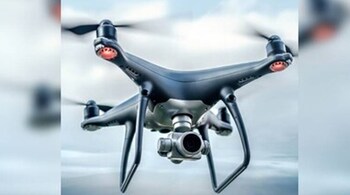
India finds itself in a very hostile neighbourhood. On our west is a bankrupt economy, thriving on the DNA of exporting terror, on the north is a revisionist power seeking to redraw boundaries through coercion. Both are nuclear-armed, and both are deeply invested in asymmetric tools of warfare that threaten to change the face of warfare itself.
Future of warfare will build on asymmetric tactics
That said, the battlefield of the future will not be defined solely by the conventional tools of kinetic warfare, it will be defined by many asymmetric ones in the hybrid domain- lethal swarm drones, cyber blackouts, narrative wars woven skillfully to sell the lies/truths as it suits the originator, tools to cause public unrest, holding critical infrastructures to risk, exploiting fault lines based on cast sensibilities, religion, political affinities and more.
India is increasingly aware of such threats are steps are afoot to counter these.
Countering asymmetric threats
Firstly, in the anti-drone space we are diversifying our capabilities on multiple fronts. For surveillance and detection of small drone threats, we are moving in a big way to acquire Electro-Optical (EO) and Radio Frequency (RF) Sensors of much better capabilities than the ones that were fielded in Op Sindoor.
The latest Drone Detection Radar (DDR) by Bharat Electronics Limited (BEL) holds a big promise. In the kill domain, efforts are already on to move beyond the RF jamming kill to hard-kill based on small arms/MMG fire as also by integrating high rate-of fire air defence guns into the kill loop.
Private firms in India are stepping up
What is promising is the fact that besides the public sector entities, private industry is also stepping up in a big way in boosting nation’s capabilities in countering asymmetric threats.
For instance, the Anti-Drone System designed, developed and manufactured by a Hyderabad based Company; Zen Technologies Limited, proved its mettle during Op Sindoor Further, this company has not only introduced AI-enabled multi-spectral cameras into drone detection enhancing the detection range manifolds, it has indigenously designed an anti-drone system (Zen Vyomkavach) that incorporates a an autonomous hard kill weapon. Zen and BEL have also integrated L 70 and ZU 23 guns as hard kill means in the anti-drone systems.
Directed energy weapons (DEWs) are also making an entry. Laser as a kill means was already a reality during Op Sindoor. DRDO’s, as well as a private sector player M/s Tonbo’s High Power Microwave (HPM) Systems are making a success story.
Compromised components are being flagged and eliminated
In the cyber domain, the shift is equally clear. Early-warning protocols, hardware audits, and threat emulation exercises have become standard. Components flagged as compromised (including Chinese-made electronics in critical platforms) are being systematically stripped from procurement pipelines.
Capabilities in Cyber Defence as well as Cyber Offence are being revamped at a fast pace. Further details about these are in the classified domain. Open sources have reported that India has established dedicated cyber units within its military and intelligence agencies and has integrated cyber warfare into its broader military strategy.
India is now conducting civil defence drills and full-spectrum simulations of cyber-attacks, bomb threats, and infrastructure disruption exercises. These they are calibrated rehearsals of response, designed to close the loop between state capacity and civilian readiness.
Political vision is not restricted to battlefields
In this context PM Narendra Modi’s of ‘Sudarshan Chakra’ does not restrict itself to battlefields or national vulnerabilities alone, it extends to every town, district and population centers and envisages resources to protect peoples and assets spread across the length and breadth of our country both from conventional, as well as, asymmetric threats.
At the same time, another front is being reinforced; the cognitive one. There is a common perception that while we inflicted a crushing defeat over our adversary during Op Sindoor our performance in the narrative war remained week and muted. There is a lot of ground to catch on this, though we are moving forward.
For instance, defence minister Rajnath Singh’s strong-worded message stating that any misadventure in Sir Creek area would invite a severe Indian response that could change both ‘history and geography’ or the COAS mentioning about Pakistan having to choose between ‘remaining in geography or becoming a history’ or the Air Chief putting out in categorical terms the air losses inflicted on Pakistan during Op Sindoor are positive signs on building strong narratives that go far.
Conclusion
The face of warfare is changing before our eyes. Drones, cyber weapons, and grey-zone tactics are not tomorrow’s challenges; they are today’s realities. India has shown time and again that it can adapt, innovate, and impose costs on those who test its resolve.
(Lt Gen VK Saxena is the former Director General of the Corps of Army Air Defence.)
Views are personal and do not represent the stand of this publication.
Discover the latest Business News, Sensex, and Nifty updates. Obtain Personal Finance insights, tax queries, and expert opinions on Moneycontrol or download the Moneycontrol App to stay updated!





