

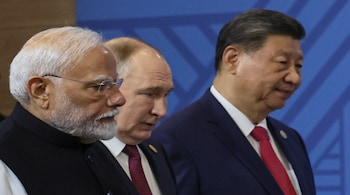
After over four years of acrimony, India and China are embarking on the long path of rebuilding their relationship. The meeting between Prime Minister Narendra Modi and Chinese President Xi Jinping in Kazan, Russia, is the first step in a process of re-engaging, building trust and potential normalisation.
However, a lot of water has flown under the bridge since the last bilateral meeting between the two in Mamallapuram in October 2019. The outcome of this current process, therefore, is likely to be a new normal rather than reverting to an earlier state of affairs.
First, the structural factors that have engendered volatility in the India-China dyad continue to persist. These include the power asymmetry between the two sides, Chinese perceptions of itself as a major power and India as an inferior, regional actor and the dynamics of Sino-US strategic competition. Within this context, the future of the Asian order lies at the heart of Sino-Indian friction. This was evident in the differences between the readouts from the two sides issued after the Modi-Xi meeting.
The Indian readout mentioned the importance of “stable, predictable, and amicable bilateral relations” for building a “multi-polar Asia and a multi-polar world.” The Chinese readout did not identify multipolarity in Asia as being a goal. Instead, it stressed that ties should be handled “from a strategic height and long-term perspective” serving the end of “world multipolarization”.
Second, the patrolling agreement announced earlier this week does not necessarily resolve the standoff in Eastern Ladakh. Since Foreign Secretary Vikram Misri’s first announcement on Monday of a deal between India and China on patrolling rights, there has been a gradual trickle of details through the week. In two separate press briefings in Kazan, Misri confirmed that the deal was rather limited in nature. It essentially covered patrolling in the areas of Depsang and Demchok. These were the remaining friction points where disengagement had not taken place earlier. In addition, Misri was clear that “as far as the disengagement agreements reached previously are concerned, those agreements were not reopened” as part of the discussion on patrolling rights. In other words, the buffer zones that had been agreed upon along the friction points of Pangong Tso, Galwan Valley, Gogra and Hot Springs would remain for now.
In addition, thus far, there appears to have been no dialogue over the next steps towards de-escalation, confidence-building measures and normalised boundary management. Misri’s remarks to the media on Wednesday after the Modi-Xi meeting indicated that it was India’s “expectation” that the latest agreement “should certainly lead to an easing of the situation along the LAC.” The Chinese readout, however, did not indicate any particular willingness to move with speed towards such an outcome. Rather, it simply mentioned a desire to seek “fair and reasonable solutions” to the boundary issue.
Third, it is also worth noting that as per the Foreign Secretary, “Prime Minister Modi underscored the importance of not allowing differences on boundary-related matters to disturb peace and tranquility on our borders.” In other words, the Indian side’s contention remains that certain actions even due to differences in perceptions over the boundary can disrupt peace and tranquility on the borders. This can have a detrimental impact on the overall state of the relationship. In contrast, the Chinese readout stressed that both sides should “not let specific differences affect the overall situation of bilateral relations.” In other words, Beijing wants to firewall the broader relationship from the situation along the borders. This, as has been evident in the past four years, has been unacceptable for New Delhi.
Fourth, both sides confirmed that the going ahead, the two foreign ministers and other officials will engage to stabilise and rebuild bilateral relations. A dialogue on trade and investments has been long pending. One of the outcomes of the informal summit in Mamallapuram in 2019 was the establishment of a new mechanism to discuss trade, investment and services. This was to be led by then Vice Premier Hu Chunhua and Indian Finance Minister Nirmala Sitharaman. Alas, the pandemic and then the standoff in Eastern Ladakh scuttled this process before it got off the ground. A renewed effort in this direction would be welcome.
That said, in terms of the economic relationship, there will likely be some easing with regard to questions around trade and talents, particularly when it comes to goods that can boost Indian exports and manufacturing. However, there are certain challenges that are now structural and unlikely to be wished away, such as concerns with regard to the broader trade imbalance, subsidised Chinese exports to India, de-risking in emerging technologies and security issues related to Chinese investments. For instance, in this week itself, the Indian government has announced anti-dumping duties on five Chinese imports for a period of five years. Likewise, the decision to engage in a security review of investments that was initiated under Press Note 3, issued in April 2020, is unlikely to be undone.
Sitharaman’s remarks this week about the need for “safeguards” with regard to investments are a case in point. “India is in a very sensitive neighbourhood”, she told a gathering at Wharton School. “I cannot blindly welcome FDI without considering where it’s coming from.” Nevertheless, the meeting between Modi and Xi opens up space for rethinking the modalities of investment scrutiny. As opposed to the current slow, ad hoc and opaque process, it would be advisable for the Indian government to deliberate on a new investment review mechanism with clear guidelines, conditions and timelines. This will engender greater predictability for industry, and ensure adequate democratic oversight.
In sum, the meeting in Kazan and the effort towards normalisation that it is likely to begin is a positive development. One must not prejudge the outcomes of this process. At the same time, it is important to be cognizant that structural challenges in the India-China relationship are likely to sustain. Normalisation is unlikely to be a smooth process, and there is nothing inevitable about it.
Discover the latest Business News, Sensex, and Nifty updates. Obtain Personal Finance insights, tax queries, and expert opinions on Moneycontrol or download the Moneycontrol App to stay updated!





