

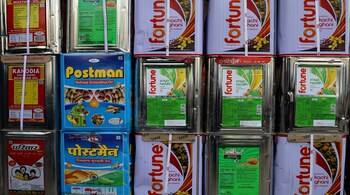
Narendra Modi is spending billions of dollars on self-reliance. On roads and in factories, the Indian prime minister’s slogan translates to generous subsidies for homemade electric-vehicle batteries, solar panels and green hydrogen — anything that can help cut an outsized dependence on Middle Eastern crude oil. There is, however, another imported oil the South Asian nation is addicted to: the one used for cooking. Indian kitchens spend $19 billion annually on Indonesian palm, Ukrainian sunflower and Argentinian soybean oil.
Food bought from overseas soaks up dollars, which no developing economy wants to part with right now. But that isn’t all. In the current geopolitical climate, it appears imprudent to leave a daily staple of 1.4 billion people to the mercy of global trade. Self-sufficiency in food has to be a legitimate public-policy concern, as Russia’s suspension of the UN-agreed corridor for grain vessels sailing from Ukraine’s Black Sea ports has recently underscored. It won’t take expensive handouts to end this nutritional vulnerability. With some public funding, scientists can do the job. The question is if politicians will let them.
We’ll know the answer soon enough. New Delhi has given environmental clearance to a genetically modified mustard crop, which promises to boost yields by as much as 28%. If all goes to plan, there’s a good chance that the nation’s farmers will have access to GMO mustard before the October 2025 planting season.
So far, Monsanto Co.’s insect-resistant Bt Cotton is the only genetically altered crop in India. It was introduced two decades ago amid strident opposition from anti-GMO activists. Debates rage even today on whether the subsequent jump in Indian cotton yields was caused by the Bt trait or more intensive fertilizer use . However, when it comes to GMO food, the bigger objection has been raised by the Swadeshi Jagran Manch, the main economic think tank of the Hindu right-wing cultural movement that backs Modi’s ruling party.
According to SJM, instead of making India’s oilseed economy self-reliant, GMO mustard would render farmers “seriously dependent” on a multinational behemoth like Bayer AG, which holds the ultimate patent on the technology. Still, the Delhi University scientists who have come up with the new variant say that their research is publicly funded and, therefore, the new seeds will be reasonably priced.
Through the millennia, cooking mediums of the Indian sub-continent have been as diverse as the food consumed in the vast region. Coconut oil is popular in the south, while the western regions like to deep fry in groundnut oil. Mustard oil is used more in the east and north. But for almost 25 years, local oilseed production has been falling short of demand. None of the traditional, cold-pressed, filtered oils have managed to hold their ground against a relentless assault of imported palm, soy and sunflower oil. Almost 70% of demand is now met with imports. Prices, which shot up last year, have only slightly cooled in 2022.
During the Cold War, the Soviet Union assisted India with local sunflower production; the Americans helped with soybean, initially marketing it as a solution to India’s protein shortage. While the population never quite warmed up to soy milk or nuggets, India did end up becoming the largest importer of soybean oil in the world. Ditto for sunflower, which nowadays meets 10% to 12% of the country’s annual cooking oil requirement, even though local production is stagnant.
After India began opening up its economy in the 1990s, large food traders such as Archer-Daniels-Midland Co. stormed the second-most-populous nation. ADM is the largest shareholder of Singapore-based Wilmar International Ltd., whose joint venture with India’s Adani Group controls the country’s top edible oil brand. A barrage of advertising dollars, trumpeting the perceived health benefits of colorless, odorless, refined liquids won over the middle class. Traditional favorites like mustard, coconut, groundnut and sesame oil suddenly started looking heavier and greasier in comparison. An adulteration scandal in the late 1990s turned the movement away from filtered oils into an exodus.
The most price-conscious segment of the market was cornered by palm oil, responsible for large-scale destruction of Indonesian rain forests. Getting rid of the 8 million tons of imported palm oil could help India lower the ischemic heart disease mortality rate associated with the cooking medium. Yet there’s no consensus on whether transgenic crops are the right weapon for this fight. At both ends of the political spectrum — left and right — there’s a shared apprehension about farmers losing the right to reuse or sell their seeds. With modified mustard, honey exporters worry that bees’ nectar collection activities will be affected.
India came close to approving GMO mustard in 2016 — six years after overblown public-health concerns quashed an engineered eggplant. (Bangladesh has allowed the variant with considerable success.) With climate change adding every year to the uncertainty of food production, delaying a decision is starting to look like a costly mistake. Almost all of the Canadian canola, consumed around the world (including India), is genetically modified. Australia has approved the release of a cross between Indian mustard and GMO canola after judging that the hybrid posed “negligible risk” to the health of the people or the environment.
An imbalance created over nearly three decades won’t be corrected in a day. But with the help of science, it may be possible to start putting the traditional, homegrown oils back on India’s kitchen shelves.
Discover the latest Business News, Sensex, and Nifty updates. Obtain Personal Finance insights, tax queries, and expert opinions on Moneycontrol or download the Moneycontrol App to stay updated!





