

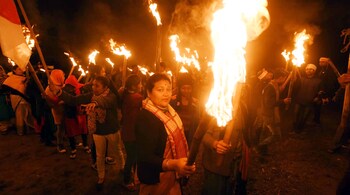
The appalling conduct of a photographer and police brutality in Assam during the eviction at Dholpur on September 23 have to be condemned in no uncertain terms. But what is shocking is the ‘expert’ comments by some sections in the media and academia on encroachment in Assam. These ill-informed statements are similar to the earlier erroneous assumptions that the Assamese are ‘xenophobic’ by nature.
The Dholpur eviction drive has been portrayed as an operation by the ruling Bharatiya Janata Party (BJP) solely against innocent Muslims, and one which must be halted. Such portrayals ignore the fact that it was Kobad Ali, an Assamese Muslim, who filed the first court case (in February 2015) for evicting encroachers at Sipajhar in Dholpur.
While police brutality cannot be condoned, the fact remains that the government’s eviction drives have large-scale support in Assam. Processions in support of the eviction have been organised at Tezpur and Nalbari. It is also true that there would be equal endorsement among the Assamese (barring a few groups) if such operations were to be against encroachments by Bengal-origin Hindus. This is due to historical factors, and owing to the current prevailing apprehension which seems to be growing by the day that Bengali-speaking migrants and refugees would soon outnumber the Assamese and other local communities in Assam.
The fear has been reinforced by the burgeoning population of the Muslims — 34 percent in the 2011 Census — which makes Assam the state with the highest percentage of Muslims in India. Bengal-origin Muslims are a majority in 23 seats, and a deciding factor in another seven of the 126 assembly constituencies. In contrast, the Assamese Muslims do not enjoy that status even in a single constituency. The tension had triggered devastating riots between indigenous communities, including the Bodos and the Bengal-origin Muslims at different places over the years.
What is disconcerting is the desperate attempts to deny the presence of foreign nationals in Assam. Any talk about erecting preventive measures to check further infiltration is considered a sign of ‘toxic Assamese nationalism’. In the same vein, encroaching government land is being justified since the encroachers are victims of erosion whose villages had been washed away.
Previous regimes have not taken appropriate and timely actions to stop things from getting out of hand and reaching the sorry situation it is today — some have chosen to ignore this problem for decades, while some feel it is ‘politically correct’ to support it. The fact is foreign nationals who have infiltrated have put pressure on the system (State resources), and Assam’s indigenous communities are at the receiving end.
To say that infiltration and illegal settlement is not a problem is to deny justice to the people of Assam. It would also mean to negate the validity of events that have taken place in this connection, which include, the historic six-year agitation in Assam (1979-85) against infiltration; it would mean that the media misreported Mohammad Kamaluddin’s story — a Bangladeshi national who entered Assam on a Pakistani passport, contested the assembly polls, and was later deported; and, put to question the Supreme Court’s 2005 observation that Assam was facing an “external aggression” while repealing the controversial IMDT Act. Further, what about the affidavit submitted to the apex court by NRC Coordinator Hitesh Deva Sarma highlighting glaring anomalies and indicating the entry of many fraudulent names in the register?
No community, anywhere in the world, would like to open its gates to immigrants — in Assam’ case it is illegal immigrants — and pushed to become a minority. The problem gets heightened when space and resources are limited. The European Union, Canada, the United States, etc. have immigration and refugee programmes, but all within certain limits which the recipient country sets.
What makes things acute for Assam is its geographical location and the geopolitical reality of being in a crisis-prone zone. This makes it all the more important that the State protect the borders and uphold the rights of the indigenous communities in Assam. Assam has already accommodated enough of foreign nationals, and there is heightened consciousness among the indigenous communities to the problems unchecked and illegal immigration can bring.
The governments, opposition parties and the rest of the nation must see this reality; because the more time it takes to realise this, the more it increases the insecurity among the indigenous sections. The political reality is that the ruling party is, and will in future, use this insecurity to its advantage.
Rajeev Bhattacharyya is a senior journalist in Guwahati.
Views are personal and do not represent the stand of this publication.
Discover the latest Business News, Sensex, and Nifty updates. Obtain Personal Finance insights, tax queries, and expert opinions on Moneycontrol or download the Moneycontrol App to stay updated!





