

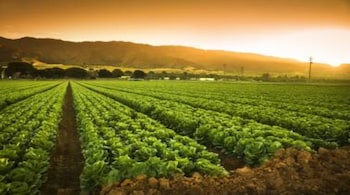
The iconic green cornfields of the American Midwest are about to shrink — not in acreage, but in stature. A new genetically modified (GMO) corn varietal stands on fatter stalks and grows less than 7 feet tall, about a third shorter than the height of conventional corn. Dubbed “Smart Corn” by its developer, the German pharmaceutical company Bayer, this well-timed mutant has been designed to withstand the increasingly costly pressures of climate change.
The implications are as harrowing as they are inspiring — and not because stubbier corn is genetically modified. I’ve argued before that GMO crop breeding, which inserts bits of DNA from one species of plant into the genome of another, can be judiciously applied in ways that benefit human health and the environment.
Short-stature corn is harrowing because it’s yet another recent example of an ingenious adaptation that’s making it easier for policymakers, investors and voters to avoid solving the far bigger challenge at hand: climate change. The most promising new methods of acclimating to the climate crisis are worth celebrating, but they should also be considered a clarion call to solve the problem at its root.
Bayer’s Smart Corn was recently determined by the Department of Agriculture to be safe for farmers to grow in the US. It still requires sign-off from the Environmental Protection Agency, pending reviews of the crop’s ecological effects. Approval is likely, in part because many other GMO crops have already been deemed environmentally benign. Moreover, Smart Corn is one of the first crops designed for the very purpose of addressing environmental factors.
Damage to corn and soy crops is becoming more costly as high-wind storms intensify in the climate change era. In the US these phenomena, known as derechos, have been devastating farms throughout the Midwest with 100-mph winds that caused billions of dollars of damage across millions of acres of crops in 2020 alone. Last month brought storms nearly as severe.
Understandably, demand is growing for a crop with shorter, fatter stalks that stands a better chance against high-wind storms. Previous types of corn developed through traditional hybrid breeding methods have had success reducing stalk height to about 9 feet, and these crops have fared better in storms. The new GMO varietal is stronger still: Bayer scientists modified the corn plant with a foreign gene that inhibits the production of the plant growth hormone gibberellic acid, enabling the corn to produce the same amount of fruit on much shorter, superstrength stalks.
The introduction of short corn comes on the heels of other notable crops designed for climate adaption. At this time last year, the Food and Drug Administration approved HB4, a new wheat varietal engineered for drought tolerance with a gene borrowed from a sunflower. Pioneered by the Argentine company Bioceres, it was recognised as an early milestone
among crops designed to survive in climate-stressed conditions. And earlier this month, the fertiliser giant Nutrien Ltd announced plans to distribute a new GMO soybean created by the San Diego-based startup ZeaKal Inc. The soybean is engineered with a foreign gene that accelerates photosynthesis, allowing the crop to soak up more carbon dioxide from the atmosphere while also producing more abundant yields.
Let’s be clear that the innovations will not, on their own, entirely solve farmers’ climate woes. Bayer’s Short Corn, for example, is engineered like traditional corn to be tended and harvested by heavy machinery, yet derechos can bring so much rain that machinery often sinks in the fields. Moreover, heavy rainfall can cause plant roots to become sodden and die, no matter how tall or short the corn is. There is also the pressure of unprecedented heat, which has been scorching farms this summer throughout the American Midwest — and from Honduras to Malawi.
It doesn’t take much to see what agriculture in the climate change era will look like down the line: plants engineered not just for wind resistance but also for drought and heat resilience and flood tolerance. Plants that can endure shifting seasons, temperature swings and invasive insects. Crops of the future won’t just need one foreign gene to survive the manifold pressures of climate change, they’ll need dozens. And that is a hard reality to swallow.
In just the past few years, the GMO debate has shifted from skirmishes
about labeling corn chips to a matter of survival. Bayer’s Smart Corn product has helped usher in a major and fairly sudden plot twist in the story of American agriculture almost overnight. The once-vitriolic conflict between the agriculture industry and environmentalists over GMOs has been replaced instead by serious discussions about how genetic engineering can help humanity endure a hotter world.
GMOs, like so many other new agricultural tools in our midst, are a testament to our human capacity to solve complex problems. But the more ingenious our methods, the more likely we are to avoid fixing the core issues driving the crisis. As the effects of climate change intensify, humans will be stuck in an endless cycle of increasingly frantic adaptions if we don’t focus on the source of the problem and its ultimate solutions: decarbonising our economy and preserving the delicate balance of the ecosystems we depend on.
Amanda Little is a Bloomberg Opinion columnist covering agriculture and climate. Views are personal and do not represent the stand of this publication.
Credit: Bloomberg
Discover the latest Business News, Sensex, and Nifty updates. Obtain Personal Finance insights, tax queries, and expert opinions on Moneycontrol or download the Moneycontrol App to stay updated!





