

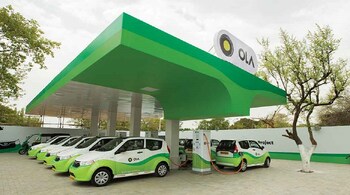
India's government is not only serious about clean mobility but is in a hurry to get there. India is planning to mandate cab-hailing companies like Ola and Uber to “convert 40 percent of their fleet” of vehicles to electric by April 2026, according to a report by Reuters.
If implemented, this will be the first major step by the Modi government to reach its goal of converting India into a 100 percent electric vehicle nation by 2030, from its current state of infancy. In the year ended March, only 3,600 units of electric vehicles were sold in India or just about 0.1 percent of the 3.3 million diesel and gasoline cars sold in the country over the period, according to industry data. In comparison, around 1.3 million EVs were sold in China in 2018.
It is obvious that the government will need to take drastic steps to achieve its goal. Following a landslide victory in the general elections, the Narendra Modi-led government now has a five-year window and the political will to push through this sort of disruptive change. Its plan to make EVs mandatory for cab aggregators is an example of that.
By asking cab aggregators like Ola and Uber to transform their fleets into EVs, India’s automobile industry will be forced to change as well.
So far, India’s EV plans stayed only on paper because of a lack of infrastructure that electric vehicles require. And, Indian automobile companies have also not taken the leap to build EVs. After all, they have made significant investments to sell cars that run on fuel, as have their vendors.
That makes it a chicken-and-egg situation. If there’s no infrastructure, EVs can't run on the roads but if there are no EVs, then setting up infrastructure will not be viable.
By asking cab aggregators to transform 40 percent of their fleets to electric, the government is creating a substantial market. If Indian companies don’t build these EVs, cab aggregators may import them to remain compliant with the law. If that happens, car-makers will lose revenues.
The conversion, the Reuters report added, will happen in stages – 2.5 percent by 2021, 5 percent by 2022, 10 percent by 2023 and 40 percent by 2026. This will give both the industry time to supply vehicles and the government time to build the requisite infrastructure.
At present, Ola’s fleet consists of around a million vehicles. By 2026, the fleet size is going to increase substantially. And 40 percent of that would be a good number. While Uber does not share details of its fleet, it officially disclosed that the American cab aggregator has around 300,000 active drivers in India who complete around 10 million trips a week.
Besides, there is a proposal to transform private-use motorbikes and three-wheeled auto-rickshaws to electric within next 6-8 years. Besides, companies in the business of delivery, including food and e-commerce will have to adopt electric motorbikes, or scooters by April 2023, according to the above-mentioned report by Reuters.
That’s a huge market that is being created by changes to regulations, which will force automobile companies to act. Otherwise, they will miss the bus.
The government has begun some groundwork on the infrastructure front. On March 5, the poll-bound Modi-government revealed details of the second phase of the Faster Adoption and Manufacturing of (Hybrid) and Electric Vehicles (FAME) scheme. In this, the government planned to infuse Rs 10,000 crore over three years from April 1, 2019 for infrastructure development and encouraging faster adoption of electric vehicles.
Under FAME-II, the government will give upfront incentives on purchase of electric vehicles, infrastructure development, including charging stations. In the first phase of FAME, the government had allocated Rs 895 crore in April 2015. As part of the FAME-II, the government stated that it will set up 2,700 charging stations in metro cities and some of the one million-plus towns, offer EV purchase incentive to 10 lakh two wheelers, five lakh three wheelers, 55,000 four wheelers and 7,000 buses.
It’s true that the current state of EV infrastructure in India is pathetic. As per a report by consulting firm EY (May 2018), there are only 222 charging stations with 353 charging points in whole of India.
To add to that, there is no policy for electric mobility in India, and the ruling government believes there’s no need for a comprehensive EV policy and has instead opted for rolling out an action plan. If the a drastic though innovative step such as mandating EVs for certain commercial uses is part of such an action plan, then one could see more electric vehicles zipping around cities by the end of this government's tenure.
Discover the latest Business News, Sensex, and Nifty updates. Obtain Personal Finance insights, tax queries, and expert opinions on Moneycontrol or download the Moneycontrol App to stay updated!





