

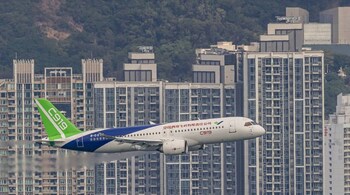
For more than a decade, China’s state-owned aircraft manufacturer has plugged away at developing commercial jets. Until recently, efforts to sell foreign customers on an alternative to the US-European duopoly of Boeing Co. and Airbus SE showed little progress. Then the American giant messed up again.
The blowout of a side panel in a 737 Max operated by Alaska Airlines starts to make Commercial Aircraft Corp of China Ltd. look like an option worth exploring. Airlines tend to share orders between Airbus and Boeing to ensure they’re not entirely reliant on one supplier and to play the manufacturers off against each other. With the latest troubles, a third choice makes sense. Better known as Comac, the Shanghai-based company has already secured more than 1,000 orders, but they’re largely from domestic customers like China Eastern Airlines Corp.
Foreign operators have stuck with Boeing and Airbus for decades, largely because the two are known entities and airlines are risk averse when it comes to shelling out billions of dollars for the single most-important piece of equipment required to run their businesses. New entrants tend to fail because the cost of developing a new plane from scratch is sky high, while customers and investors are unlikely to pony up the capital needed until a proven product can be demonstrated.
Like its Western counterparts, Comac has benefited from government support and guaranteed orders from state-backed airlines. With funding secured, all Comac needed to do was build a viable and reliable plane. It took a while, but its C919 — a counterpart to A320 and Boeing 737 jets — finally went into commercial service in May last year. Now, it’s plying the Shanghai-Chengdu route for China Eastern and the carrier has since upped its order. From an initial five, the company in September announced it would buy a further 100, worth $9.9 billion at list prices.
It’s unlikely that major Boeing customers like United Airlines Holdings Inc, Ryanair Holdings Plc or Emirates Airline will be dropping the Arlington, Virginia-based manufacturer in favor of Comac anytime soon. But a key advantage that had secured the American aerospace firm’s market position — safety and reliability — is starting to look weak.
The past five years have proven expensive for Boeing’s clients. The cost of grounding 737 Max aircraft after fatal crashes in 2018 and 2019 was, ironically, ameliorated by the Covid pandemic that halted most flights. Had the industry been in full swing after those tragedies, the impact of being unable to generate revenue from dozens of planes — and the slowed delivery of new aircraft — would have been much worse. The aerospace industry has experienced incredible progress in making flying safer because all players have largely been honest about finding and rectifying problems.
That’s why the revenue hit to airlines pales in comparison to Boeing’s
misdirection, including charges of fraud and manipulation of tests for the 737 Max. Comac is so new as to have no track record. It will take at least a decade, hundreds of aircraft in service, and millions of flight hours to get a picture of whether this new competitor stacks up.
It’s very easy to dismiss the Chinese manufacturer because of a perception that its jets may not be safe. A long history of stealing foreign secrets in furtherance of aerospace development bolstered the case for staying clear. Yet it’s also worth asking whether major US contractors deserve legal protection for intellectual property when some of those same players have failed in their duty to keep the aviation public safe — not just over American skies, but across the globe.
So far, Comac doesn’t even have the production capacity to match its older rivals. In the short term, Ryanair Chief Executive Officer Michael O’Leary told Simple Flying, the biggest benefit its entry brings to Western airlines is to fill Chinese carriers’ demand for planes. That allows the rest of the world to soak up Boeing and Airbus output at a time when the industry awaits the delivery of hundreds of aircraft.
For the long term, though, Comac is already making progress. Rather than touting massive orders from global carriers, it’s quietly picking up smaller, lesser-known airlines — using those as a proving ground. Indonesian low-cost operator PT Transnusa Aviation Mandiri — known as TransNusa — was the first foreign carrier to sign up when it ordered 30 of the smaller ARJ21 jets in 2021. Last year, Brunei-based GallopAir became the debut overseas client for the C919. Tibet Airlines subsequently agreed to work with Comac to develop a version of the C919 for mountainous airports.
Such orders don’t amount to much, now. But as Boeing chief Dave Calhoun said in October, “This is a complex, long-cycle business and enduring change takes time.” Indeed, change is afoot, and it may end up happening faster than the Western giants expect.
Tim Culpan is a Bloomberg Opinion columnist. Views do not represent the stand of this publication.
Credit: Bloomberg
Discover the latest Business News, Sensex, and Nifty updates. Obtain Personal Finance insights, tax queries, and expert opinions on Moneycontrol or download the Moneycontrol App to stay updated!





