

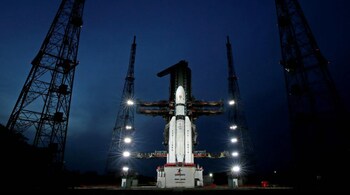
India has successfully launched its next lunar mission, Chandrayaan-3 (C3), using the Geosynchronous Satellite Launch Vehicle Mk III (LVM-3). The Indian Space Research Organisation (ISRO) has incorporated various adjustments to the mission profile and enhanced the robustness of the spacecraft modules to ensure this mission succeeds where the Chandrayaan-2 (C2) failed.
C3 And The Global Space Race
The C2 was launched in July 2019 to explore the south pole of the moon, where water deposits in the form of water ice were discovered by the instruments onboard Chandrayaan-1 (C1). The C2 carried a lander and a rover to enable the in-situ study of the lunar surface and sub-surface to further validate these findings. These mineralogical studies are critical for designing the future human lunar missions envisioned by major spacefaring countries such as the United States (2025) and China (2030).
Unlike the Apollo missions that lasted merely a few days, these future missions will see extensive stay of astronauts on the moon. The moon is also seen as an interim stop on the way to Mars. These mission architectures depend on the extraction and utilisation of lunar minerals, such as water, for consumption (oxygen) and rocket fuel (hydrogen).
At this juncture, the prospect of commercial extraction and ownership of space resources has further intensified the competition between the major powers to mount complex lunar missions. China has taken the lead in this emerging space race by launching the Chang’e series of robotic missions to the moon.
Also Read: Chandrayaan-3: When and where to watch the Moon mission launch LIVE
How China Stole A March
In 2013, Chang’e-3 became the first spacecraft to land on the moon in 37 years since the Soviet Union’s Luna-24 mission. Chang’e-4 demonstrated China’s leap in space technology and mission management when it became the first ever spacecraft to land on the far side of the moon in January 2019. A communications satellite was stationed at the Earth-Moon L2 Lagrange point in June 2018 to facilitate data relay between Chang’e-4 and the ground stations.
But the finest accomplishment of the Chinese Lunar Exploration Programme (CLEP) was the Chang’e-5 mission, which returned samples of lunar rocks to Earth in December 2020. Such a mission was not undertaken by any space power in the past 40 years. These samples allowed the Chinese scientists to test the moon formation theories and the composition of various minerals in them. China also discovered a new lunar mineral, named Changesite-(Y), in these samples.
When the CLEP was initiated, India showed the political will to match China’s designs. Then Prime Minister Atal Bihari Vajpayee announced the C1 mission during the 2003 Independence Day speech. The mission was launched as promised in October 2008, trailing the Chang’e-1 launch by only a year (October 2007). However, India took more than a decade to launch its second mission (C2 in July 2019) while China followed up with its second mission in just three years (Chang’e-2 in October 2010).
Also Read: ISRO’s Chandrayaan-3 begins countdown for launch from Sriharikota
India’s Launch Vehicle Setbacks
A chief reason for this delay could be the lack of viable launch options satisfying the increasing demand for polar and geosynchronous orbits. The GSLV Mk II began flying in 2001 but it had a chequered success rate, unlike the record of the PSLV or the LVM-3. The indigenous cryogenic engine (CE-7.5) was successfully flight tested only in January 2014 onboard the GSLV-D5. The PSLV launched the C1, but its payload capacity would have constrained the prospective Chandrayaan mission after C1 to be an orbiter project, like the C1.
Meanwhile, the growing weight and scope of Chang’e missions were satisfied by the increasing payload capacity of China’s Long March (LM) rockets, from LM-3A (Chang’e-1) to LM-5 (Chang’e-5). The Chang’e follow-on missions will also be supported by LM-5 while its variant LM-5B supported the construction of China’s space station, Tiangong.
The responsibility of such a mission for India has shifted now from GSLV Mk II to LVM-3, it being entrusted with launching both Chandrayaan and Gaganyaan (human-rated LVM-3) missions.
With LVM-3, India Is Back
The LVM-3 has already proven its reliability. Consequently, the future of India’s lunar exploration programme hinges on the success of the C3 mission, particularly since the failure of the C2 lander to land safely on the moon. The failure analysis reported that the C2 lander descended at a higher speed than expected and the onboard software failed to correct the spacecraft’s orientation necessary for proper landing on the lunar surface.
The ISRO has incorporated several corrective measures in the C3 lander to avoid a similar fate. These include a higher fuel allocation, robust navigation algorithm, sturdy lander legs and the ability to communicate and operate the lander in the event of an undesirable orientation. The target site was also expanded to accommodate last-minute changes in the descent pattern.
It would be two decades next August 15 since Vajpayee announced the Chandrayaan programme. Even as it suffered delays and failures, India hopes the failure-based design approach and robust testing done by the ISRO on C3 will ensure a successful mission and an expanded lunar exploration programme in the future.
Vidya Sagar Reddy is a research analyst on outer space affairs. He tracks Indian, Chinese and American space activities. Vidya has published book chapters, and research articles in the Astropolitics and NewSpace journals. He also provided analyses for The Space Review, SpaceNews, East Asia Forum and DNA India. Views are personal, and do not represent the stand of this publication.
Discover the latest Business News, Sensex, and Nifty updates. Obtain Personal Finance insights, tax queries, and expert opinions on Moneycontrol or download the Moneycontrol App to stay updated!





