

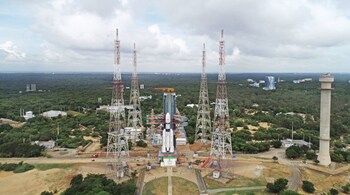
The Indian Space Research Organisation (ISRO) is set to launch its heavy-lift LVM3-M6 rocket shortly today, carrying the BlueBird Block-2 satellite of US-based AST SpaceMobile in what will be the heaviest payload ever flown by an Indian launch vehicle.
The 6,100-kg communications satellite is scheduled to lift off at 8.54 am and will be injected into a low Earth orbit (LEO) of about 520 km roughly 15 minutes after launch. ISRO said the mission will be the sixth operational flight of the LVM-3 and its third commercial launch.
“The LVM3-M6/BlueBird Block-2 mission is a dedicated commercial launch and will place the largest commercial communications satellite ever deployed in low Earth orbit,” ISRO said.
What is BlueBird Block-2?
BlueBird Block-2 has been designed by AST SpaceMobile as part of a next-generation satellite constellation aimed at providing direct-to-mobile connectivity. Unlike conventional communication satellites that route signals through specialised ground stations, this system is designed to connect directly with standard smartphones.
“The satellite is designed to enable space-based cellular broadband connectivity directly to standard mobile smartphones,” ISRO stated.
According to AST SpaceMobile, the constellation will support 4G and 5G services, including voice calls, text messaging, video streaming and data access, even in remote and underserved regions.
Why the mission is significant
The launch marks another step in ISRO’s push to expand its footprint in the global commercial launch market. The LVM-3 has previously carried out two major commercial missions for OneWeb in 2022 and 2023, deploying 72 satellites after Russia declined to launch them following the Ukraine war and Europe’s Ariane-5 launcher was retired.
While heavy-lift launch vehicles such as SpaceX’s Falcon 9 and Europe’s Ariane 6 dominate the market, ISRO is positioning the LVM-3 as a lower-cost alternative for commercial satellite launches.
Wednesday’s mission will also be the third time the LVM-3 places a satellite into low Earth orbit. Originally designed to carry payloads to geosynchronous orbits nearly 36,000 km above Earth, the rocket was later adapted for LEO missions and renamed from GSLV-Mk3 to LVM-3.
Faster turnaround, heavier payloads
The launch comes less than two months after the LVM3-M5 mission, which successfully placed the CMS-03 communications satellite into orbit on November 2. The short gap between the two missions represents the fastest turnaround yet for the vehicle and highlights ISRO’s growing ability to assemble and launch heavy missions in quick succession.
At 6,100 kg, BlueBird Block-2 surpasses ISRO’s previous LEO payload record set during the OneWeb launches. The agency also set a separate milestone last month by placing its heaviest-ever satellite into geosynchronous transfer orbit — the 4,410-kg CMS-03 — using the same rocket.
Upgrades for future missions
ISRO said the mission aligns with ongoing efforts to upgrade the LVM-3 for future programmes, including the Gaganyaan human spaceflight mission and the planned Bharatiya Antariksh Station.
The space agency is working to increase lift capacity by boosting the thrust of the cryogenic upper stage and is also exploring the use of a semi-cryogenic engine for the second stage. These changes could raise the vehicle’s payload capacity to around 10,000 kg to LEO.
ISRO is also developing a “bootstrap reignition” system for the cryogenic engine, which would allow the upper stage to restart without external gases. This would improve efficiency and enable more complex missions involving multiple satellite deployments.
“These upgrades are aimed at enhancing payload capability, reducing costs and expanding the operational flexibility of the LVM-3,” the agency noted.
With the BlueBird Block-2 mission, ISRO is looking to underline both its commercial launch capabilities and its readiness for more demanding space missions in the years ahead.
Discover the latest Business News, Sensex, and Nifty updates. Obtain Personal Finance insights, tax queries, and expert opinions on Moneycontrol or download the Moneycontrol App to stay updated!





