

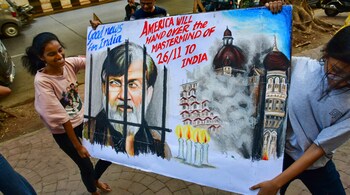
The path for the extradition of Tahawwur Rana, one of the conspirators behind the 26/11 Mumbai attacks, from the United States to India is now clear. He will soon be brought to India and tried in a special court in Mumbai. The question now is: can the Indian government prove him guilty and sentence him to death?
The primary evidence against Rana is the confessional statement of his accomplice, David Headley, which was given via video conferencing from a US prison, apart from the records of financial transactions between Headley and Rana. As per officers of the Mumbai Police formerly associated with the case, securing Rana's conviction will not be as easy as it was in the case of Ajmal Kasab.
So far, Ajmal Kasab is the only person sentenced to death for the 26/11 terror attacks. Two other accused are still awaiting the noose—one is Abu Jundal, who was a handler of the terrorists at a camp in Pakistan, and the other is Tahawwur Rana, accused of being one of the masterminds behind the plot.
Tahawwur Rana was a doctor in the Pakistani army and is accused of being involved in the planning of the Mumbai attacks. The 26/11 attacks are a wound that India can never forget. From the night of November 26 to the morning of November 29, Mumbai was engulfed in bloodshed and destruction. Ten terrorists arrived by sea from Pakistan and targeted the city's railway station, luxury hotels, a hospital, and a Jewish center. Of the ten, only one—Ajmal Kasab—was captured alive, while the rest were killed in encounters.
Kasab was tried in India and executed in 2012. However, a year after the attacks, two more names surfaced as key figures behind the deadly conspiracy—David Headley, a US citizen of Pakistani origin, and Tahawwur Rana, a Canadian of Pakistani descent. Both were arrested by the FBI in Chicago, though initially in connection with a different case—an alleged plot to attack a Danish newspaper.
During intense FBI interrogations, Headley confessed that he had conducted surveillance of the attack sites in Mumbai. He visited India five times, scouting the locations that were later targeted. He also revealed that the plot was orchestrated by Lashkar-e-Taiba. To maintain his cover, he opened an immigration firm, First World Immigration Services, in Mumbai’s Tardeo area. This firm was owned by Tahawwur Rana and had branches worldwide.
Who is Tahawwur Rana?
Born in 1961 in Punjab, Pakistan, Rana served as a doctor in the Pakistani army, reaching the rank of captain. In 1997, he left the military and moved to Canada with his wife, obtaining Canadian citizenship in 2001. However, he primarily lived in Chicago, where he ran his immigration business.
In Chicago, he reconnected with his old friend David Headley, who had received terrorist training in Lashkar-e-Taiba’s camps in Pakistan. ISI officer Major Iqbal reportedly involved both men in the Mumbai attack plot. Rana himself visited Mumbai with his wife and stayed at the Taj Mahal Hotel, which later became one of the key attack sites.
The case against Rana
After their arrest in the U.S., Headley testified before Indian investigators and revealed the entire conspiracy involving himself and Rana. In an American court, Headley was sentenced to 35 years in prison, but Rana was acquitted of charges related to the Mumbai attacks. However, he was convicted for plotting the attack in Denmark and sentenced to 14 years in prison.
Meanwhile, Indian authorities arrested another accused, Abu Jundal. Headley was granted a pardon and turned into a government witness. Through video testimony, he recounted the entire attack plan in an Indian court, exposing Rana’s role. Headley’s testimony remains the strongest piece of evidence India has against Rana.
Following Headley’s revelations, India formally requested Rana’s extradition from the U.S. under their bilateral treaty. The U.S. agreed, but Rana challenged the order in an American court, claiming he was being falsely implicated. However, his arguments were rejected by the court. In January, an appellate court also dismissed his appeal.
Now, if Rana is convicted in an Indian court, the death penalty seems inevitable. But will the available evidence be enough to ensure his conviction? That remains the biggest challenge for Indian prosecutors.
Discover the latest Business News, Sensex, and Nifty updates. Obtain Personal Finance insights, tax queries, and expert opinions on Moneycontrol or download the Moneycontrol App to stay updated!





