

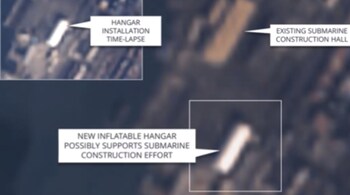
Months after the Indian Navy demonstrated its maritime dominance by placing Karachi Port among its potential strike options during Operation Sindoor, a new development from Pakistan has drawn attention in New Delhi. Geostrategy expert Damien Symon has shared fresh satellite imagery indicating that Pakistan may be constructing a new submarine at the Karachi Shipyard.
Posting a GIF compiled from visuals captured over the past two months, Symon noted that new defence infrastructure appears to have emerged at the facility. "Imagery from Karachi Shipyard shows a new inflatable hangar opposite the main construction hall where Pakistan is building its Hangor-class submarines. The structure could support ongoing work and possibly signals significant progress in the build cycle," the OSINT analyst wrote on X (formerly known as Twitter).
The activity is expected to reignite the strategic competition between India and Pakistan in the region, especially as India prepares to induct INS Chakra 3-a nuclear-powered attack submarine being delivered by Russia.
Based on the Akula-class (Project 971U Shchuka B), Chakra 3 measures 110 metres, displaces 14,000 tons submerged, and is powered by a 190 MW nuclear reactor, giving it high underwater speed and virtually unlimited range. Equipped with eight torpedo tubes, it can deploy torpedoes, mines, anti-submarine rockets, and Kalibr cruise missiles, carrying more than 40 weapons.
The Indian variant includes quieter machinery, anechoic coatings, and indigenous sensors. Unlike the Arihant-class SSBNs built for nuclear deterrence, this SSN is designed for conventional strikes against ships, submarines, and land targets. India is also developing six indigenous nuclear attack submarines with similar capabilities.
Karachi Shipyard has remained a focal point of discussion since Operation Sindoor. During a May 12 press briefing, a senior naval officer confirmed that Karachi was indeed considered as a target during India's coordinated military response to the Pahalgam terror attack.
At a joint briefing with Army and Air Force commanders, Vice Admiral A.N. Pramod, Director General of Naval Operations, had said the Navy's deployment in the Arabian Sea forced the Pakistan Navy to remain confined to its harbours or operate only near the coastline. He had revealed that the Navy had reached full combat readiness within 96 hours of the April 22 attack and was prepared to execute strikes on Pakistani military assets, including Karachi Port, pending government approval.
Pramod had also said that the Indian warships, submarines, and aircraft were rapidly mobilised following the Pahalgam attack, ensuring the Navy was ready to undertake both sea-based and land-based operations if instructed.
Discover the latest Business News, Sensex, and Nifty updates. Obtain Personal Finance insights, tax queries, and expert opinions on Moneycontrol or download the Moneycontrol App to stay updated!





