

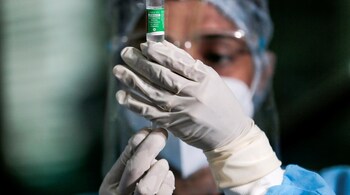
Congratulatory messages poured in for India on August 27 after it recorded a fresh milestone in daily vaccinations against COVID-19 — over 1 crore or 10 million jabs in a day — a number that is a multiple of the population of many countries.
RS Sharma, CEO of the National Health Authority, said India’s COVID-19 vaccine delivery tech platform CoWin has been designed to absorb even higher numbers and can make swift changes in line with the Government’s vaccination policy.
Sharma, who is chairperson of the empowered committee for CoWin, said every jab is recorded, even if people are not registered on CoWIN, and that concerted efforts are being made by various stakeholders to ensure people also get their second dose of the vaccine.
As the former chief of the Unique Identification Authority of India (UIDAI), the semi-government body tasked with rolling out the national identity project Aadhaar, Sharma believes the Made in India CoWin is now ready for the world.
One crore or 10 million jabs in a day is a historic milestone for India’s vaccination effort. What did it take to clock this number and how can we sustain this pace? Even if not 10 million, to ensure that it is at a steady clip of 7-8 million every day?
The credit for this must go to everybody working in the field, from doctors to health workers, civil servants, State governments. It is collective strength that the country has demonstrated. The CoWIN platform has played an important role in that journey. It has enabled a systematic, transparent and orderly vaccination. If there was no such platform, it would have been very difficult for us to even measure and get data. We have provided a single source of truth for every stakeholder. We have built CoWIN as an extremely scalable platform — 10 million in 10 hours translates to 1 million an hour or 50,000 per minute. It is an extremely fast platform. There were no complaints or issues on how it works. The platform has been architected for population scale.
Right, you’ve said it can go up to even 2 crore a day...
The platform will not disappoint you.
Interestingly, if you look at the numbers clocked on August 27, three States accounted for 50 percent of the jabs, with villages accounting for 70 percent of the inoculations. How difficult was it to collect and reconcile the numbers in real-time?
People confuse the fact (have the misperception) that somebody who doesn’t register on CoWIN does not get recorded on CoWIN. But the platform has four applications: a citizen-facing application where you can register and get an appointment, and then there are three more parts. One is the vaccinator module, where he or she records the fact that a person has been vaccinated. There is another module to record the adverse impact post-vaccination. There is also a hospital module where they declare their calendar and modules. The last is the part where you download the certificate. So, even if you don’t register, every vaccination gets recorded. There are many areas where people are vaccinating but are not recording in real-time. But it is recorded. The data entry is real-time for 90 percent of the cases. The CoWIN dashboard gets updated every hour.
The other milestone India clocked is that over 50 percent of its adult population has received at least one dose of the vaccine. But the second-dose percentage is significantly lower and there were reports recently that 1.6 crore people have missed their second shot. What can be done to bridge this gap?
From a technology perspective, we are ensuring that if you have booked your first dose, we remind you to get your second dose with multiple messages. This will be sent even if you haven’t registered on CoWIN. We send 3-4 SMSes to that number. When the date has lapsed, then again the message goes. But people do ignore messages sometimes. State governments are now taking a number of measures. They have taken a number of community measures, like reserving centres, dates for the second dose. There is community mobilisation at almost every level to sensitise people that they are not safe till they take the second dose. We also give district administrators a list of people who have not had the second dose so this effort can be taken up at the field level. Every strategy is being applied to ensure people get the second dose.
Supply-side issues also seem to have come down compared to a few months ago. People are finding it easier to book their second dose compared to the first. Serum Institute has said it will supply 20 crore doses in September, for example...
This (difficulty in booking slots) was happening at some point in the past and people were talking about booking through bots. There was no booking by bots. We took measures to ensure that people don’t do automated bookings by using scripts. Now, even walk-in percentages have increased significantly. The situation has eased quite a bit. But we still recommend that you go after booking on CoWIN. Things have become much easier.
There were also plans to take the CoWIN platform global, as over 70 countries have expressed interest. Can you give us an update on that?
We had on the 5th of July convened a CoWIN global conclave, where 147 countries participated. Many ministers from these countries participated. Thereafter, we open-sourced the whole thing. We have also trained people for capacity building. Now, we have a number of consulting firms that have been trained, that can install and establish this platform wherever it is required. We also have complete documentation. We have also prepared a draft MoU to be signed with countries that has gone to the Ministry of External Affairs. The MEA is in various stages of taking this forward. We have made the entire thing ready so that it is ready to be deployed — by capacity building, open-sourcing, documentation, and legal agreements. So, Made in India CoWin is ready to go global.
Tell us about the team that helped architect this platform.
There are many people and it would not be fair to name one and leave out the others. My contribution is minimal. There are people who are extremely dedicated, who have worked on this day and night. They are largely government employees, though we have taken advice from private companies. I have drawn a lot of lessons from the Aadhaar experience. Aadhaar is a wonderful platform in terms of numbers — I have taken help from those teams. The basic design is very important for APIs, open standards. I think my team has done a wonderful job. Vikas Sheel, an Additional Secretary from the Ministry of Health and Family Welfare, has worked with me side by side.
Discover the latest Business News, Sensex, and Nifty updates. Obtain Personal Finance insights, tax queries, and expert opinions on Moneycontrol or download the Moneycontrol App to stay updated!





