

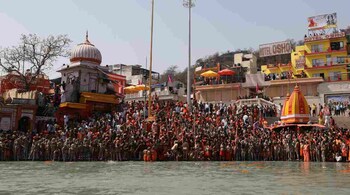
The Centre has written to Uttarakhand strongly highlighting the concerns raised by a high-level central team about the need for stringent measures to control the spread of COVID-19 during the Kumbh Mela. The central team led by the National Centre for Disease Control (NCDC) Director visited Uttarakhand on March 16-17 to review the medical and public health measures undertaken by the state for the ongoing Kumbh Mela in Haridwar, the Health Ministry said in a statement.
What is Kumbh Mela?
The Kumbh Mela is held at one of the four holy pilgrimage destinations, Haridwar, Nashik, Allahabad (now Prayagraj), and Ujjain, every 12 years by rotation. However, this year, the event is taking place after 11 years instead of 12 years. According to the astrological calculations for this Kumbh, Jupiter will complete this cycle in 11 years and enter the Aquarius sign in 2021. By the time the Sun enters Aries in 2022, Jupiter will have entered Pisces. Jupiter will be available in Aquarius and the Sun in Aries in 2021. Therefore, Kumbh Mela will be organized in the year 2021, according to the official website.
Why is Kumbh Mela celebrated?
According to the beliefs, the nectar from the pot fell at four locations - Prayagraj, Ujjain, Haridwar, and Nashik during an epic battle between the gods and the demons. At these four places, Kumbh Mela takes place. The Hindu devotees throng these places with a belief that a dip in the waters of the sacred rivers will wash away all their sins.
Important dates of Kumbh Mela, 2021
Due to the ongoing COVID-19 pandemic, this year the Kumbh Mela will be held for 48 days in Haridwar, Uttarakhand, instead of three-and-a-half months. The Kumbh Mela began on January 14, while the first Shahi Snan (holy dip in river) took place on March 11 on Maha Shivratri.
Here are the upcoming Shahi Snan:
> April 12: Somvati Amamvasya
> April 14: Baisakhi
> April 27: Chaitra Purnima
The last Shahi Snan will mark the end of the Haridwar Kumbh Mela.
Guidelines for pilgrims visiting Kumbh Mela
> Devotees and tourists visiting the Kumbh Mela will have to carry a negative COVID-19 RT-PCR report. The report should have a test date 72 hours before the date of the visit.
> Devotees and tourists will also have to obtain a compulsory medical certificate in their state from the nearest Community Health Center/District Hospital/Medical College.
> Based on the guidelines issued by the Ministry of Health and Family Welfare, the Standard Operating Procedures (SOPs) also makes it compulsory for devotees to bring a medical fitness certificate and an e-pass or e-permit issued to them after registering on the Kumbh Mela web portal.
> The devotees may carry their test reports, fitness certificate, and e-passes on their mobile phones or in hard copies for verification as and when required.
> All state governments have been requested to widely publicise the SOP so that there is no confusion about it among the devotees.
> Use of face covers or masks will be compulsory.
> All devotees will have to register with the government of Uttarakhand.
> Those who are above 65 years of age, or senior citizens, pregnant women, children below 10 years of age and those with comorbid conditions like diabetes, hypertension, chronic lung disease and cancer should avoid visiting the Kumbh Mela.
> Individuals should always maintain a distance of six feet from each other at all times.
> Wash your hands frequently with soap, even when they do not look dirty. Alcohol-based sanitisers will be made available.
> Spitting is strictly prohibited.
> Aarogya Setu app should be installed by everybody.
> Any violation of the SOP will attract penal action against the defaulters.
These are some of the guidelines and rules which will have to be observed by everybody visiting the Kumbh Mela in Haridwar.
Discover the latest Business News, Sensex, and Nifty updates. Obtain Personal Finance insights, tax queries, and expert opinions on Moneycontrol or download the Moneycontrol App to stay updated!





