

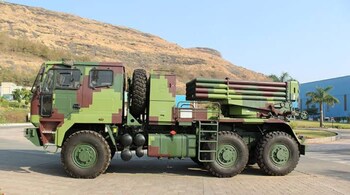
In a major breakthrough, the Indian Army has forged a new path towards its indigenisation drive in the Year of Tech Absorption. The Army has significantly reduced dependence on foreign suppliers across critical weapon systems, soldier gear and emerging technologies.
Over 1,050 spares and more than 60 major assemblies of foreign-origin equipment have already been indigenised, enabling upgrades and significantly enhancing self-reliance. In addition, 1,035 assemblies and sub-assemblies and 3,517 spares for existing equipment have been successfully developed within the country, marking a substantial step towards the national goal of self-reliance.
The Army is simultaneously advancing a range of key technologies - from cryo-coolers for thermal imagers and flight controllers to GNSS systems and electrical speed controllers for Unmanned Aerial Systems and drones. These initiatives, driven by in-house innovation and close collaboration with Indian industry, MSMEs and start-ups, are aimed at boosting operational readiness and align directly with the national vision of Atmanirbhar Bharat and Viksit Bharat @2047.
In a parallel development, the Army has recorded a major milestone in indigenising Special Clothing and Mountaineering Equipment (SCME) for troops deployed in Super High Altitude Areas. According to the Additional Directorate General of Public Information (ADG PI), 55 of the total 57 SCME items - a remarkable 97% of the inventory - have now been fully indigenised. The remaining two are undergoing trials and are expected to be indigenised by 2026.
ADG PI, in an X post on Thursday, emphasised that this progress strengthens logistics resilience while cutting import dependence for critical high-altitude gear.
Further bolstering operational capability, the Army has introduced the three-layered, ergonomically engineered New Coat Combat (Digital Print), designed by the National Institute of Fashion Technology (NIFT), New Delhi. The jacket, which uses advanced technical textiles for enhanced performance across varied terrains, was rolled out in January 2025.
The Indian Army has also secured Intellectual Property Rights (IPR) for the New Coat Combat design and camouflage pattern. The design, registered with the Controller General of Patents, Designs and Trademarks under Design Application No. 449667-001 dated February 27, 2025, was published in the Patent Office journal on October 7, 2025. With this, exclusive IPR now rests solely with the Army.
The New Coat Combat ensemble comprises an outer digitally-printed camouflage coat for durability and concealment, an insulated inner jacket for warmth without restricting mobility, and a thermal base layer to ensure optimal regulation and moisture control in extreme weather.
The Ministry of Defence noted that the adoption of advanced indigenous textiles and layered design marks another step in strengthening soldier survivability and operational effectiveness.
Discover the latest Business News, Sensex, and Nifty updates. Obtain Personal Finance insights, tax queries, and expert opinions on Moneycontrol or download the Moneycontrol App to stay updated!





