

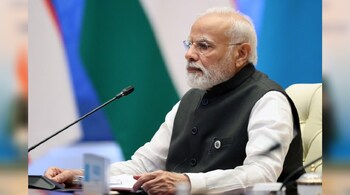
India has decided to hold next month’s Shanghai Cooperation Organisation (SCO) summit in New Delhi in a virtual format.
Until recently, indications suggested that the SCO summit scheduled for July 4 would have given leaders of participating countries to meet “in person” and interact with each other.
Though no reasons for turning the summit into a virtual one were given by the Ministry of External Affairs, the decision comes at a time when fresh strains have been added in India’s relations with China and Pakistan on the issue of Jammu and Kashmir.
The other reason behind India’s decision could have been because of the situation in Ukraine and its ongoing war with Russia.
Prime Minister Narendra Modi will chair the SCO summit and invitations have been sent to all the member countries and other invitees and organisations for their participation in the July meeting.
Other than India, the countries in the nine-member SCO include Russia, China and Pakistan. The four Central Asian countries — Kazakhstan, Kyrgyzstan, Tajikistan, and Uzbekistan — are also full members, along with India.
Besides, there are four Observer States interested in joining the SCO as full members — Afghanistan, Belarus, Iran, and Mongolia.
Observer States get to participate in SCO meetings but do not have the right to vote.
In addition, there are six Dialogue Partners — Armenia, Azerbaijan, Cambodia, Nepal, Sri Lanka and Turkey.
Dialogue Partners enjoy a consultative relationship in agreed areas of common interest.
Heads of two SCO bodies – the secretariat and SCO Regional Anti-Terrorist Structure (RATS) – are also likely to attend the summit, along with the heads of six international and regional organisations, including the UN, Asean and Conference on Interaction and Confidence Building Measures in Asia (CICA).
The theme of the New Delhi summit next month is ‘Towards a SECURE SCO’.
SECURE stands for security, economy and trade, connectivity, unity, respect for sovereignty and territorial integrity and environment.
New themes have also been introduced by India for cooperation like start-ups and innovation, traditional medicine, digital inclusion, youth empowerment and shared Buddhist heritage and culture.
It has also stressed on people-to-people ties to celebrate the historical bonds between the member states.
Under India’s SCO presidency, 134 meetings and events have been held in different parts of the country to project its diversity to the visiting leaders and officials.
G20 Summit in September
But as the chair of the Group of Twenty (G20) India will also hold a summit of the world leaders who are members of the bloc in New Delhi in September.
Russia and China are both members of the G20 and the presidents of the two countries, Xi Jinping and Vladimir Putin, are likely to be present in New Delhi for the summit.
Turning the SCO summit into a virtual format allows the Chinese and Russian Presidents to avoid travelling to India in quick succession for the two summits.
Moreover, the Ukraine war is entering a crucial phase as the US-led Western countries are making a last-ditch effort to arm Ukraine so that it can get back some territory from Russia before negotiations begin to end the war.
Therefore, even if Modi does not meet them at the SCO summit, the September summit of the G20 will provide another opportunity for the Indian Prime Minister to have meetings on the G20 summit sideline with Xi and Putin.
Tensions with China, Pakistan
Also, India does not seem too keen to resume any high-level political engagement with Pakistan at this juncture.
Terror attacks in Kashmir have continued with support from terrorist groups based in Pakistan while Islamabad is vociferous on the issue, which has led to strained relations.
Besides, Pakistan had campaigned relentlessly among Islamic countries to stay away from a tourism meeting of the G20 countries in Kashmir recently.
Though most countries participated in the meeting, some members of the Organisation of Islamic Cooperation (OIC) stayed away.
China, a close ally of Pakistan, had also decided to boycott the meeting.
In addition, India and Chinese troops continue to be in a military face-off since May 2020 in eastern Ladakh along the Line of Actual Control (LAC), the informal boundary of the countries.
Indian and Chinese officials both at the diplomatic and military levels have engaged with each other and continue to meet. Delhi has made it clear that normal relations between the two neighbours were not possible until the situation at the LAC normalised.
The normal situation at the LAC India means the Chinese troops that had unilaterally broken the status quo at the border return to their original position before the stand-off began.
But India has not had any high-level political engagement with Pakistan since Modi’s visit to Lahore in 2015 to have an impromptu meeting with his Pakistani counterpart Nawaz Sharif.
At the SCO foreign ministers’ meeting in April in Goa, Indian foreign minister S Jaishankar refused to have a bilateral meeting with his Pakistani counterpart Bilawal Bhutto Zardari on the sidelines.
Moreover, the economic and political instability in Pakistan does not inspire the Indian leadership at this juncture to reach out to Islamabad for a dialogue.
In the coming weeks, Modi will meet both the Chinese and Russian Presidents at the BRICS Summit in South Africa.
It remains to be seen if it leads to a meeting between the Indian Prime Minister and Xi Jinping on the BRICS sidelines to pave the way for a more substantive meeting between the two leaders in the coming days.
Discover the latest Business News, Sensex, and Nifty updates. Obtain Personal Finance insights, tax queries, and expert opinions on Moneycontrol or download the Moneycontrol App to stay updated!





