

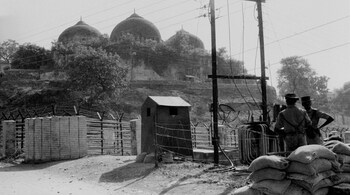
By the mid-20th century, Ayodhya had already witnessed decades of contesting claims over the site known to Hindus as Ram Janmabhoomi and used by Muslims as the Babri Masjid for congregational prayers.
Various records of the 19th century, including district gazetteers and surveys prepared under British rule, refer to a physical division of the premises following mid-19th century clashes: the outer courtyard was used by Hindus for worship, while the inner courtyard, including the domed mosque structure, remained reserved for Muslim worship. This arrangement continued, with occasional tensions, until 1949.
This dual use of the larger site was remarked upon by several officials and surveyors of the time, including Francis Buchanan in the early 19th century, Montgomery Martin, and P. Carnegy in the later 19th century. Their accounts record that the mosque structure remained in the hands of Muslims and was used for namaz, even as Hindu pilgrims assembled and performed rituals in the outer courtyard. By the 1940s, this bifurcated pattern of usage had become the established practice on the ground.
The political and communal climate in the 1940s
The years immediately before and after Indian independence were marked by heightened communal anxieties in large parts of North India. Ayodhya, with its overlapping religious associations, was one site where these anxieties were symbolically expressed.
For many years prior to 1949, local Hindu groups like Akhil Bharatiya Ramayana Mahasabha agitated for increased access of Hindu pilgrims to what they believed was the precise birth site of Ram. In the months leading up to December 1949, the Mahasabha and affiliated organisations organised public meetings, bhajan sessions and rallies that progressively focussed their target on the inner courtyard.
Meanwhile, district-level administrative records for the period reveal that local officials were concerned with maintaining at the site a fragile balance, given the history of communal clashes there. Occasionally, the mosque was kept locked administratively, but Muslim prayers were held continuously inside it, and the Hindu community kept using the outer courtyard without disruption. Official correspondence echoed this position of maintaining the status quo.
Night of 22-23 December 1949: What the records state
The crucial incident took place between the night of 22 December and the early hours of 23 December 1949, when idols of Ram Lalla were found to have appeared inside the central dome of the mosque. Contemporary administrative records, police reports, and the proceedings in the criminal case later titled State vs. Priyadatt Ram, in which the episode was investigated, are the principal sources for reconstructing this event.
According to these records:
• A number of people placed idols inside the mosque in what the administration subsequently labelled as criminal trespass.
• According to eyewitness accounts and police reports, after dark, a small group entered the premises.
• By morning, people heard of the presence of the idols and started gathering outside, the people considering it a godly sign rather than done by man.
The district magistrate and other senior officials reached the site shortly thereafter. As reflected in official notes and subsequent testimonies, their immediate concern was to avert communal violence at a time when relations between communities were already fragile in the aftermath of Partition.
Administrative response: Closing the premises
The authorities then pursued a policy of containment: the inner courtyard housing the mosque structure was sealed off and brought under strict administrative control. In addition to this. two more decisions were taken which set in motion the course that the controversy would take.
1. The idols were not removed
Removing the idols was considered by officials, but the idea was discarded. Records indicate that they were afraid such an act might provoke serious unrest in the surcharged atmosphere and the rapidly gathering crowd. A decision was thus taken to let the idols stay where they had been housed inside the central dome.
2. Hindu worship was permitted, only outside the locked gates
Hindu devotees were allowed to do darshan and worship the idols but only from outside the locked grill. This perpetuated the earlier pattern in form—Hindus outside and Muslims inside—but changed its substance. The idols, which now were the focal point of Hindu worship, remained inside the same structure that had hitherto been used as an exclusive mosque.
These steps were characterized as temporary measures, in the interest of peace. In practice, of course, they established a new order that was to last and become a focal point of reference for subsequent law and political claims.
Early legal proceedings: Suits and counter-suits begin
Over the next several months, the incident found its way from the administrative arena into the courts. In general, two types of legal actions emerged.
Suits by Hindu plaintiffs
Hindu litigants filed suits seeking:
• Recognition of the idols as manifestations of the deity Ram Lalla.
• The right to worship at the exact spot where the idols had appeared.
• The idols should not be removed by the administration.
One of the earliest and most commonly mentioned suits was filed in 1950 by Gopal Singh Visharad, praying for undisturbed rights of worship. In due course other suits were filed on behalf of Hindu religious leaders and groups.
Suits by Muslim plaintiffs
Muslim parties had filed suits and petitions demanding:
• Restoration of the mosque to its pre-December 1949 condition.
• Removal of the idols within the structure.
• Protection of their right to offer namaz, which they argued had been effectively suspended due to the administrative sealing of the inner courtyard.
These suits began to be heard by the Faizabad civil courts from the early 1950s. Each party used historical records, witness testimonies, and administrative documents to substantiate its claim. These proceedings comprised the core legal framework that would eventually develop into a decades-long dispute.
The site's locking: A status that shaped future claims
The impact of the December 1949 incident did not remain limited to that night. By sealing the premises and leaving the idols in place, the administration created a new status quo that had important long-term consequences.
1. The inner courtyard was no longer used as a mosque.
Once the structure was sealed, Muslim prayers within the mosque ceased. Namaz was no longer offered within the structure, and over time this absence of worship became one of the central arguments in later legal and political narratives on possession and usage.
2. Hindu worship focussed on the idols
While access was still restricted, the idols within the central dome gave fresh vigour to the Hindu claims over the spiritual centrality of the inner courtyard. The devotees who congregated outside the locked gate directed their worship towards the idols. In this way, the association of the inner dome with Ram Janmabhoomi was reinforced in public perception.
3. The question of possession became legally complicated
The courts now had to factor in not just historical title and documentary evidence but also the changed pattern of usage after 1949. The fact that idols were there inside the structure, that the Muslim worship had stopped there, and the Hindu worship was allowed from outside the grill complicated the legal determination of who actually possessed and controlled the site.
These complexities are discussed at length in later judicial reviews, particularly in the detailed narrative of the dispute contained in the 2010 judgment of the Allahabad High Court and the 2019 judgment of the Supreme Court of India, both of which identify the 1949 incident as a critical turning point.
Government of India’s White Paper (1993): Official documentation
Decades later, the Government of India's White Paper on Ayodhya, brought out in 1993, provided an official consolidated account of the events in December 1949. Drawing on administrative files, police reports, and court records, the White Paper emphasized a few key points:
• The idols were placed illegally inside the mosque.
• The administration treated the event as a case of criminal trespass.
• The site was sealed in an attempt to prevent communal violence, not to resolve ownership questions.
• The incident changed, instead of settling, the controversy on the site.
Since then, the White Paper has frequently been cited, both in litigation and scholarship, as an authoritative summary of what the government itself understood the 1949 episode to be.
The long-term implications on the dispute
The placing of the idols in 1949 resolved no historical, theological or legal questions. Instead, it intensified the struggle in several identifiable ways.
1. It widened the purview of litigation
From the 1950s onwards, the dispute grew into multiple, overlapping suits—title suits, rights-of-worship suits, and a variety of procedural petitions. The litigation became more complex as various parties, Hindus and Muslims, sought to lay different claims over the site.
2. It embedded the site deeper in national politics
During the 1960s and 1970s, political organisations increasingly invoked the 1949 incident in speeches, campaigns and organisational literature, using it to argue for exclusive control over the site or to criticise opponents' positions. What had begun as a local incident in Faizabad district slowly became a matter of broader political mobilisation.
3. It set the stage for the 1986 unlocking
When in 1986 a district court in Faizabad ordered the gates to be unlocked to allow Hindus unrestricted access to the idols inside, it was doing so against the backdrop of an arrangement created in 1949. The earlier decision to keep the idols in place and lock the structure made the question of access central to later petitions. The 1986 order dramatically raised the political salience of the dispute and triggered new waves of mobilisation nationwide.
4. It shaped judicial logic in later judgments
In both the judgment pronounced by the Allahabad High Court in 2010 and by the Supreme Court in 2019, the incident of 1949 is regarded as a legally significant milestone. The courts examined it in relation to the archaeological reports provided by the Archaeological Survey of India, historic records, and evidence of patterns of worship, with the view to reconstruct the site's long and contested history.
How historians and legal scholars interpret the incident
Most historians and legal experts view the 1949 placement of idols as a human act rather than any miraculous event. This conclusion is based upon:
• Eyewitness testimony recorded in court.
• Police records and first information reports
• Administrative correspondence by local officials
• References to the incident in later commission reports and judicial proceedings.
The event, in 1949, generally tends to be located within an extended narrative of religious mobilization, local politics, and post-independence communal tensions rather than being treated as an isolated event. Its importance lies in the way it reshaped the legal, religious, and political meanings attached to the site.
Conclusion: A decisive moment in a long historical arc
The night of 22-23 December 1949 proved to be one of the most consequential turning points in the Ayodhya dispute. What began as a localised incident—the placing of idols inside a locked mosque—changed the very nature of the conflict. It initiated decades of litigation, changed ritual practices at the site, and provided new material for political mobilization at the regional and national levels.
It was the combination of three elements—the placing of the idols, the administrative decision to lock the site while continuing Hindu worship from outside, and the competitive legal claims that followed—that constituted the starting point of modern history in Ayodhya. The chronology of events that night, reconstructable from court records, government documents and subsequent judicial summaries, provided the foundation on which later phases of the Ram Janmabhoomi-Babri Masjid dispute were built.
Discover the latest Business News, Sensex, and Nifty updates. Obtain Personal Finance insights, tax queries, and expert opinions on Moneycontrol or download the Moneycontrol App to stay updated!





