

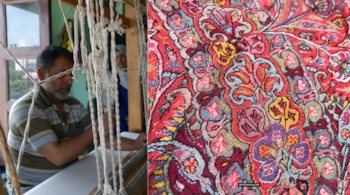
For the past three months, Nazir Ahmad Ganie, 62 has poured his “blood, sweat and skill” into a single Pashmina shawl. The process began with collecting raw wool, which he carefully cleaned and sorted before spinning it into the finest yarn. From there, he wove the delicate threads into fabric, and now, with steady hands and years of practice, he is adding the intricate designs that give each shawl its unique identity. “It will take another three-four months,” he says.
Ganie, a resident of Srinagar’s Zoonimar area, grew anxious when he learnt that the US President Donald Trump had upped tariff on Indian products, including Kashmiri handicrafts like the Pashmina shawls, to 50 percent tariff on Indian products.
For decades, the US has been a huge market for Kashmir’s famed handicrafts which include pashmina shawls, carpets, papier-mâché, wood-carving items and other articles. With the US imposing a 50 percent tariff on Indian goods from August 27, Indian exporters have been left rattled by the Trump administration’s move, which is expected to impact nearly US$12.5 billion worth of exports, as per a report.
Of course, the dust hasn't settled on the issue of US tariffs on Indian exports. Even as the US Supreme Court agreed to decide on the legality of Trump's global tariffs earlier this week, the US President has reportedly urged the European Union to increase tariffs on Indian and Chinese products to 100 percent. There've also been avowals of a long-standing cordial relationship between India and the US in the meantime—and rising hopes of a potential high-stakes meeting between Trump and Prime Minister Narendra Modi.
Impact of US tariffs
The Kashmiri handicrafts are believed to be one of the major sectors of Kashmir’s economy after horticulture. A large number of people in Kashmir are associated with the trade. As per the data, over 422,000 artisans are directly or indirectly associated with this trade, including 280,000 artisans registered with the government. Not only that, the shawls have also been an integral part of Kashmir's cultural heritage. However, as per a report, the handicraft exports have witnessed a significant decline in the financial year 2024–25.
Kashmir’s famed Pashmina has gained significant recognition both in India and abroad, as tourists often carry these shawls as Kashmiri-made gifts for their families, friends, and relatives. The raw material for Pashmina is being supplied from the Changthang goats in Ladakh and then skillfully processed in the valley, mostly in the Srinagar city.
Last month, Prime Minister Narendra Modi presented a handcrafted Kashmiri Pashmina shawl to Japan’s first lady during his visit.
However, the centuries old-handicraft in Kashmir are already going through tough phases, with the influx of machine-made shawls in the market.
Javid Ahmad Tenga, who heads the Kashmir Chamber of Commerce and Industry (KCCI), tells Moneycontrol that they would export shawls worth Rs 350 crore every year to different parts of the world. However, over the last four years, there has been a sharp decline in shawl exports, he adds.
“The reason is the Ggobal conflict, especially Russia-Ukraine, Iran and Israel involving US as well,” he says “now the tension between India and US has put the Kashmiri handcrafts under additional strain,” Tenga says.
Tariq Dar, a pashmina shawl exporter, says the US is a huge market for the pashmina shawls and the tariff will badly hit the artisans and the exporters alike. He says that the pashmina shawls are handmade products, which are already costly and with higher tariffs, the shawls will be more expensive and will be “impossible” to sell. “We are really worried and we don’t know how to deal with the crises right now,” says Dar, who runs the brand Pashmkaar Kashmir in Srinagar.
Dar hopes that all handmade products would be exempt from tariffs, as they take months or even years to craft and embody the cultural heritage of a country or region. Dar explains that the traders and exporters are hit especially hard since demand for expensive handmade products like shawls usually have low demand in the region, and selling shawls in overseas markets help them to survive and support their families.
“Customers from other (Indian) states are very fond of handmade Kashmiri shawls, but we also used to receive bulk orders from abroad — particularly,” says Sheikh Ashiq, a former trade leader from Srinagar. Ashiq argues that they have built the market in the US over decades, and it will be difficult to find the alternatives in a short period of time.
India has fast-tracked conversations for free-trade agreements (FTAs) with countries like Peru and Chile to curb the impact of higher US tariffs. While the India-UK FTA - signed July 24 - has already reduced UK tariffs on Kashmiri Pashmina shawls to just 3 percent.
“Exploring new markets is definitely a good option but it takes time,” Ashiq says. “Although the quantity of Pashmina shawls (exported) to US was low, it (the new tariff regime) will hamper the exports,” he adds.
Ashiq, who regularly exports Pashmina shawls and other handicraft items to European countries, observes that buyers there are “holding back” their money and becoming reluctant to spend amid the ongoing global turmoil.
Ejaz Ayoub, a Srinagar-based economist, claims that the impact on Kashmiri goods will be “minimal” as the component of export to J&K’s Gross State Domestic Product (GSDP) is minimal. But, he argues that the revision of the goods and service tax (GST) from the earlier 12 percent to 5 percent won’t be sufficient to neutralise the tariffs. “To make the prices competitive, the first casualty will be the artisan wages. Given the inflexibility of other variable costs like raw material and logistics,” he adds. He adds that Pashmina shawls from other countries, including neighbouring Pakistan, on which the tariffs are less than India will thrive since the product will be cheap.
Ashiq, however, argues that the Pakistan’s Pashmina shawls can’t compete with the Kashmiri pashmina shawls. “Our shawls are unmatchable, no one can compete with us,” he adds.
Atul Sharma, managing director, Handloom & Handicraft Corporation, says that India has options to export their items to European countries. He says India and the United Kingdom have signed a Free Trade Agreement (FTA), and can export all the items to the UK with least tariffs. The FTA signed between the two countries in July this year, will slash trade tariffs from 15 percent to 3 percent. “It will take some time, the US will have to slash the tariffs, and everything will be normal,” he adds.
However, for artisans like Ganie and exporters like Dar, Ashiq and countless others, the tariff war between the two countries, if not resolved in time, could threaten their only source of livelihood, pushing families who survive on this centuries-old craft into deeper hardship and despair.
Discover the latest Business News, Sensex, and Nifty updates. Obtain Personal Finance insights, tax queries, and expert opinions on Moneycontrol or download the Moneycontrol App to stay updated!





