

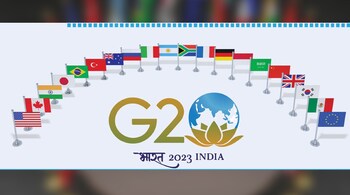
It is a gigantic opportunity as well as a steep challenge. As India assumed the presidency of the Group of Twenty (G20) this week, it gave one of the world’s oldest civilisations a chance to showcase its multicultural heritage, aware in the knowledge that the new world order also presents problems not confronted before.
No one understands this paradox better than Prime Minister Narendra Modi. “The world must cooperate to tackle the greatest challenges of climate change, terrorism, and pandemics,” he said on November 1, as India began its year-long presidency of the G20.
“Today, we do not need to fight for our survival ― our era need not be one of war. Indeed, it must not be one,” the prime minister said in a declaration published in Indian newspapers to mark the start of the G20 presidency.
Modi’s comment on war echoed a remark he made to Russian President Vladimir Putin at a regional conference in September, when he told him “now was not the time for war”, widely interpreted as a mild rebuke of Russia.
India will host the G20 leaders' summit in New Delhi on September 9 and 10 in 2023 under its presidency, a Ministry of External Affairs (MEA) press release said.
Former foreign secretary Kanwal Sibal told Moneycontrol, “For India, it is an opportunity of a century, where the country can assume global leadership and reflect the concerns of the Global South. India has the credibility to mediate disputes with all sides, except China. We have credibility in many areas like digital transformation, successes in UPI and Aadhar, DBT, and building inclusive societies, which would undoubtedly inspire many countries to do the same.”
Modi had said earlier, “Our G20 priorities will be shaped in consultation with not just our G20 partners, but also our fellow travelers in the Global South, whose voice often goes unheard.” Global South is a term often used to identify regions within Latin America, Asia, Africa, and Oceania.
Added Sibal, “India’s stance on climate change and meeting sustainability targets by 2030, its role in the International Solar Alliance and women’s empowerment are all issues that inspire countries. In addition, India will get a chance to showcase its heritage sites and increase tourism in the country.”
That the year-long presidency will give India the chance to flaunt its endowments are not in doubt. Suitably, 100 monuments, including UNESCO world heritage sites bearing the G20 logo, will be illuminated for seven days from December 1 to 7.
They will adorn several historical structures ― from Srinagar's Shankaracharya temple to Delhi's Red Fort to Thanjavur's Great Living Chola temple. The illumination will also include Humayun's Tomb and Purana Qila in Delhi, the Modhera Sun Temple in Gujarat, the Konark Sun Temple in Odisha, and Sher Shah Suri's Tomb in Bihar, to name just a few.
Then begins a series of meetings and mini summits. During this year's presidency, India will host 200 meetings across nations in over 50 cities and 32 different sectors.
The G20 is an intergovernmental forum comprising 19 countries and the European Union (EU). It works to address major issues related to the global economy, such as international financial stability, climate change mitigation, and sustainable development. For the 2023 Summit, India's objectives include the supply of affordable technology for sustainable environmental development and highlighting the digital transformation of the country.
The G20 members represent around 85 percent of the global GDP, over 75 percent of the global trade, and about two-thirds of the global population.
Rajeesh Kumar, an Associate Fellow at the Manohar Parrikar Institute for Defence Studies and Analyses, told Moneycontrol that the G20 presidency is very significant because India will have the opportunity to set the agenda.
“It is not ceremonial. This is a huge chance for India to set the global agenda, as opposed to, let’s say, the UN Security Council, where other powers dominate.” A multilateral expert, Kumar is currently working on a project titled ‘Emerging Powers and the Future of Global Governance: India and International Institutions.
The Ukraine conflict, which started with the Russian invasion in February, dominated the two-day G20 summit in Bali, Indonesia, recently to the frustration of some members who wanted more attention on global economic woes. In a world bogged down by the unpredictable war in Europe, environment and development could well take a back seat.
In adherence to PM Modi's recommendation to not limit G20 to major urban cities and to use the opportunity to display India's rich and diverse cultural landscape, MEA officials said that the proposed meetings will take place in lesser-known but very exotic locations. For instance, India will kick off the celebrations for the G20 presidency at the Hornbill Festival in Nagaland.
Recently, G20 Chief Coordinator, Harsh Vardhan Shringla, discussed the opportunities to showcase the festival with Nagaland Chief Minister Neiphiu Rio. Shringla, a former foreign secretary, is reaching out to various states to identify opportunities to showcase the country's cultural heritage through G20 events.
The website G20.org has changed for India and it now reads 'Vasudhaiva Kutumbakam', i.e., ‘One Earth, One Family, One Future’.
Earlier this month, the prime minister unveiled the theme and website of India's G20 presidency via video conferencing. The lotus in the logo symbolises India's ancient heritage, faith, and thought.
This logo and theme represent many key messages from India. “The message of Buddha for freedom from war, Mahatma Gandhi's solutions in the face of violence, through G20, India is giving them a new height,” he said.
However, Sibal warns of the pitfalls that may not be so evident at this stage. “Let us also not forget the problematic areas. The Ukraine problem is unsolved and fluid; the views of the UN and the EU are far from settled. India will have to tackle these subjects with great care. As president of G20, India will have to handle the ticklish issue of supply chains, which are basically aimed against China; so a common language would need to be evolved.
India will be hosting the next G20 summit and global leaders with conflicting aims will attend. There will be Biden and Putin. We don’t know for sure if Xi would attend, but if he does, India cannot ignore him as New Delhi is the host. PM Modi has done well to break the ice with the Chinese president at Bali.”
Another former diplomat concurs. Kalarickal Pranchu Fabian, who once headed the Gulf Division of the Ministry of External Affairs, says that while the presidency of G20 is a big opportunity to showcase the country, there is also a flip side to holding events in exotic locations, as “the world gets to see places where India would not like them to go”.
Diplomats also warn of another common failing. “We should not use this G20 presidency to show that India has arrived. India has arrived, but that is independent of this G20 presidency, which is rotational. It is an opportunity, but we should not harp too much on it and avoid hype. After all, we have our own fault lines like a receding place on the global democratic ladder and there are powerful elements in the West who are keen to discredit us,” said one top official.
It is often wise to tread with caution on global multilateral platforms because the chance to get caught in the crossfire remains high.
Discover the latest Business News, Sensex, and Nifty updates. Obtain Personal Finance insights, tax queries, and expert opinions on Moneycontrol or download the Moneycontrol App to stay updated!





