

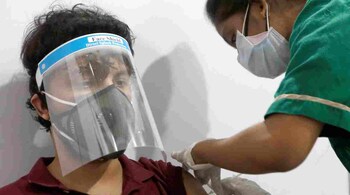
India is expected to end July at about 46 crore total COVID-19 vaccine doses administered over six-and-a-half months, leaving it with an ambitious task to give 142 crores more vaccine jabs over the next five months to fulfil its aim of fully vaccinating all adults in 2021.
Achieving this will depend on three major factors, senior government officials have told News18. One, Bharat Biotech coming to the party and upping its production capabilities of Covaxin as envisioned, as the country is banking on it for a total of 48 crore doses. Two, the Biotech-E vaccine getting emergency use authorisation as the Centre is banking on it for 30 crore doses and has invested Rs 1,500 crore as an advance for “at-risk” manufacturing of the vaccine. Three, people shedding ‘vaccine hesitancy’ and getting both their doses by December.
The vaccination level of July is expected to be similar to June at about 12 crore doses, despite a new vaccination policy in place since June 21, highlighting that the real issue remains in supply but vaccine hesitancy is a factor too. This may lead to a scenario where most of the adult population could get the first jab by the end of 2021 while the second jab may remain a work in progress.
The Covaxin Mystery
In India’s vaccine story, so far only one engine (Covishield) seems to be firing. Sample this – out of the 44 crore-odd doses given as on date, nearly 39 crore are of Covishield while Covaxin accounts for a little over 5 crore doses. Bharat Biotech had orders to supply 8 crore vaccines till the end of July but had supplied only 5.45 crore of those doses till July 16. The company has told the government that it has a current capacity to only produce 2.5 crore doses each month but would soon increase it to 5.8 crore doses each month.
But will even that be enough? It does not seem so as the government has told the Supreme Court that it is expecting 40 crore doses of Covaxin between August and December. That means Bharat Biotech will need to produce eight crore doses per month. However, the company is yet to fulfil its previous order to supply eight crore vaccines by July. Further, on July 16, the Centre has placed an order with Bharat Biotech for 28.5 crore vaccines that are to be supplied starting August. The rest of the Covaxin supply (11.5 crores) seem to be accounted for by the private sector which has a 25% share by the way of direct procurement.
The Fourth Vaccine
The government is waiting desperately for its fourth vaccine after Covishield, Covaxin and Sputnik V – the one from Biological-E. Though the company is still to apply for Emergency Use Authorisation (EUA) from the regulator, which government officials say could happen in August, the company was given an advance of Rs 1,500 crore last month to begin ‘at-risk’ production of the vaccine. The government has told the Supreme Court earlier that it is expecting 30 crore doses of the Biological-E vaccine this year and this is a key element to the government achieving its big aim of fully vaccinating all 94 crore adults in the country.
Sputnik V imports remain at a modest level and only 4.23 lakh doses of the Russian vaccine have been given in the country so far after imports. The government is banking on the local production of Sputnik V, for which permission has been given, to achieve a supply of 10 crore doses of Sputnik V starting September till the end of December. The Zydus Cadila vaccine, for which EUA has been applied, could pitch in from October with supplies if the EUA comes through. The centre is banking on it for 5 crore doses.
The Serum Institute is expected to fulfil its part of supplying a total of 90 crore doses in 2021, having supplied close to 40 crore doses so far and promising 50 crore doses in the next five months as its production capacity is over 11 crore doses a month already.
Vaccine Hesitancy
Senior government officials concede that while the aim is to fully vaccinate 94 crore adults in the country by the end of December, it is possible that many do not turn up for the jabs given vaccine hesitancy. The government’s aim hence could be tailored to vaccinate all “willing” adults, one senior official told News18. “Even some health and frontline workers have not turned up for one or both jabs despite them being eligible for the same for many months, showing complete 100% vaccination of all adults is a desirable but may not be an achievable task. In senior citizens too, many have not taken the first jab yet. The demand is however high in the 18-44 category of young populace,” the official pointed out.
This may lead to a scenario where most of the adult population may get its first jab by the end of December while the second jab may remain a work in progress. The recent uptick in vaccinations from the rural regions has however enthused the government that a large percentage of the target can be achieved by December-end.
Discover the latest Business News, Sensex, and Nifty updates. Obtain Personal Finance insights, tax queries, and expert opinions on Moneycontrol or download the Moneycontrol App to stay updated!





