

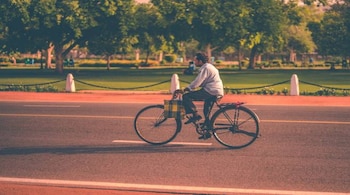
To support Indian cities to quickly implement cycling-friendly initiatives in response to COVID-19, the Ministry of Housing and Urban Affairs along with Smart Cities Mission and The Institute for Transportation and Development Policy (ITDP) opened registration for India Cycles4Change Challenge on July 10.
The challenge is open to all cities under the Smart Cities Mission, capital cities of states/union territories and all cities with more than 5 lakh population. Eligible cities can register and submit their applications on the portal from July 10 to 21.
The challenge was launched on June 25, 2020, by Minister of Housing and Urban Affairs Hardeep Singh Puri.
The cities can register for the India Cycles4Change Challenge on the portal at https://smartnet.niua.org/indiacyclechallenge/.
The initiative will be held in two stages. Stage One will run until October where cities will focus on piloting quick interventions to promote cycling and develop a scale-up strategy.
In October 2020, 11 cities will be shortlisted and will receive Rs. 1 crore award and guidance from national and international experts to further scale up the initiatives in Stage Two, which will be held until May 2021.
“The ministry is committed to helping cities develop high-quality transport systems that offer sustainable mobility options to their residents. I urge all cities to work towards achieving a vision of safe and fun cycling for everyone,” said Puri.
“This is the beginning of a national cycling revolution. The Challenge is a way of connecting the entire ecosystem around cities including citizens’ experts, cycling groups, people in the business of manufacturing and selling cycles and repair shops into a single unit to promote this important concept around sustainable and personalised transport," said Kunal Kumar, joint secretary, Smart Cities Mission.
"In COVID times we have witnessed people moving towards personalised modes of transport and cycling stands out as one of the most important ones. The last few months has seen an increase in cycle sales in many Indian cities,” he said at the event.
The initiative will help attain the twin goals of encouraging active mobility in our cities and at the same time promote fitness. The aim of the India Cycles4Change Challenge is to create extensive cycling networks through low-cost interventions such as pop cycle lanes and traffic calmed or non-motorised zones, he added.
“Cycling affords us a personalised transport, ensures that we maintain social distancing, keeps us healthy and reduces burden on public transportation,” said Shreya Gadepalli, South Asia Director at the Institute for Transportation and Development Policy (ITDP).
Citizen collaboration will be a key metric in the evaluation of proposals submitted by the cities, she said.
The need for personalised forms of transport is expected to increase as a response to COVID-19. A recent survey by the ITDP India Programme shows that cycling would increase by 50-65 percent as cities come out of lockdown.
As per ITDP, increasing cycling can help cities in a green economic recovery. Investments in cycling infrastructure have economic benefits of up to 5.5 times the initial investment. Cycling for short distances can result in an annual benefit of Rs 1.8 trillion to the Indian economy.
“Ansterdam took two decades to make this change happen, we are asking this to happen in India in a year or two and it is possible to do so,” she said.
The Smart Cities Mission with the assistance of the ITDP India Programme and a panel of experts will review the submissions and shortlist the first set of cities which will move into the second stage. Cities that do not clear the first stage would be encouraged to revise their proposal and re-submit for selection to the second stage.
From October to January, shortlisted cities would be hand-held to further develop and commence the implementation of the concept scale-up plan submitted in Stage 1 with inputs from national and international experts. They would be provided support through online workshops to review designs, and peer-to-peer workshops to share learnings.
Indian cities have started working towards promoting cycling as a response to the COVID-19 pandemic. Kolkata has proposed a dedicated cycle corridor by reclaiming parking spaces. The city will conduct a preliminary road survey within four months, after which the project will be implemented by early next year.
In Guwahati, The Green lane Foundation, with the support of the Bicycle Mayor of Guwahati and Pedal for a Change, is conducting a survey for citizens to vote for the best routes for bicycle lanes in the city, which will be incorporated into the Challenge.
Milan is in the process of transforming 35 km of streets to pedestrian and cyclist priority lanes while Paris is creating 650 km of pop-up cycle-ways. Britain has decided to invest £2 billion in cycling and walking in response to the coronavirus pandemic.
Discover the latest Business News, Sensex, and Nifty updates. Obtain Personal Finance insights, tax queries, and expert opinions on Moneycontrol or download the Moneycontrol App to stay updated!





