

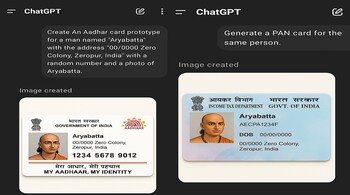
Since its launch, OpenAI's ChatGPT has sparked concerns over privacy, especially regarding content and image generation. The AI's ability to produce highly realistic and precise content has advanced considerably, making it much easier to forge documents.
Cybercriminals, who once struggled to create fake government-issued IDs, now find that models like GPT-4 have simplified the process. Recently, some enthusiastic social media users discovered that by crafting effective prompts, they can easily generate counterfeit documents like Aadhar and PAN card. Several users have shared images of these forged documents on the social media platform X.
One user, Yaswanth Sai Palaghat, said, "ChatGPT is generating fake Aadhaar and PAN cards instantly, which is a serious security risk. This is why AI should be regulated to some extent."
Another user, Piku, commented, "I asked AI to generate an Aadhaar card with just a name, date of birth, and address... and it created a nearly perfect copy. Now anyone can make a fake version of an Aadhaar or PAN card. We often discuss data privacy, but who's selling these Aadhaar and PAN card datasets to AI companies to develop such models? How else would it know the format so accurately?"
While the AI does not use real personal information in its generation, it has been known to create fake IDs for well-known individuals, underscoring the potential risks associated with these technologies.
The rapidly expanding capabilities of AI models present a significant danger, increasing the chances of their misuse in activities such as cybercrimes and fraud.
Discover the latest Business News, Sensex, and Nifty updates. Obtain Personal Finance insights, tax queries, and expert opinions on Moneycontrol or download the Moneycontrol App to stay updated!





