

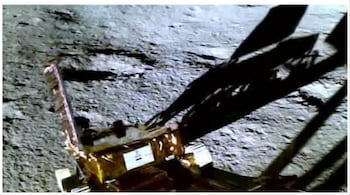
What was known in theory has now been confirmed twice. The Chandrayaan-3 mission has authenticated the presence of sulphur on the lunar south pole region after on site tests, a historical first that could provide clues to the origins of the Moon and also have profound significance for space exploration, say scientists.
On Thursday, India’s space agency ISRO said the Alpha Particle X-ray Spectroscope (APXS) instrument onboard the Pragyan rover confirmed the presence of sulphur and some other elements in the lunar south. Before that, on Tuesday, ISRO announced that another instrument, the Laser-Induced Breakdown Spectroscope (LIBS), found sulphur in the region.
Such findings not only reshape our comprehension of lunar formations but also offer potential prospects for lunar exploration and habitation, Akash Sinha, who was involved in developing software for the Pragyan rover, told PTI. An old undated document from the US space agency NASA suggested the potential utilisation of sulphur for making lunar bricks or concrete using it with moon soil. Interestingly, China’s reported plans to test printing bricks from lunar soil this decade for constructing a permanent moon base align with this idea.
”Surface sulphur comes from volcanic activity, indicating heavy volcanism at some point in the Moon’s history. However, the detection is from only one spot, so we need more data to gain a clearer picture,” said T V Venkateswaran, a scientist at Vigyaan Prasar, an autonomous organisation under the Department of Science and Technology (DST). The presence of sulphur, especially in an area where volcanic activitya common source of sulphuris notably absent opens up intriguing possibilities about the origins of the Moon, he said. ”
The compositions show abundant lighter metals such as aluminium and also abundant sulphur and iron. Sulphur could come from lunar volcanoes. Only traces of heavy metals such as titanium, and chromium, were found. These are along the expected lines,” Chakrabarti, director of the Indian Center for Space Physics in Kolkata, told PTI. ”
The discoveries made by Chandrayaan-3 hold vast implications for lunar exploration. Beyond the allure of space travel, the presence of these elements paints a vivid picture of the Moon’s character, Chakrabarti reflected. Chakrabarti expressed his enthusiasm for Pragyan’s contribution. ”It is indeed heartening that Pragyan is actually sending the composition of the topsoil of the landing area, namely, Shiv-Shakti point. ”Right now, we are concentrating on survival on the Moon and not getting richer, he added.
Venkateswaran, who is also a member of the outreach committee of the Astronomical Society of India, emphasised the rover’s role in confirming a finding from Chandrayaan-1 about hydrogen particles reflected by the Moon’s surface in 2008. Chandrayaan-3 touched down on the lunar south pole on August 23, making India the first country to land on the uncharted surface.
Discover the latest Business News, Sensex, and Nifty updates. Obtain Personal Finance insights, tax queries, and expert opinions on Moneycontrol or download the Moneycontrol App to stay updated!





