

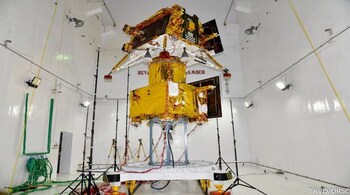
The Chandrayaan-3 that aims for a soft landing on the moon's surface, paving the way for future interplanetary missions, carries six payloads that would help ISRO understand the lunar soil and also get the blue planet's photographs from the lunar orbit. The payloads, which include RAMBHA and ILSA, would perform a series of path-breaking experiments during the 14-day mission. They would study the moon's atmosphere and dig the surface to understand its mineral composition. The payloads, which include RAMBHA and ILSA, would perform a series of path-breaking experiments during the 14-day mission. They would study the moon's atmosphere and dig the surface to understand its mineral composition.
Lunar lander Vikram will click photos of the rover Pragyaan as it studies the seismic activity on the moon by dropping some instruments. Using laser beams, it would try to melt a piece of the lunar surface — the regolith — to study the gases emitted during the process. The third lunar expedition in 15 years — Chandrayaan-3 — started its journey towards the moon from Sriharikota on Friday afternoon and is expected to reach the lunar orbit on August 5. It will attempt to land on the moon on August 23 evening. The third lunar expedition in 15 years — Chandrayaan-3 — started its journey towards the moon from Sriharikota on Friday afternoon and is expected to reach the lunar orbit on August 5. It will attempt to land on the moon on August 23 evening.
"We know the moon does not have any atmosphere. But this is not exactly true because gases do come out of it. Rather they get ionised and stay very close to the surface. This changes with day and night," ISRO Chairman S Somanath told PTI. The Radio Anatomy of Moon Bound Hypersensitive ionosphere and Atmosphere (RAMBHA) on the lander will measure the near-surface plasma density and its changes with time. The Radio Anatomy of Moon Bound Hypersensitive ionosphere and Atmosphere (RAMBHA) on the lander will measure the near-surface plasma density and its changes with time.
The rover will study how this small atmosphere, atomic atmosphere and the charged particles vary, Somanath said. "This is very interesting. We also want to find out whether the regolith has electric or thermal characteristics," he said. "This is very interesting. We also want to find out whether the regolith has electric or thermal characteristics," he said.
The Instrument for Lunar Seismic Activity (ILSA) will measure seismicity around the landing site and delineate the structure of the lunar crust and mantle. "We will drop an instrument and measure the vibration — what you call the 'moonquake' behaviour or the internal processes — the movements happening there," the ISRO chief said. "We will drop an instrument and measure the vibration — what you call the 'moonquake' behaviour or the internal processes — the movements happening there," the ISRO chief said.
The Laser-Induced Breakdown Spectroscope (LIBS) will determine the elemental composition of lunar soil and rocks around the landing site, while the Alpha Particle X-Ray Spectrometer (APXS) will derive the chemical composition and infer the mineralogical composition of the moon's surface. The Spectro-polarimetry of HAbitable Planet Earth (SHAPE) will study the spectro-polarimetric signatures of the earth in the near-infrared wavelength range which could be used in the search for life on exo-planets beyond the solar system. The Spectro-polarimetry of HAbitable Planet Earth (SHAPE) will study the spectro-polarimetric signatures of the earth in the near-infrared wavelength range which could be used in the search for life on exo-planets beyond the solar system.
The timing of the landing on the lunar surface is crucial as it will decide the duration the payloads get to conduct experiments. Chandrayaan-3 will send its lunar lander near the south pole of the moon at 70 degrees latitude where it is expected to stay for 14 earth days which is equivalent to one lunar day, before the night sets in. Chandrayaan-3 will send its lunar lander near the south pole of the moon at 70 degrees latitude where it is expected to stay for 14 earth days which is equivalent to one lunar day, before the night sets in.
The night-time temperatures on the moon plunge to as low as minus 232 degrees Celsius. "The temperature drops drastically and the possibility of systems surviving those 15 days of nighttime has to be seen. If it survives those 15 days and the batteries charge up as a new day dawns, it can possibly extend the life of the spacecraft," Somanath said. "The temperature drops drastically and the possibility of systems surviving those 15 days of nighttime has to be seen. If it survives those 15 days and the batteries charge up as a new day dawns, it can possibly extend the life of the spacecraft," Somanath said.
The soft landing on the lunar surface has been planned for 5.47 pm on August 23. A successful mission would mean India becomes the fourth nation to accomplish the challenge after the United States, China and the erstwhile Soviet Union. Chandrayaan-2 could not achieve the soft landing when communication with the lander 'Vikram' was lost. Chandrayaan-2 could not achieve the soft landing when communication with the lander 'Vikram' was lost.
Discover the latest Business News, Sensex, and Nifty updates. Obtain Personal Finance insights, tax queries, and expert opinions on Moneycontrol or download the Moneycontrol App to stay updated!





