

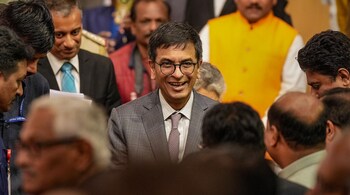
Former Chief Justice of India DY Chandrachud has defended his remark that he sat before the deity a day before the pronouncement of the verdict in theAyodhya Ram Janmbhoomi-Babri Masjid dispute and said that the Constitution does not require one to be an atheist to be an independent judge.
"If you look at social media and try and derive what was said by a judge, you will get the wrong answer. I make no bones of the fact that I am a man of faith, our Constitution does not require you to be an atheist to be an independent judge, and I value my faith, what my faith teaches me is the universality of religion and irrespective of who comes to my court, and that applies to all other judges in Supreme Court, you dispense equal and even-handed justice," Justice (retd) Chandrachud said is response to a question on BBC's HARDtalk.
In October last year, then CJI Chandrachud said that he had prayed to God for a resolution to the Ram Janmabhoomi dispute. "Very often, we have cases (to adjudicate) but don’t arrive at a solution. Something similar happened during the Ayodhya (Ram Janmabhoomi-Babri Masjid dispute), which was in front of me for three months. I sat before the deity and told him he needs to find a solution," Justice (retd) Chandrachud has then said. "Believe me, if you have faith, God will always find a way."
The historic Ayodhya verdict on November 9, 2019, was delivered by a five-judge Supreme Court bench led by then Chief Justice of India Ranjan Gogoi, which cleared the path for constructing the Ram temple. The judgment also allocated five acres of land in Ayodhya for building a mosque.
CJI Chandrachud was part of the bench that pronounced the landmark verdict.
Speaking to journalist Stephen Sackur on BBC's HARDtalk, Chandrachud said hat judges work in areas of conflict and every judge has a different way to approach that need for calm and equanimity.
"For me, time in meditation and prayer is very important, but my time in meditation and prayer teaches me to be even-handed to every religious group and community in the country," he said.
During the interview, the former CJI also delved into several crucial verdicts during his tenure as a Supreme Court judge and also addressed the criticisms around some of them. One such case was the SC's decision to dismiss a plea challenging the abrogation of Article 370 of the Constitution and stripping the state of its special status.
Defending the top court's verdict, Chandrachud said that Article 370 was always a transitional and temporary provision of the Constitution.
"Article 370 when it was introduced into the Constitution was part of a chapter which is titled Transitional Arrangements, it was later renamed Temporary and Transitional Arrangements. Therefore at the birth of the Constitution, the assumption was that what was transitional would have to fade away and merge with the overall context of the Constitution. Is 75 plus years too less for abrogating a transitional provision?" he wondered.
Discover the latest Business News, Sensex, and Nifty updates. Obtain Personal Finance insights, tax queries, and expert opinions on Moneycontrol or download the Moneycontrol App to stay updated!





