

The days following the victory at Shalateng marked a crucial shift in the 1947-48 Kashmir conflict. For nearly a week, the Valley had hung on a razor’s edge as the lashkar drove toward Srinagar, scattering the State Forces and overrunning towns in a surge of violence and chaos.
The Indian airlanding on 27 October and the counter-offensive at Shalateng checked the advance, shattered the invaders’ offensive capability and sent the surviving columns fleeing. But even after Shalateng, the war for the Valley was far from over. Between Srinagar and the frontier town of Uri lay a narrow corridor — the Srinagar-Baramulla-Uri road — the only artery linking the capital to the west. This corridor had to be secured, reopened and held. And at its heart stood the town of Pattan, where the tribal remnants regrouped for one final attempt to block the Indian advance.
The Battle of Pattan and the subsequent push to Baramulla and Uri formed the second great phase of India’s campaign in the Valley. These operations enabled the Indian Army to stabilise the front, retake lost ground and transform a desperate defence into a confident westward thrust. They were not just clean-up actions; they were decisive encounters that shaped the strategic geography of Kashmir for decades.
After Shalateng: Why the road to Uri became the next objective
The victory at Shalateng on 7 November 1947 had broken the spine of the tribal offensive. Armour from 7 Cavalry, combined with infantry assaults and deception, inflicted heavy losses and sent the lashkar streaming toward Baramulla in disarray. Indian commanders quickly realised that this fleeting collapse presented a rare operational window.
The Valley’s geography demanded urgency. The entire western sector hinged on a single road, running from Srinagar to Baramulla and then to Uri. Baramulla — once a prosperous trading town — had been devastated by days of looting. Beyond it lay the bottleneck terrain of the Jhelum gorge, where the road wound through forests and ridges toward Uri, Domel and the approaches to Muzaffarabad.
If India did not seize the initiative and press westward, the invaders would regroup. Pakistan-based irregulars, supported by ex-servicemen and local guides, could re-establish blocking positions, ambush supply lines and restore pressure on the Valley. A renewed lashkar threat could not be allowed to reform on the Shalateng–Baramulla axis.
Thus, stabilising Srinagar was only half the task. India had to drive the enemy out of the Valley entirely, seize key towns and push up to the natural defences of the Uri sector. The first obstacle in this new phase lay at Pattan.
Enemy regrouping at Pattan: A last organised stand
As the shattered lashkar streamed west from Shalateng, many fighters halted at Pattan, a small but strategically placed town lying roughly between Srinagar and Baramulla. Here, they found remnants of other tribal bands, stragglers from Baramulla, and ex-soldiers who had joined the offensive. In the chaos of retreat, a semblance of resistance began to take shape.
Reports reaching Indian commanders suggested that several hundred tribal fighters had entrenched themselves in and around Pattan. The town’s position on the highway, combined with surrounding orchards and villages, offered good defensive ground for delaying actions. If the lashkars could slow Indian armour and infantry, they believed reinforcements from Pakistan-side launch points might arrive, enabling a renewed challenge.
For the Indian Army, therefore, Pattan was not merely a waypoint — it was an enemy redoubt that had to be broken quickly. Any pause here would give the remnants time to harden their defences, receive fresh fighters and potentially block the crucial road.
Indian advance from Shalateng: Momentum as a weapon
Brig. LP Sen’s brigade — strengthened after Shalateng and building confidence after its first major victory — pushed forward on the morning after the battle. Units from 1 Sikh, 4 Kumaon, 1 Assam, and armour from 7 Cavalry spearheaded the advance. Their orders were clear: clear Pattan, secure the road, and push toward Baramulla.
Momentum was now India’s greatest weapon. The lashkar was disorganised, its morale shaken, its command structure in tatters. Striking quickly would prevent the enemy from consolidating. The Indian plan relied on speed, pressure and continuous thrust — the very opposite of the defensive posture forced upon them in late October.
The column moved cautiously but firmly, watching for ambushes in the orchards and roadside clusters of houses. The enemy’s previous pattern of attack — sudden bursts of fire from concealed positions — meant every bend in the road had to be treated as a potential trap.
The Battle of Pattan: Breaking the lashkar’s last line in the Valley
The engagement at Pattan unfolded over several hours and was characterised by short, sharp firefights rather than a single set-piece battle. As Indian forces approached the town, enemy riflemen opened fire from buildings and tree lines. Small tribal groups attempted to ambush the lead elements, hoping to replicate earlier successes against the State Forces.
However, the Indian troops now advancing were experienced regulars with armour and artillery backing. Their tactical discipline, combined with coordinated movement, quickly outmatched the defenders. The Dakotas that had brought them into the Valley only days earlier now served as a reminder that the Indian Army’s build-up was fast, organised and decisive.
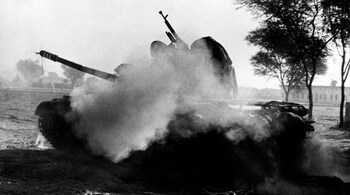
Infantry sections flanked enemy positions, while supporting armour from 7 Cavalry provided shock action. Tribal fighters, lightly armed and unprepared for sustained battle, could not hold ground. Attempts at roadblocks were swept aside, and resistance pockets crumbled one after another.
By the end of the engagement, Pattan was firmly in Indian hands. The lashkar’s attempt at a last stand within the Valley had failed.
The strategic significance was enormous: the road to Baramulla was now open.
Entering Baramulla: A town in ruins, a Valley reclaimed
Once Pattan fell, Indian forces struck quickly toward Baramulla. The town, which had been captured by the lashkar on 26 October, was now a devastated shell. Looting, arson and atrocities had ravaged the settlement. Buildings lay burned, markets gutted, and survivors emerged with harrowing accounts of the violence they had endured.
For Indian troops, the liberation of Baramulla was both emotionally charged and militarily essential. Clearing the enemy from the town allowed the Army to establish a firm administrative foothold and reassert civil control. Crucially, Baramulla’s capture removed the last significant settlement before the steep, narrow road to Uri.
The Valley, long under existential threat, had been reclaimed. Now, the war would shift into the mountainous gorges beyond.
The advance to Uri: Fighting through the Jhelum gorge
The road from Baramulla to Uri is one of the most difficult stretches in the region — a winding path carved between the Jhelum River and steep ridges. In 1947, this terrain created natural choke points ideal for ambushes.
Tribal fighters retreated into this rugged landscape, attempting to delay the Indian advance by sniping, blocking roads, felling trees and setting up makeshift defensive positions. Each bend in the road required caution. Armour was limited by terrain; infantry often had to lead, clearing obstacles and rooting out snipers.
Despite this, the Indian advance maintained tempo. The enemy was exhausted and disjointed; their lack of heavy weapons and poor coordination gave Indian units an advantage even in such difficult terrain. A combination of firepower, patrols and aggressive forward movement gradually pushed the lashkar back toward Uri.
Securing Uri: Establishing the new western front
When Indian forces finally reached Uri, they found another town scarred by occupation but relieved at the arrival of disciplined troops. Seizing Uri secured the gateway to the western approaches and placed Indian forces in control of the most defensible line in the Valley.
With Uri held, the Indian Army now had:
•control of the entire Srinagar–Baramulla–Uri axis
•a natural defensive line anchored in mountainous terrain
•the ability to launch future operations toward Domel and beyond
•assurance that the Valley was safe from sudden westward thrusts
It also placed the onus back on Pakistan-backed irregulars to fight in terrain favourable to defenders — a reversal of roles that would define the next phase of the war.
Strategic significance: How Pattan and Uri shaped the campaign
Capturing Pattan, Baramulla and Uri was not merely a geographical success; it transformed the strategic complexion of the conflict:
It eliminated the immediate threat to Srinagar.
No lashkar could now mass in the Valley undetected or unchallenged.
It restored the territorial integrity of the Kashmir Valley.
The tribal offensive, which had burst into the Valley with alarming speed, was now physically pushed out.
It created space for civil administration to stabilise.
Srinagar could now breathe, rebuild and reorganise without the fear of collapse.
It shifted the initiative permanently to India.
From November onward, Indian forces dictated the tempo, pushing into frontier regions and consolidating gains.
It established the Valley’s defensive shield that still endures.
The Uri sector remains one of India’s most fortified and strategically crucial zones on the Line of Control today.
Legacy: The operations that closed one campaign and opened another
While the airlanding at Srinagar and the victory at Shalateng saved the Valley, it was the battles of Pattan and the advance to Uri that secured it. These operations closed the first phase of the conflict and opened the door to the winter campaign that followed — including the defence of Poonch, the battles around Naushera, and the dramatic assault across Zoji La in 1948.
The men who advanced those miles westward did so through ruined towns, treacherous roads and unpredictable enemy resistance. Their steady push ensured that the story of Kashmir did not end in Srinagar’s fall but evolved into a protracted, determined defence that endures to this day.
Discover the latest Business News, Sensex, and Nifty updates. Obtain Personal Finance insights, tax queries, and expert opinions on Moneycontrol or download the Moneycontrol App to stay updated!





