

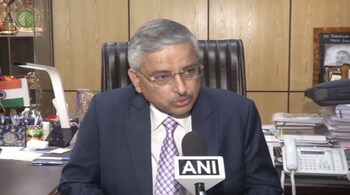
The Covid vaccines in use in India are providing cover for the original Wuhan strain but if the need for another booster dose is felt as new variants emerge, it should be able to provide protection against all circulating as well as future strains, according to former AIIMS director Randeep Guleria.
During an interview to PTI, he stressed on the need for two data sets - first to ascertain whether the degree of immunity is waning and secondly if the vaccines need to be tweaked when asked if it is time for another precaution dose almost a year after the first one amid the recent uptick in Covid cases.
"Currently the vaccines that we have in India are covering for what was originally the Wuhan strain. After that we had so many variants. And therefore if we have to have a new vaccine, it should provide cover for the circulating strains like we do for influenza," he said.
The renowned pulmonologist, who was part of the national Covid task force, highlighted the need for research on developing vaccines which will cover not only the current circulating strains but also from the emerging variants.
His comments come at a time when the country is witnessing a rise in Covid cases. Prime Minister Narendra Modi held a high-level meeting on Wednesday to review the Covid situation and also took stock of the public health preparedness.
Terming the new XBB.1.16 variant as a "new kid on the block" that could be driving the recent rise, Dr Guleria said new variants will keep coming as the virus keeps on mutating over the time but "as long as they don't lead to severe illness, hospitalisation and deaths, it is alright because it helps in giving some degree of immunity to the population if they have mild illness".
On whether XBB 1.16 has the potential to drive a fresh wave of cases or lead to significant rise in cases in the next few days, he said, "Even if we see a surge, there is no need to worry, as long it does not translate into hospitalization and deaths." Asked whether Covid is now an endemic, he said, "In my opinion, Covid has more or less become endemic. We have a good amount of immunity. Cases will continue and it's going to be here. We will continue to have some waves of cases coming and going but it is not going to cause the kind of waves we saw in the last two years. We will have to learn to live with it." On the surge in cases of H3N2, which is a subtype of seasonal influenza virus along with rise in Covid cases, Dr Guleria said H3N2 is part of the influenza family.
The influenza virus has been around for quite a long time.
"We had the H1N1 pandemic in 1918 also. Therefore this virus has been there but it keeps changing and the current circulating strain is H3N2," he said.
It behaves very similarly to flu-like syndrome and one gets fever, sore throat, body aches, and a runny nose along with a cough that can be persistent and troublesome.
And some people in the high risk group can also have pneumonia, which can be more serious and need hospital admissions, he said.
Everyone who comes in contact with an infected patient is at risk of getting influenza, he said.
"So we all will get influenza on and off but then there is a group which is at risk of getting severe infection and which may need hospitalisation and sometimes even cause death." Those who are elderly and have co-morbidities are prone to getting more severe infection, he said.
On the implications of H3N2 infections on those who were infected by Covid in the past and on the health scenario in general, Dr Guleria said it should not be a problem for those who had Covid because they have now recovered.
"But we have a small group of people who had Covid-19 which caused lung damage and they had lung fibrosis. So their lungs were already compromised to some extent and in some the immunity is also low. So in this small group of people who had Covid and have residual effects of Covid, they again fall in the high risk category and can have more severe infection," he said.
Coming to the implications of outbreaks of H3N2 as far as the health scenario is concerned, he said, "India is already having a huge burden as far as health is concerned, in terms of hospitals, ICUs, beds and then we have an outbreak where there is a surge in cases." Dr Guleria, who headed AIIMS-Delhi at the peak of the pandemic, highlighted the need for developing a strategy for ensuring day-to-day management of other diseases are not disrupted while managing an environment.
"One of the downside or the collateral damage we saw in Covid was that a lot of patients suffering from other diseases such as cancer and tuberculosis suffered a lot as the focus was only on managing Covid-19." "We were not able to manage these illnesses amid outbreak. Patients were not diagnosed at the right time. The treatment was not being provided on time. So we develop a strategy where we can manage the outbreak but at the same time our health systems, the policies and programmes continue and do not suffer," he said.
Besides, Dr Guleria stressed on being prepared and deploy active surveillance. "So that if there is a surge in number of cases, be it of influenza or Covid or any other new viral disease, we should be able to pick it up early and say that there is an outbreak that is happening," he said.
He also underlined the need for good laboratory networks so that samples can be tested in case of an outbreak and surveillance system which is hospital and clinical based. If there is a cluster of cases in a particular place, and a doctor or a healthcare worker notices a large of people coming with peculiar types of symptoms, he or she should immediately report that this may be an outbreak that is developing so that investigation can be done, it can be managed and prevented from spreading, Dr Guleria said.
Then there is sentinel surveillance wherein hospital admissions are looked at to see if there are more hospital admissions and deaths happening amid rise in cases.
For both Covid and influenza, Dr Guleria said the precautions in terms of Covid- appropriate behaviour will protect against all these viruses. "If you have a definite diagnosis, for influenza there is a definite antiviral drug that is available which we used a lot even during the H1N1 pandemic... it is available as oseltamivir (Tamiflu) which is useful against influenza virus. So that drug can be given to a high risk group in case of a definite diagnosis besides symptomatic treatment," he elaborated.
"Finally if you are in the high risk group then you have a vaccine which is there both for influenza and Covid," he said.
Asked if were better prepared now three years after the pandemic, Dr Guleria said "We are better prepared than we were in the past because we have a learnt a lot from Covid. The challenge of course is that we keep implementing what we have learnt as we move forward and the memory of Covid fades." Noting the country has seen lot of outbreaks in the last 23 years such as swine flue or H1N1, Covid, Nipah virus and monkeypox, he said, "We should learn from what we have seen in the last two decades that we need to prepared. The preparedness has to be in terms of good surveillance, an action plan on how do we upscale our health facilities both in terms of human resources and infrastructure."
Discover the latest Business News, Sensex, and Nifty updates. Obtain Personal Finance insights, tax queries, and expert opinions on Moneycontrol or download the Moneycontrol App to stay updated!





