

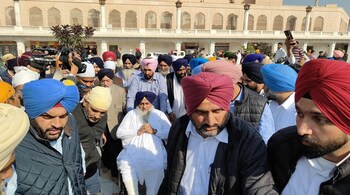
Pronouncing 'tankhah' (religious punishment) for Sukhbir Singh Badal and other leaders for the "mistakes" committed by the Shiromani Akali Dal government in Punjab from 2007 to 2017, the Sikh clergy at the Akal Takht on Monday directed the senior Akali leader to perform as a 'sewadar', and wash dishes and clean shoes at the Golden Temple in Amritsar.
Pronouncing the order from the 'faseel' (podium) of the Akal Takht in Amritsar, Jathedar of the highest temporal seat for Sikhs, Giani Raghbir Singh, also announced to withdraw the title of 'Fakhre-e-Qaum' bestowed upon former chief minister late Parkash Singh Badal, father of Sukhbir Badal.
The scathing verdict came days after Sukhbir Singh Badal had tendered his resignation as president of the Shiromani Akali Dal after he was declared ‘Tankhaiya’, or guilty of religious misconduct.
On Tuesday morning, Badal was seen sitting in a wheelchair by the gate with a plaque around his neck and spear in his hand at the Golden Temple in Amritsar. He admitted his mistakes and tendered an unconditional apology to the Akal Takht.
‘Tankhaiya’ – What it means?
According to Sikh religious doctrine, a person who has been found guilty of religious wrongdoing by the Akal Takht, the Sikhs' highest temporal seat, is referred to as a ‘Tankhaiya’. If someone violates the Sikh Rehat Maryada (code of conduct) or participates in anti-Panthic activities, the Jathedar, the top priest of the Akal Takht, has the power to proclaim them a ‘Tankhaiya’.
Once declared a ‘Tankhaiya’, the person is required to tender a public apology for his acts in front of the Sikh Sangat (congregation) at the Akal Takht. The Jathedar, in consultation with the five high priests, then determines the appropriate punishment.
Although punishments can take many forms, they frequently entail community duty, such as washing dishes in a langar hall or cleaning shoes at a gurdwara. Upon fulfilling the prescribed penalty, the person is released from Tankhaiya status.
Upholding Sikh religious values and discipline within the community is accomplished through the idea of Tankhaiya. It emphasises the significance of abiding by the Sikh code of conduct and the repercussions of doing otherwise.
'Tankhaiya' - Historical origins
Although it is difficult to pinpoint the exact origins of ‘Tankhaiya’, the practice can be traced back to the time of Sikh Gurus. The Gurus placed a strong emphasis on moral behaviour and spiritual purity, and they set up procedures to deal with transgressions of these ideals.
Throughout history, several notable figures have been declared Tankhaiya. One of the most famous examples is Maharaja Ranjit Singh, the founder of the Sikh Empire. In 1802, he was declared Tankhaiya by the Akal Takht for marrying a Muslim dancer, Moran Sarkar. However, he was later forgiven after publicly apologising and undergoing a purification ceremony.
Similarly, former Union Minister Buta Singh was also declared ‘Tankhaiya’ by the Akal Takht in 1984 for his alleged role in Operation Blue Star. The operation involved the Indian Army attacking the Harmandir Sahib complex in Amritsar, leading to significant loss of life.
Buta Singh was excommunicated from the Sikh community and faced severe criticism for his involvement in the operation. He later sought forgiveness from the Akal Takht after 10 years and was reportedly relieved of the Tankhaiya status.
In the recent case of Sukhbir Singh Badal, he and rebel leader Sukhdev Singh Dhindsa have been asked to sit outside the Golden Temple wearing the dress of 'sewadar' and holding a spear for one hour each for two days.
They will also wear small boards around their necks acknowledging their "misdeeds", and perform the service of 'sewadar' at Takht Kesgarh Sahib, Takht Damdama Sahib, Darbar Sahib at Muktsar and Fatehgarh Sahib for two days each.
Both Sukhbir Badal and Sukhdev Dhindsa have been asked to clean utensils and shoes of devotees at the Golden Temple for one hour each, besides listening to 'kirtan'.
Before the pronouncement of the edict, Sukhbir Badal admitted the mistakes, including pardoning Dera Sacha Sauda chief Gurmeet Ram Rahim Singh in a 2007 blasphemy case during the SAD rule in Punjab.
Within the Sikh community, the announcement of Tankhaiya frequently provokes discussion and controversy. Critics contend that it is a type of religious policing that can be employed to settle political scores or quell opposition. Supporters, however, insist that it is an essential instrument for upholding the integrity of Sikhism and guaranteeing that those who transgress the Sikh code of conduct face consequences.
Discover the latest Business News, Sensex, and Nifty updates. Obtain Personal Finance insights, tax queries, and expert opinions on Moneycontrol or download the Moneycontrol App to stay updated!





