

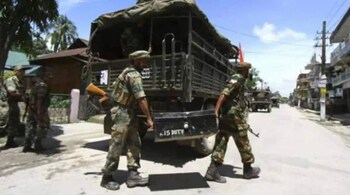
The AFSPA, under which a geographical location is declared as disturbed area to facilitate operations of the armed forces, will now be applicable fully only in 31 districts and partially in 12 districts of four states in the Northeast Assam, Nagaland, Manipur and Arunachal Pradesh. These four states together comprise 90 districts.
The Armed Forces (Special Powers) Act, 1958, was completely withdrawn in Meghalaya in 2018, Tripura in 2015 and Mizoram in the 1980s. The announcement for the reduction of the 'disturbed area' imposed under the AFSPA in the Northeast was made by Union Home Minister Amit Shah on Thursday.
The move apparently came following the recommendations of a high-level committee constituted to examine the possibility of lifting the law after the killing of 14 civilians by the army in Nagaland's Mon district in December last year in a case of "mistaken identity".
The AFSPA empowers security forces to conduct operations and arrest anyone without any prior warrant besides giving immunity from arrest and prosecution to the security forces if they shoot someone dead.
In two separate notifications issued late on Thursday, the Union Home Ministry said Dimapur, Niuland, Chumoukedima, Mon, Kiphire, Noklak, Phek, Peren and Zunheboto districts in Nagaland and the areas falling within the jurisdiction of police stations of Khuzama, Kohima North, Kohima South, Zubza and Kezocha in Kohima district, Mangkolemba, Mokokchung-I, Longtho, Tuli, Longchem and Anaki 'C' in Mokokchung district, Yanglok in Longleng district and Bhandari, Champang, Ralan and Sungro in Wokha district were declared as 'disturbed area' under the AFSPA for six months with effect from April 1.
Nagaland has 15 districts. The 'disturbed area' notification has been in force in the whole of Nagaland from 1995.
For Arunachal Pradesh, the home ministry said Tirap, Changlang and Longing districts, and the areas falling within the jurisdiction of Namsai and Mahadevour police stations in Namsai district bordering Assam have been declared 'disturbed areas' under AFSPA for six months from April 1.
There are 26 districts in Arunachal Pradesh. The AFSPA has been in force only in the said districts of Arunachal Pradesh for the last several years and other districts of the state are by and large free from any kind of insurgency and hence not imposed.
While for Assam, a notification was issued by the state government, which said that 'disturbed area' under the AFSPA has been withdrawn completely from 23 districts and one sub-division of the state's 33 districts -- from Dhemaji, Lakhimpur, Majuli, Biswanath, Sonitpur, Nagaon, Hojai, Morigaon, Kamrup Metro, Darrang, Kamrup, Nalbari, Barpeta, Goalpara, Bongaigaon, Dhubri, South-Salmara Mancachar, Kokrajhar, Chirang, Baka, Udalguri, Karimganj, Hailakandi and Cachar districts, except Lakhimpur sub-division. The 'disturbed area' under the AFSPA will be applicable in nine districts and one sub-division of Assam.
They are Tinsukia, Dibrugarh, Charaideo, Sivasagar, Jorhat, Golaghat, Karbi Anglong, West Karbi Anglong, Dima Hasao districts and Lakhipur sub-division of Cachar district. The 'disturbed area' notification is in force in entire Assam since 1990.
The Manipur government has also issued a similar notification where it said that the 'disturbed area' tag will no longer be applicable in seven police station areas of Imphal West district, four police station areas under Imphal East district and one police station area each in the districts of Thoubal, Bishnupur, Kakching and Jiribam. There are 16 districts in Manipur.
The police stations are Lamphel, City, Singjamei, Sekmai, Lamsang and Patsoi (all Imphal West district), Porompat, Heingang, Lamlai and Irilbung (all in Imphal East district), Thoubal (Thoubal district), Bishnupur, (Bishnupur district), Kakching (Kakching district) and Jiribam (Jiribam district). The 'disturbed area' declaration is in force in entire Manipur, except Imphal municipality area, since 2004.
There have been protests and demands for the complete withdrawal of the law from the Northeast as well as Jammu and Kashmir for its "draconian" provisions. Manipuri activist Irom Chanu Sharmila fought against the law by remaining on hunger strike for 16 years, before ending it on August 9, 2016.
Discover the latest Business News, Sensex, and Nifty updates. Obtain Personal Finance insights, tax queries, and expert opinions on Moneycontrol or download the Moneycontrol App to stay updated!





