

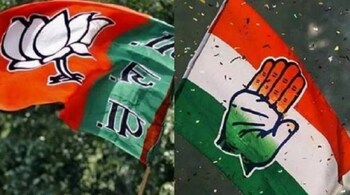
The Bharatiya Janata Party’s appointment of Bihar minister Nitin Nabin as its national working president has once again put the spotlight on how India’s two biggest national parties rotate their top leadership.
Nabin’s elevation, widely seen as a preparatory step ahead of a full-time presidential transition after JP Nadda, adds another name to a long list of BJP presidents since the party’s formation in 1980. Over four decades, the BJP has cycled through multiple leaders at the top, frequently reshuffling organisational command ahead of key political moments.
BJP leadership churn: 12 presidents in 45 years
Since its inception, the BJP has had 12 national presidents, several of whom have served more than once. The list includes Atal Bihari Vajpayee, Lal Krishna Advani, Murli Manohar Joshi, Kushabhau Thakre, Bangaru Laxman, K Jana Krishnamurthy, M Venkaiah Naidu, Rajnath Singh, Nitin Gadkari, Amit Shah and Jagat Prakash Nadda.
Advani remains the longest-serving BJP president, having held the post across three different stints. Amit Shah led the party during its most electorally dominant phase between 2014 and 2020, while Nadda’s term, which began in 2020, was extended through the 2024 Lok Sabha elections.
With Nitin Nabin stepping in as working president, the party is expected to soon initiate the long-pending formal process of electing its next national president.
Congress at the top: fewer presidents, longer tenures
In contrast, the Indian National Congress, founded in 1885, has seen far fewer changes at the top over comparable periods. Since India’s Independence, and particularly after 1980, the party’s presidency has often remained concentrated within the Nehru-Gandhi family for long stretches.
Notable Congress presidents over the decades include Pattabhi Sitaramayya (1948–49), Jawaharlal Nehru (1951–54), Indira Gandhi (1959; 1978–83), Rajiv Gandhi (1985–91), and P V Narasimha Rao (1992–94).
The pattern of long tenures became most pronounced under Sonia Gandhi, who served as Congress president from 1998 to 2017 and again from 2019 to 2022, making her the longest-serving president in the party’s history. Rahul Gandhi succeeded her briefly between 2017 and 2019.
In 2022, Mallikarjun Kharge broke a 24-year trend by becoming the first non-Gandhi Congress president since the late 1990s. He defeated Shashi Tharoor in the party’s internal election and continues to lead the party.
Beyond BJP and Congress: leadership stays in the family
The leadership contrast becomes sharper when viewed across the wider opposition landscape, where party control has largely remained within founding families.
The Samajwadi Party has been led by Akhilesh Yadav since 2017, after his father Mulayam Singh Yadav headed the party from its founding in 1992. Mamata Banerjee has remained at the helm of the Trinamool Congress since founding it in 1998. Mayawati continues to lead the BSP, while MK Stalin succeeded his father M Karunanidhi as DMK president in 2018. The Shiv Sena split saw Uddhav Thackeray retain control of his faction, while the Aam Aadmi Party has been led by Arvind Kejriwal since its formation.
Earlier this year, the Rashtriya Janata Dal elevated Tejashwi Yadav to a status equivalent to party president, granting him decision-making authority over key party matters and reinforcing dynastic continuity.
Discover the latest Business News, Sensex, and Nifty updates. Obtain Personal Finance insights, tax queries, and expert opinions on Moneycontrol or download the Moneycontrol App to stay updated!





