

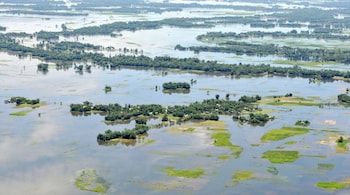
Every day of the three months of monsoon this year, between June and August, heavy to very heavy and extremely heavy rainfall was recorded in some parts of India. All regions were affected. In Assam, people lost their lives, homes and sources of livelihoods as large parts of the state were submerged. The floods were so frequent it forced many people to permanently move out of their homes.
An extreme weather event is one that is “rare at a particular place and time of year”, according to the Intergovernmental Panel on Climate Change (IPCC). Unfortunately, they have become increasingly common. According to a report by the Centre for Science and Environment (CSE), published this month, India witnessed 241 days of extreme weather events in 2022. Painting a grim picture, it states that the country has seen a disaster nearly every day in the first nine months — from heat and cold waves, cyclones, lightning to heavy rain, floods and landslides. These disasters have claimed 2,755 lives, affected 1.8 million hectares of crop area, destroyed over 416,667 houses and killed close to 70,000 livestock.
CSE director general Sunita Narain, while releasing the report, said, “What the country has witnessed so far in 2022 is the new abnormal in a warming world. There is a clear spike in frequency and intensity of extreme events that we are seeing.”
Hot stuff
It’s not like extreme weather events have never happened before. This drastic change, however, is due to the rise in greenhouse gas emissions in the Earth’s atmosphere in the past 150 years. It’s making the planet hotter. Warmer air holds more water vapour. When combined with warmer ocean temperatures, it leads to increased precipitation, which can cause frequent cyclones, flooding and landslides.
Extreme heat can also lead to severe and prolonged heat waves and droughts, and can make forest fires worse. Warmer land temperatures result in reduced snowpack and more snowmelt. As Earth continues to heat up owing to global warming, the frequency, intensity, and impacts of extreme weather events are only expected to worsen. It will affect everyone, living everywhere.
The summer of 2022 has already given us a sneak-peek into our collective future. South Asia baked under a deadly heatwave, and India experienced its hottest March ever. Floods washed away entire cities in Pakistan. France logged its hottest May on record, while the UK declared its first-ever national emergency red heat alert as temperatures rose above 40 degrees Celsius. Nearly half of Europe had warning conditions declared for what was called the continent’s worst drought in at least 500 years. The repercussions of this summer were felt in the Arctic, where ice melt reached yet another record high.
Deep impact
India’s geography and population makes it particularly vulnerable to the effects of extreme weather events. They claim lives and impact livelihoods. According to a World Bank estimate, nearly half of India’s population (approximately 600 million people) could have lower standards of living due to climate-change impacts.
They also affect food production and cause shortages of vital resources. Rising temperatures and erratic rainfall patterns deeply affect the farming sector. A Government of India estimate, according to the CSE report, indicates that extreme temperature shocks reduce average farmer incomes by 4.3 per cent and 4.1 per cent during kharif and rabi seasons, respectively, while extreme rainfall shocks reduce average incomes by 13.7 per cent and 5.5 per cent.
Cumulatively, they have a significant impact on the economy. In 2021 alone, India suffered an income loss of $159 billion (now around Rs 13 lakh crore), almost 5.4 per cent of its gross domestic product, owing to extreme heat. “Exposure to higher temperatures and the resulting reduction of working hours led to substantial income losses in services, manufacturing, agriculture, and construction,” notes the Climate Transparency Report 2022. If the warming continues unabated, then by 2100, the country’s average income could be 92 per cent lower than what it would have been without climate change.
What further complicates matters is that 80 per cent of India's population live in regions highly vulnerable to extreme disasters such as severe flooding or heatwaves. It means they are exposed to its impacts, and have to constantly adapt to survive.
One world
To mitigate the risks of climate change, India has set its own ambitious green pledges and has a net-zero goal. At COP26, Prime Minister Narendra Modi announced his intention to achieve them by 2070. The government is also pushing for the adoption of a sustainable life at the individual and community level via Mission Life.
But it can’t get there by itself. The country needs climate finance to help its people adapt and to build resilience among its communities. It also needs financial assistance for climate change-induced loss and damages. It must also boost investment in renewables. Which is why at COP27, India is pushing the international community to deliver on its $100 billion-a-year pledge.
There is no doubt that 2022 will be one for the record books. More climate action is needed immediately, globally and at scale to ensure this record isn’t broken soon.
Discover the latest Business News, Sensex, and Nifty updates. Obtain Personal Finance insights, tax queries, and expert opinions on Moneycontrol or download the Moneycontrol App to stay updated!





