

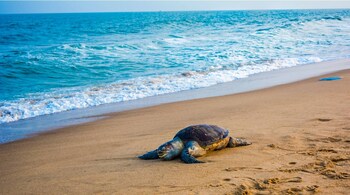
Every year, a mass nesting event sees thousands of female Olive Ridley turtles come together on the same beach to lay their eggs. It is referred to as arribada (arrival). Millions of tourists witness this phenomenon on Odisha’s Rushikulya beach. But the small sea turtle is in trouble. It is fighting a losing battle with climate change. Global warming and extreme weather events, including frequent cyclones, intense flooding and increase in tidal surges, are leading to a decline in numbers of this already vulnerable species.
Climate change is an unprecedented environmental crisis. It affects everyone on the planet — people, species and even ecosystems. Oceans cover around 70 per cent of the surface of the planet, and are deeply impacted by rising global temperatures. From ocean warming and acidification to biodiversity loss and mass migration, the effects can be extreme and far reaching.
Several coastal communities are already feeling the impact. Kiribati, for example, is expected to be the first country that rising sea levels will swallow up. Also, being a global climate regulator, the further deterioration of ocean health will only exacerbate the ffects of climate change.
At the same time, oceans have a vast potential to store carbon, and coastal waters are, for example, a prime location for renewable energy projects, and ecosystem protection and restoration. Its why momentum is building for COP27 to blue the Paris Agreement.,
Cause and effect
We know by now that the overwhelming cause of human-induced climate change is the growing concentration of greenhouse gases in the Earth’s atmosphere. But the destruction and removal of carbon sinks also has a significant role to play.
As the largest heat sink on the planet, the ocean has absorbed more than 90 per cent of the excess heat trapped by the rising concentration of greenhouse gases. This has caused significant ocean warming.
Carbon sinks such as terrestrial and marine vegetation are crucial too for regulating CO2 levels through photosynthesis. They also trap carbon. Human activities such as extensive agriculture, overfishing, dredging and oil and gas extraction take a toll on these environments, leading to their removal or destruction. According to the Blue Carbon Initiative, in the last 50 years alone, between 30-50 per cent of mangroves have been lost globally and they continue to be lost at a rate of 2 per cent each year. Tidal and freshwater marshes are being lost at a rate of 1-2 per cent per year, while seagrass meadows are seeing an annual global loss of 1.5 per cent.
This means less CO2 is being absorbed from the atmosphere. That’s not all. When these carbon sinks are removed or damaged, they also release stored carbon back into the atmosphere.
“In addition, chemicals, oil spills, overfishing, unsustainable tourism, urban development, sewage pollution and plastic pollution create havoc and lead to the decline of delicate ecosystems that can help modulate the global climate and mitigate climate change,” says Ajai Singh, an independent marine biologist.
Impact on India
India’s 7,517 km-long coastline is home to nine coastal states and 1,382 islands, making the ocean critical to its future. It also makes our country especially vulnerable to the effects of ocean-driven climate change.
The Indian Ocean, for example, has a significant role to play in controlling and modulating the regional and seasonal climate. As per scientists at the Indian Institute of Tropical Meteorology (IITM), Pune, 66 marine heatwave events have occurred in the western Indian Ocean, and 94 in the northern Bay of Bengal between 1982 and 2018. Once rare, these heat-waves are now annual affairs. The effect: a reduction of monsoonal rains over central India and intense cyclones.
Extreme weather events such as heavy rainfall and cyclones are also contributing to plastic pollution by transporting litter into the sea. A new review study has found that around 0.1 million tonnes of debris, including plastics, were deposited along Chennai’s coast in the aftermath of the 2015 floods.
There’s more. Rising sea levels are expected to have a major impact on India’s coastal cities with a NASA study revealing that cities such as Mumbai, Kochi, Mangaluru, Chennai, Visakhapatnam, and Thiruvananthapuram will be underwater by 2050.
What can be done?
To reverse the ocean and climate crisis, we need an urgent and drastic reduction in greenhouse gas emissions, especially carbon dioxide. That’s where net-zero comes in.
Earth’s temperature has risen by 0.08° Celsius per decade since 1880. In time, it will result in a catastrophe that will impact all life on the planet. To prevent it, the Paris Agreement was adopted by 196 countries in December 2015. It established that the world must limit global temperature rises to well below 2 degrees Celsius in this century, and preferably to no further than 1.5 degrees Celsius. To achieve that, countries need to be net zero, which means no country will put any more man-made carbon into the atmosphere than it removes from it.
Reducing carbon emissions alone will not be enough. “Carbon must also be removed from the atmosphere. Rewilding, restoring and protecting natural carbon sinks such as kelp forests, salt marshes, mangroves and seagrass meadows can be an effective way to do so,” says Tejas Jha, an independent marine biologist, who has been working towards the conservation of mangroves in West Bengal for over a decade. Mangroves and coastal wetlands, for example, annually sequester carbon at a rate ten times greater than mature tropical forests. They also store three to five times more carbon per equivalent area than tropical forests. It’s also why mangroves have been identified as an important solution to climate change at COP27.
Think about it. Between 1992-2018, global oceans have taken up 67 billion tonnes of CO2. Which is why it is vital that the ocean’s voice is heard when discussing climate action at COP27.
Discover the latest Business News, Sensex, and Nifty updates. Obtain Personal Finance insights, tax queries, and expert opinions on Moneycontrol or download the Moneycontrol App to stay updated!





