

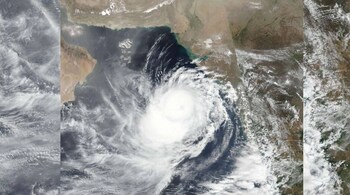
Cyclone Biparjoy brewed in the Arabian Sea for more than a week. Prior to its landfall, the Indian Meteorological Department (IMD) warned of tidal waves as high as six metres, wind speeds that touched 150 kmph and extensive damage in Gujarat.
It is the third cyclone to make its way to the state in June since 1965. “Based on data from 1965 to 2022 for the month of June, 13 cyclones developed over the Arabian Sea. Of these, two crossed the Gujarat coast, one Maharashtra, one Pakistan coast, three Oman-Yemen coasts and six weakened over the sea,” the IMD said.
The lifespan of Biparjoy, which developed over the southeast Arabian Sea at 5.30 am on June 6, was a long one. According to meteorologists, it underwent rapid intensification in the initial days and sustained its strength due to an unusually warm Arabian Sea.
Biparjoy, which means disaster in Bangla, certainly lived up to its name. The powerful storm is the latest example of how high sea surface temperatures are making cyclones in the Arabian Sea more intense and recurrent. Cyclone Vayu (2019), Cyclone Nisarga (2020) and Cyclone Tauktae (2021), too occurred off the west coast in recent years.
But why is this happening, and what does it mean for India? Let’s find out.
Fact of the matter
The Bay of Bengal in the east and the Arabian Sea in the west make up the north Indian Ocean. It accounts for 6 per cent of all global tropical cyclones annually. According to research by the Indian Institute of Science Education and Research (IISER), an average of 50.5 tropical cyclones have formed per decade over the region during a 130-year study period, based on data from the IMD.
Although cyclones in the Bay of Bengal have a history of causing widespread damage, researchers have observed a decline in their number in recent years. As per a 2021 paper published in Climate Dynamics, there’s been an 8 per cent decrease in the frequency of cyclonic storms in the Bay of Bengal from 2001 to 2019.
In contrast, cyclonic storms in the Arabian Sea have become more frequent and severe in recent years. According to a study by the Indian Institute of Tropical Meteorology, their frequency has increased by 52 per cent in the last four decades. Their duration has also increased, with very severe cyclones lasting 260 per cent longer than they did four decades ago.
Show cause
“Global warming is the main culprit. It is causing surface sea temperatures to rise and causing a change in the Arabian Sea’s character. This is leading to more severe cyclones forming and sustaining over it,” says Abhay Karnik, an independent climatologist.
Sea surface temperatures in the Arabian Sea have increased by 1.2–1.4°C in recent decades, as per a 2022 paper in Elsevier's Earth Science Reviews. This rapid warming is increasing the heat flux from the ocean to the atmosphere and fuelling the rapid intensification of cyclones in the region.
Another factor that influences cyclones is vertical shear, which refers to how strongly the winds can change from the surface to the top of the atmosphere. If vertical shear is strong, it can prevent cyclones from forming or growing. However, weak vertical shear promotes the formation of cyclones.
The global trend over the past few decades has been a decrease in the number of tropical cyclones forming worldwide. However, there has been an increase in the number of cyclones forming in certain regions, such as the Arabian Sea. Researchers attribute this trend to a combination of global warming and weak vertical shear.
Brace for impact
storm made landfall in coastal areas of Gujarat on Thursday The change in the Arabian Sea’s character also means India’s west coast is now more vulnerable, as cyclones can cause widespread damage and loss of life. Another concern is its impact on the southwest monsoon, which the country relies upon heavily for its drinking water and agricultural needs.
Incidentally, a weak monsoon onset often leads to the formation of a cyclone. This is because the strong southwest monsoon current usually blows in two directions: southwest in the lower levels and northeast in the upper levels. This prevents the cyclone from rising vertically and hinders its formation.
The 2023 monsoon season, for instance, was off to a weak start. The exact reason for the weak onset is not clear, but it could be due to El Niño, the warm phase of a recurring climate pattern across the tropical Pacific. Indian Ocean warming due to climate change could also be playing a role. It may have allowed Cyclone Biparjoy to form.
Once a cyclone forms, it can further influence the monsoon. The direction of the cyclone's track can either enhance or hamper it. If the cyclone moves away from the mainland, it can drive away the moisture that is needed for the monsoon. However, if the cyclone moves towards the coast, it can enhance the monsoon by bringing in moisture and rainfall.
For example, Cyclone Nisarga helped the progression of the monsoon in 2020 because it moved towards the subcontinent. Biparjoy, on the other hand, delayed its onset and impacted its intensity in Kerala. But once it had formed, it also helped the monsoon in advancing over southern parts of the peninsula by increasing the cross-equatorial flow over the Arabian Sea. By June 14, it had completely detached from the monsoonal flow. “We do not expect any large-scale impact either on the monsoon advance or its performance,” said IMD chief Mrutyunjay Mohapatra.
One thing is clear: changes in ocean-cyclone interactions have emerged in recent decades in response to the warming of the Indian Ocean. “Climate projections also indicate warming at a rapid pace and an increase in the intensity of cyclones in the basin. This makes monitoring and forecasting the rapid intensification of cyclones crucial, especially for India’s coastal communities,” says Karnik.
Discover the latest Business News, Sensex, and Nifty updates. Obtain Personal Finance insights, tax queries, and expert opinions on Moneycontrol or download the Moneycontrol App to stay updated!





