

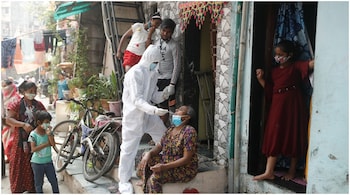
As India battles the surging COVID-19 cases in its deadly second wave, laboratories are finding it challenging to consistently test samples. Against this backdrop, the ICMR has now has issued fresh guidelines for COVID-19 testing regarding RT-PCR and RAT tests.
According to the new guidelines issued, an "RT-PCR test must not be repeated in any individual who has tested positive once either by RAT or RT-PCR". Moreover, recovered individuals who get discharged from hospitals will not require another round of testing, the ICMR said.
Further, the ICMR also seeks to remove mandatory negative RT-PCR test reports for healthy individuals undertaking inter-state domestic travel.
"The need for RT-PCR test in healthy individuals undertaking inter-state domestic travel may be completely removed to reduce the load on laboratories," the guidelines read.
However, it added that non-essential travel or inter-state travel of symptomatic individuals should be avoided. Whereas all asymptomatic individuals undertaking essential travel must follow COVID-19 appropriate behaviour, the guidelines added.
As of May 4, the overall nationwide test positivity rate has gone up above 20 percent in the past month and India currently has 2,506 molecular testing laboratories, including RT-PCR, TrueNat, CBNAAT, and other platforms,
India on May 4 reported a slight dip in single-day COVID-19 cases as it registered 3,57,229 new infections in the last 24 hours. The daily spike had reached its peak of over four lakh cases on May 1 but came down to 3,68,147 cases on May 3. With this, India's overall COVID-19 caseload has surged to 2,02,82,833.
Discover the latest Business News, Sensex, and Nifty updates. Obtain Personal Finance insights, tax queries, and expert opinions on Moneycontrol or download the Moneycontrol App to stay updated!





