

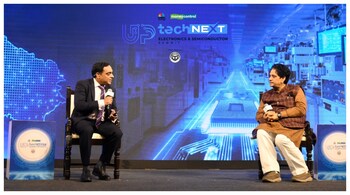
The CNBC-TV18 & Moneycontrol UP Tech Next Electronics & Semiconductor Summit revealed a state government that is not just preparing for the semiconductor era, but actively shaping it. Through focused policy measures and coordinated planning, Uttar Pradesh is positioning itself as a critical engine in India’s Viksit Bharat 2047 vision, especially in electronics and chip manufacturing.
Setting the tone, Sunil Kumar Sharma, Minister for Information Technology & Electronics, Uttar Pradesh, shared how foundational work is already in motion. The state has earmarked significant land parcels to host upcoming semiconductor facilities, supported by central government funding through the National Semiconductor Mission. With the first facility targeted to go live by 2027–28, he stressed that UP’s intention is not symbolic participation but meaningful capacity-building. The emergence of a stronger investor ecosystem, coupled with state incentives, reflects this seriousness. For him, reducing foreign dependency and creating skilled employment sit at the heart of this policy shift.
Adding a strategic economic lens, Awanish Kumar Awasthy, Chief Advisor of Chief Minister Yogi Adityanath, highlighted that semiconductor manufacturing is now central to UP’s ambition of becoming a $1 trillion economy. As domestic chip consumption soars, he argued that self-reliance is no longer aspirational; it is an economic necessity. He also pointed to growing revenues as early proof of policy effectiveness, while calling for improved inter-departmental coordination and greater public–private collaboration to accelerate execution on the ground.
Representing the national viewpoint, Dr. Sushil Pal, IAS, Joint Secretary, MeitY, explained how Semicon 2.0 marks India’s shift from policy design to policy delivery. Over the next 3–4 years, the priority is to strengthen fabs, elevate node capabilities, and build a complete semiconductor value chain, not isolated facilities.
Importantly, UP’s semiconductor vision extends beyond industry. Dinesh Pratap Singh, MoS (Independent Charge), Horticulture, Agricultural Marketing, Agricultural Foreign Trade & Agricultural Exports, Uttar Pradesh, showcased how chip-enabled agri-tech can transform farm productivity and traceability, while JPS Rathore, MoS (Independent Charge), Cooperative, Uttar Pradesh, highlighted opportunities for cooperatives and public services through digital and semiconductor-led innovation.
Culminating the day’s discussions, a multi-stakeholder panel echoed a shared belief: with a skilled workforce, export-focused policies, and thriving manufacturing clusters, Uttar Pradesh is steadily carving its place as a major semiconductor hub in India’s next growth chapter.
Explore the full dialogue between policymakers, industry leaders, and innovators from the summit here: https://www.moneycontrol.com/msite/up-technext-summit
Discover the latest Business News, Sensex, and Nifty updates. Obtain Personal Finance insights, tax queries, and expert opinions on Moneycontrol or download the Moneycontrol App to stay updated!





