

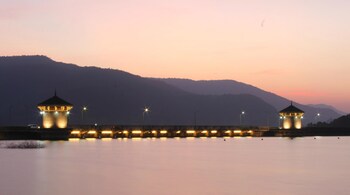
Two new bids have recently been received by creditors of the debt-ridden Lavasa township, which was earlier under the control of Hindustan Construction Company (HCC). The outstanding loans currently amount to Rs 6,000 crore.
The two new bidders are Alchemist ARC president Srishti Dhir along with her brother Madhav and Darwin Projects. The Dhirs have bid Rs 550 crore and Darwin Projects has offered Rs 750 crore. Both bids come with massive haircuts. The upfront cash proposed by both bidders is less than Rs 100 crore.
Srishti Dhir confirmed to Moneycontrol that the bid is in the names of Srishti Dhir, Madhav Dhir and Dhir Hotels and Resorts. Darwin Projects did not respond to queries sent by Moneycontrol. Emails to Lavasa's Insolvency Resolution Professional (IRP) Shailesh Verma also remained unanswered. Emails to Lavasa's Insolvency Resolution Professional (IRP) Shailesh Verma also remained unanswered.
People in the know said that the two bids come with the condition that the project will receive environmental clearance.
The lenders to the project, which include Bank of India, Axis Bank, L&T Finance, and asset reconstruction companies Arcil, Edelweiss, and Acre, had met on August 11.
The case so far
The case went to the National Company Law Tribunal (NCLT) in 2018. In August that year, the NCLT had accepted an application by HCC that sought the commencement of insolvency proceedings against its real estate arm, Lavasa Corporation, under the Insolvency and Bankruptcy Code (IBC).
The bidders
The project has received several bids. In 2019, bids were received from Pune-based realty developer Anirudh Deshpande and a Dubai-based fund. Before that, Haldiram Snacks had also put in a bid. In 2020, bids were received from Oberoi Realty and US-based fund Interrups. In 2020, Haldiram Snacks Pvt Ltd and Oberoi Realty quit the race citing falling realty prices and the impact of Covid-19.
Also Read: Lenders cancel bankruptcy proceedings against Lavasa Corporation, to invite new bids: Report
Environmental clearance was also the main deterrent for the project, experts said.
The background
The company was set up in 2000 by the Ajit Gulabchand-led Hindustan Construction Company (HCC). His idea was to develop the country’s first privately developed city, spread over 20,000 acres in the Mulshi and Velhe areas in Maharashtra’s Pune district.
Lavasa City by Lavasa Corporation is a joint venture between HCC (68.7 percent), Avantha Group (17.18 percent), Venkateshwara Hatcheries (7.81 percent) and Vithal Maniar (6.29 percent).
The township was planned for a population of three lakh people. The project was to include apartments, villas and hotels.
It defaulted on bank loans after the environment ministry issued a stop-work order to the project in 2010.
The promoter had agreed to hand over possession before October 4, 2016, but when Lavasa registered the township project with MahaRERA, it revised the date to December 31, 2020.
Homebuyers’ take
Netherlands-based investor Vinay Kulkarni, a representative of homebuyers in the project, told Moneycontrol that some homebuyers have been waiting for over 10 years, some had approached RERA and other courts and the wait seems endless.
Also Read: Homebuyers hit by Lavasa project delay contemplate approaching Maharashtra RERA
“We have demanded that the principal and interest be refunded to us. We had also proposed several times that homebuyers take over the project and complete it themselves,” he told Moneycontrol on a call from Amsterdam.
“The NCLT process is an eyewash,” he said. “Our demand for a forensic audit was not heeded. Several bidders have come forward as part of the NCLT process but the bids never saw fruition.”
There are about 1,500 property owners in Lavasa of which about 1,200 have been contacted as part of the insolvency process. “As many as 300-400 owners are out of the process,” Kulkarni said.
The homebuyers comprise people from all walks of life, who have put their savings into the project, including defence personnel, teachers and businessmen. “For some this was meant to be a second home and for others it was a primary home,” Kulkarni said, adding that buyers have paid up almost 60-90 percent of the project cost but have no hope left of getting their homes.
“Some have lost their jobs, others are taking tuition just to make ends meet,” he says.
With regard to the insolvency process, unlike the Jaypee Infratech insolvency case, where homebuyers were part of the CoC and had a 66 percent vote share, in the Lavasa matter, buyers have only a 7 percent vote share, Kulkarni said.
This means that “buyers have been pushed into a corner. There is no active authorised representative either. Even if liquidation were to take place, we would only get the leftovers, which could be as little as 10 percent of what we may have paid,” he said.
Also Read: MahaRERA dismisses complaint filed by Lavasa homebuyer over possession delay
Most buyers have paid up 60-100 percent for their unit. An apartment in the project was priced at around Rs 40 lakh to Rs 60 lakh and a villa cost Rs 2 crore. “All of us have waited for almost 10 years. The entire project is spread across 20,000 acres. Even by selling the parcels, enough money can be raised to pay of the principal and interest amount to buyers. We have also paid stamp duty to the government,” he says.
“Now even if a new promoter comes in to take over the project, it will take another seven years. We cannot wait for eternity. We cannot continue to wait on promises,” he added.
Kalpesh Patel, another buyer, told Moneycontrol that the two new bids are an “eyewash.”
Another issue with the project is to do with the fact that it is perceived as a second-home project and has only 1,500 buyers unlike the Jaypee matter, which was a primary home for over 20,000 people. “The impression all along has been that this is a retirement home, a second home for most people. The impression is that it only comprises premium homes. This is not true. For me it was a first home and I have paid Rs 95 lakh. When I stopped servicing my home loan, the lender filed a default case against me,” he told Moneycontrol.
What next?
Given that the amount of debt owed in this project is so large, the objective going forward should be to try and maximize the economic value of the sale.
“This is more likely today due to the sudden uptick in the market post Covid-19 — demand for second homes, townships and resorts has increased, says Amit Goenka, MD and CEO, Nisus Finance.
Besides the environmental clearance, the biggest challenge in this case is the lack of clear timelines and the fact that the process seems undermined.
“This may only lead to the company going into liquidation. Once that happens, it can be broken into multiple parts and sold to different bidders for a fraction of the value. The logical outcome basis current bids seems to be to permit liquidation and a strip sale to happen,” he said.
There is a waterfall mechanism in the IBC wherein there has to be distribution between secured and unsecured financial creditors. In this case, homebuyers may have to take a deep haircut but that would also be through a pro-rata distribution mechanism, he explains.
This case is unprecedented in the sense that in most real estate cases, liquidation is largely avoided.
“Most of the projects are integrated developments in which case a strip sale is not possible and the entity is sold as a going concern to the new buyer. The composition of buyers in this case is much smaller and there are large tracts of land that can be monetised. Considering that around 1,000 homebuyers would have paid anything between Rs 50 to Rs 60 lakh on an average, around Rs 700 crore would have been collected by the builder of the total sales worth Rs 1,200 crore. Therefore, of the Rs 6,000 crore of debt, claims of homebuyers seem to be less than 10%,” Goenka added.
Discover the latest Business News, Sensex, and Nifty updates. Obtain Personal Finance insights, tax queries, and expert opinions on Moneycontrol or download the Moneycontrol App to stay updated!





