

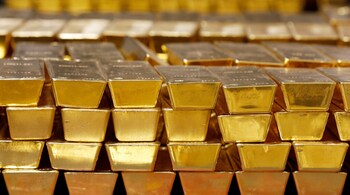
In this segment of The Wealth Formula podcast with N Mahalakshmi, Kalpen Parekh, Managing Director and CEO of DSP Mutual Fund, articulates how he thinks about gold — not as a return-chasing asset, but as a portfolio balancer shaped by cycles, currency dynamics and investor behaviour. From intrinsic value frameworks and gold-silver ratios to the limits of forecasting and the role of gold in a leveraged world, Parekh lays out why gold made sense over the past few years — and why he is now turning more neutral.
You’ve spoken earlier about the intrinsic value of gold, and I remember you had put out a number on this in Netra. What is it, and how should investors think about it?
There is no clean way to value gold or silver because they don’t generate cash flows. I’m upfront about that. What we’ve tried to do is build a reference framework rather than claim precision.
We’ve used money supply — specifically M2 — as a proxy. We take US M2 and about half of Eurozone M2, but not the rest of the world, because much of global surplus capital eventually parks itself in US treasuries, leading to double counting.
When you track this combined money supply against gold prices over long periods, gold today is much closer to what that framework suggests is fair value. That’s why we are saying this is not the time to massively overweight gold. If you don’t own it, having 5–10% still makes sense — but the big margin of safety is gone.
When we launched our gold and silver funds two to three years ago, they were trading well below these reference points. This framework doesn’t always work — there’s no guarantee — but historically it has helped identify turning points.
At around $3,300 per ounce, gold is now close to fair value under this model. The gold-silver ratio — another derived indicator — suggests silver’s fair value is closer to $63, versus about $55 currently. But again, the margin of safety is limited in both.
That’s why we’ve moved to a neutral stance.
In our multi-asset allocation fund, we’ve reduced gold and silver exposure from about 22% to roughly 13–14%. We’ve taken some profits after a sharp run-up. Whether this proves right or wrong, time will tell.
How should investors think about gold – in general, because Indians largely buy gold only because of social conditioning.
Let me share a personal story. Until about seven years ago, the only gold I owned was my wedding ring. I never really thought about gold as an asset.
What changed my thinking was looking at long-term data. In most emerging markets, where currencies depreciate against the dollar, gold has delivered about 6–7% returns in dollar terms. Add currency depreciation of around 3–4%, and gold delivers low double-digit returns in local terms.
When you look at median returns — not point-to-point returns — Indian equities have delivered about 12% over the long term, while gold has delivered around 11%.
If you blend equities and gold in a 50:50 portfolio and rebalance annually, returns are slightly higher than equities alone, but more importantly, volatility drops by 35–40%.
Equities have a standard deviation of about 16. Gold and silver are actually more volatile at 18–22. But together, portfolio volatility drops to around 12. That was a lightbulb moment for me. Gold is volatile on its own, but powerful as a diversifier.
So, gold is more of a balancing asset than a return engine?
Exactly. Gold works best when other assets are expensive and it has gone nowhere for a long time. That’s when you overweight it.
Today, gold has beaten equities in almost all emerging markets. It has become the hero asset. Historically, being counter-cyclical has worked better for me than following the hero of the moment.
We also live in a post-2008 world marked by heavy money printing and leverage. Somewhere, future returns have been borrowed. If the future turns out very different from the past 30 years, gold deserves space in portfolios.
That’s why I was comfortable holding around 15% in gold. After the recent run-up, that has drifted higher. I’ve trimmed a bit, but I’m not dogmatic.
Trade wars, slower global growth and stretched equity valuations mean stocks could underperform. If both stocks and gold underperform for a while, I’m okay with that — the role of gold is protection, not excitement.
Do you think about crypto the same way?
I started studying Bitcoin very early — around 2014 — but I’ll be honest, I never fully understood what problem it solves. I didn’t want to pretend I understood something I didn’t.
Many people have made a lot of money in crypto, and many have also lost money very quickly. As of today, I don’t know how to think about it clearly.
I don’t dismiss it. Large institutions getting involved doesn’t automatically mean it will make money, but it does mean we should pay attention.
Most people buy assets simply because prices are rising — that’s risky. Until crypto becomes a clearly defined and legally recognised asset class in India, I’ve parked the idea.
There are different schools of thought. Some investors prefer only assets with cash flows — even excluding gold. Everyone has to find what aligns with their own framework.
Gold returns in India also include currency depreciation. As India develops, should we assume that 3–4% depreciation continues?
Nothing should be taken for granted. Every five years, we need to reassess assumptions.
There were periods — like 2003 to 2008 — when the rupee actually strengthened. Today, gold prices have risen sharply and the rupee has depreciated sharply. Over the next few years, outcomes could be less favourable.
That’s another reason not to go overboard on gold right now. Structurally, India still has an inflation differential versus the US, and export-import dynamics haven’t changed dramatically. So the long-term trend may still be rupee depreciation — but likely at a slower pace.
Discover the latest Business News, Sensex, and Nifty updates. Obtain Personal Finance insights, tax queries, and expert opinions on Moneycontrol or download the Moneycontrol App to stay updated!





