

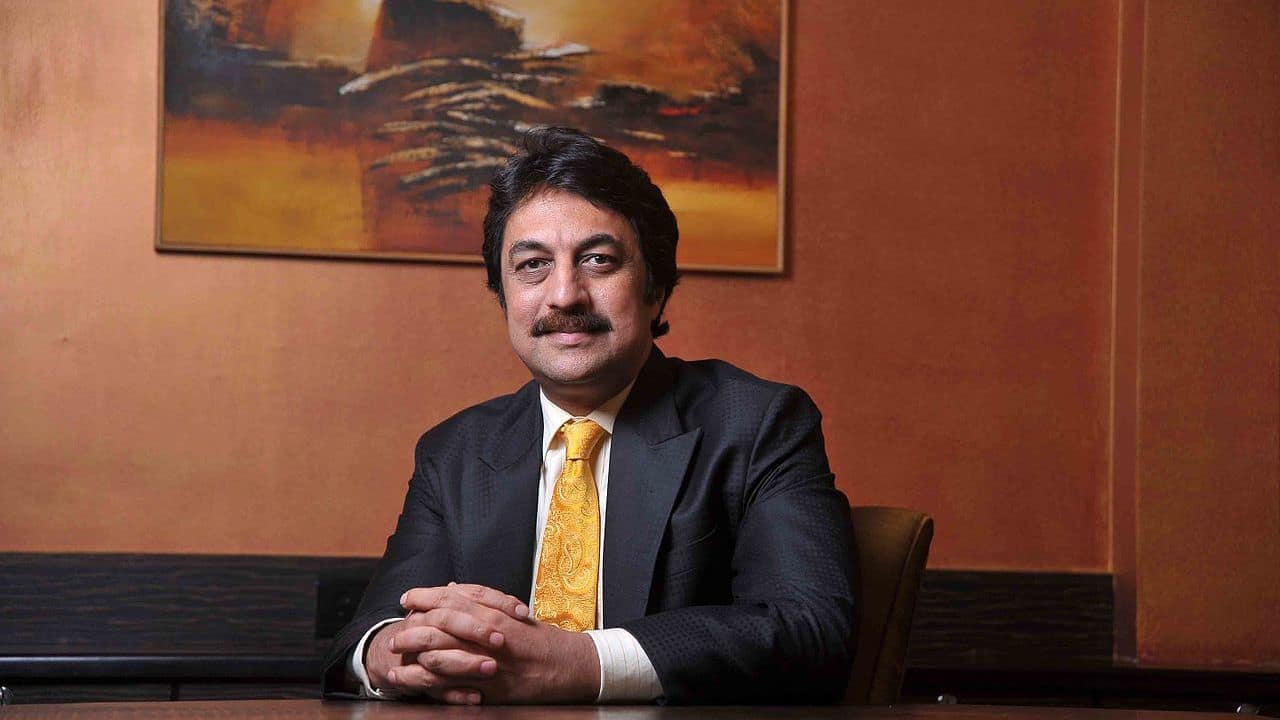
We follow a tactical asset allocation approach in which we are not exposed to a single market or a single currency or a single asset, and we diversify to the best opportunities available at that point in time. That is our central mantra, Shankar Sharma, co-founder and vice-chairman, First Global, said in an interview with Moneycontrol’s Kshitij Anand.
edited excerpts:
Q) How important is Global Portfolio Diversification for investors? This is one theme that is fast catching up but it is hardly understood by investors. Some would probably buy a global ETF and feel that the job is done. But it is a complicated process – what would you advise to listeners?
A) Yes, this whole thing started back in November when I addressed a conference in Mumbai. I gave the data that for the last ten years Indian investors have made zero returns in dollar terms and that has what set the cat among the pigeons because nobody had ever told Indian investors how badly off they were.
The data is very clear -- if you would have invested $100 in the Sensex 10 years back, it is worth maybe $110 today which is virtually zero returns over 10 years period while globally it would have given you 2.5 times.
So the point is, it has to be a part of your portfolio to diversify out of a single country, single currency, single asset risk which is called SCCARS -- we call it SCCARS.
If you want to avoid SCCARS, you need to diversify, but it has to be done very, very intelligently and very, very selectively because just going and buying a NASDAQ ETF, is not the solution.
Why we say that is because NASDAQ has done well only in the last 12 or 18 months.
But, if you see the data, every year some different market outperforms. Last year, it was not NASDAQ, it was actually Russia which was up 48 percent while the NASDAQ was up only 30 percent.
The point is you have to have diversification. Just buying a single country ETF is going to lead you to bigger problems. What will happen if global equities tank, are you in US treasuries also which will gradually go up when global equities will tank.
The point to remember is that one has to be diversified globally across markets, across asset classes, across currencies, in order to have genuine diversification and you can't do it on your own, let's be very clear about it. It has taken us 25 years to understand this.
There are ways how diversification can be done, but definitely not just going and opening an account and trading foreign stocks or buying a single country Feeder Fund or an ETF because they do not give you diversification at all.
Q) Indian market has not done much in dollar terms say in the last 10 years. If investors are not diversified globally, they will suffer SCAARS. That is: Single Country, Single Currency, Single Asset Risk. Can help us understand this concept?
A) For example, you have got investments only in India whether you got real estate or you got equities or fixed deposits, etc. Now, suppose the rupee tanks and it has been falling for the last several years, right.
You have to be exposed to a world that is basically a dollarized world. Everywhere you go, the US dollar is a standard, and everything is measured against the US dollar as a standard.
You are exposed to only a single country, all your eggs are in one basket and that basket has some problem. It could be an economic recession, currency fall, etc. and there could be many problems that can happen in a country, and you are suddenly left with no leg to stand on.
Which comes to our next point -- we need to diversify out of a single country, single asset risk, go outside but do it correctly.
Q) You have two global funds that have been marked outperformers since inception. What is the strategy you are following?
A) So we have 2 fund products and by the way, these are all in-house managed because we have been in-house expertise and we have developed. It took us over 25 years of global investments to perfect these products.
I bought Amazon in 2001, Apple in 2002 personally speaking, and I bought Netflix in 2010. We have done this a long time. We’ve bought Chinese companies about four years back, so we have done this a long time.
Yes, we have also made mistakes, and we have learned from them. These products were launched about between one-and-five years back and there are thousands of Indian investors are now in these products as well as foreign investors, non-residents, foreign citizens. We have a total of more than half a billion dollars in these products now.
It's not a single country fund, so for example, right now we have gold, oil, investment-grade bonds, emerging market sovereign debt which is in dollars and we also have equities which are probably 75-78 percent.
Under equities, the share of the US market is around 40 percent, and China is about 18 percent. We are also invested in Switzerland, the UK, Taiwan, South Korea, and Japan.
It’s a diversified to the best opportunities in the world right now. We are not exposed only to NASDAQ.
If NASDAQ falls it doesn't matter. NASDAQ is not the only game in town, for example even this year Taiwan has done better than most of the US indexes
We follow a tactical asset allocation approach in which we are not exposed or overexposed to a single market or a single currency or a single asset we diversify to the best opportunities available at that point in time. That is our central mantra.
Q) In one of your interviews you highlighted thumb rules on investing. You said that ‘If there is one God in investing, it is risk management’. I think apart from asset allocation, investors should pay attention to this rule as well. How to manage risk when the market has run ahead of fundamentals?
A) So I'll give you a live example, this year is the best year in ten years for anybody to understand the value of risk management.
We usually forget about these things but when markets are good we tend to say, this is all very, very vague stuff, why to bother about risk management, markets only go up all the time.
This year, the reality was slightly different. In our global portfolios as well as in our India PMSes, in the month of February, we made some change because there was enough evidence that there is some kind of problem building up.
What we did was we trimmed our positions, we tightened our risk management when the market fell, like everybody, we took a hit too. But, we were down only 3 percent or 5-6 percent versus the market that was down 30 percent.
When the markets recovered, we were back again into positive territory. So, both are global products and India products and now up for the year between 5 percent and 25 percent, up in a year in which markets are still down.
2020 -- is a great year. It’s like a laboratory or more like a classroom where you’ve learned the lesson of risk management and that is the reason why in our global products we have delivered 21 percent CAGR in dollar terms over the last five years.
That is one of the major reasons that we avoid big falls. When you avoid the big falls and the markets are then running up, you participate. It comes down to something as simple as that.
It is not that simple to practice but it is at the core of it, it is what it is to avoid big mistakes, to avoid big losses, whether in India or globally.
But, if you’ve gotten into something which is giving you exposure across the world into different asset classes if one market falls don't matter, something else will compensate for it. That is the main establishment.
That is the meaning of global diversification. It is not just buying a single market, single ETF, single-country fund, and by the way, the other thing is important that a Feeder Fund, for example, doesn't manage the money themselves. They give it to somebody sitting in New York and London.
So, don’t just go out and swing your bat, because swinging bat often make a six but often get you out very quickly as well.
Q) Small & midcaps have outperformed in the first six months – what is driving the rally in the broader markets and also the penny stocks which is seeing smart rally?
A) If you see, the smallcap index had a great 2017. And then everybody went into 2018 expecting a repeat.
We all know how terrible 2018 turned out to be for smallcaps. Even 2019 was a poor year.
And then came 2020 March. At the lows of March 2020, the smallcap index had fallen nearly 50 percent from its highs of 2017.
When and the index falls so much then you can take a reasonably calculated bet that it is going to outperform for the next few months. Which is exactly what is happening.
What also happened in the last three years is that any number of smallcap companies became extremely undervalued. Most had been delivering decent performance but the market was not interested.
So you had companies that were earning 20 percent on equity and trading at book value.
This kind of mispricing had to get corrected to some extent at some point and this is exactly what is happening right now.
Disclaimer: The views and investment tips expressed by experts on Moneycontrol.com are their own and not those of the website or its management. Moneycontrol.com advises users to check with certified experts before taking any investment decisions.
Discover the latest Business News, Sensex, and Nifty updates. Obtain Personal Finance insights, tax queries, and expert opinions on Moneycontrol or download the Moneycontrol App to stay updated!





