

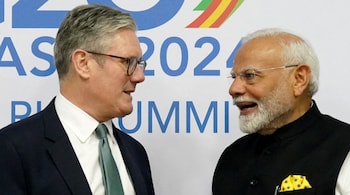
The Free Trade Agreement (FTA) between India and the United Kingdom is expected to be signed on July 24 during Prime Minister Narendra Modi’s visit to the country. The deal, which was agreed on May 6, took around three months to conclude the legal vetting as well as to finalise the contours around tariff concessions for automobiles.
Tariff concessions
Indian exports are set to benefit from duty elimination on about 99 percent of the tariff lines, covering almost 100 percent of the trade value, especially aiding labour-intensive shipments of textiles, marine products, leather, footwear, sports goods and toys, gems and jewellery.
Other key Indian exports like engineering goods, auto parts and engines, and organic chemicals are expected to get a boost too.
India, on the other hand, will slash duties on British goods, locking in reductions on 90 percent of tariff lines, with 85 percent of these becoming fully duty-free within a decade.
Notably, tariffs on British whiskey and gin will be halved from 150 percent to 75 percent before reducing to 40 percent by year ten of the deal, while automotive tariffs will benefit from a quota that reduces tariffs from over 100 percent to 10 percent gradually over 10 years.
Mutual wins
Similarly, Indian access to the UK market for EVs and hybrids is also staged and under a quota to support the British auto industry’s transition to electric vehicles.
While the concessional quota for British cars will cover electric and hybrid vehicles, it will be limited to high-end vehicles in a bid to protect India’s domestic automobile sector.
India has been able to exclude traditionally sensitive items like dairy products, apples, cheese, among others, from the FTA with the UK.
The country’s dairy sector remains protected from duty concessions in FTAs due to its sensitivity involving small farmers. Recent agreements with Switzerland, Norway, and Australia too excluded this sector.
This deal also excludes other domestic sectors from liberalisation, such as sugar, milled rice, pork, chicken, and eggs.
On the other hand, Indian products such as frozen shrimp are expected to get better access to the British market thanks to tariff cuts.
According to the British government, the deal will also cut tariffs for UK cosmetics and toiletries exporters, who have seen a spike in Indian sales despite current duties of between 10 and 20 percent.
Indian duties on soaps, shaving cream, face cream, and nail polish will either be removed on day one or after staging for over 10 years. In addition, perfumes and eau de cologne will see tariffs of 20 percent being gradually halved.
The deal is expected to increase bilateral trade between the two nations by £25.5 billion, £15.7 billion of which is expected to be from rising exports from UK businesses into India, according to estimates from the British government.
Barclays, in a note in May, said India's imports from the UK are less diversified, largely concentrated in gems and jewellery, while Britain expects tariff reductions will expand its exports of autos, aircraft, electrical circuits, cosmetics, whiskies, and agri-food products such as gin, soft drinks, lamb, and frozen fish.
“We note that India's imports from the UK of these categories are relatively smaller, and even with increased imports under the FTA, are unlikely to materially impact India's current account balance,” Barclays said.
India is the UK’s 12th largest trading partner, with total trade worth £43 billion in 2024.
Beyond tariffs
India has been able to secure a three-year exemption from Britain’s national insurance contributions for short-term workers.
This means that Indian employers in the UK will only be liable to pay social security contributions in their home country for three years, as per the Double Contributions Convention (DCC) agreed by both nations along with the FTA.
Though this exemption has sparked controversy in the UK, the British government has defended it by terming it as reciprocal and in line with their understanding with other FTA partners.
This practice will operate on similar principles to the UK’s other Social Security Agreements (SSAs) with the European Union and countries such as Switzerland, Norway, Canada, Japan, Chile, and South Korea.
India has also secured commitments on digitally delivered services for Indian service suppliers such as in computer-related services. This is crucial as the UK is the second-largest destination for India's biggest services exports of IT and ITeS (with a share of 17 percent), Barclays noted.
Britain, on the other hand, has secured guaranteed access to the Indian government procurement market for UK businesses.
UK companies will get exclusive treatment under the ‘Make in India’ policy, which currently provides preferential treatment for federal government procurement to businesses that manufacture or produce in India.
British firms will be treated as a class 2 supplier if at least 20 percent of their product or service is from the UK, putting them at par with the benefits Indian companies enjoy.
The Make in India preference will still apply for approved ‘class 1’ suppliers offering 50 percent or more of their goods or services from India.
This means, for the first time, UK businesses will be able to compete for a broad variety of goods, services, and construction procurements, for the majority of central government entities in India, as well as for several of India’s federal state-owned enterprises at thresholds lower than ever before, according to the British government.
Innovation and gender
The India-UK FTA will include a chapter on innovation that includes setting up a Working Group, which will allow the two countries to enhance existing collaboration, research, and development, covering a range of areas such as future regulatory approaches, the commercialisation of new technologies, and supply chain resilience.
According to the British government, this Working Group will provide an opportunity for industry, academia, and civil society to advise government on key challenges surrounding innovation and trade, and to help shape an appropriate response.
The chapter on Trade and Gender Equality will enhance the opportunities for women to access the full benefits of the UK-India FTA.
“This chapter will create the space for the UK and India to work together to support women business owners, entrepreneurs, and workers to fully access and benefit from the opportunities created by this agreement. Women’s economic empowerment is a growth enabler, which is at the heart of the UK government’s agenda,” according to a statement by the British government.
Other key chapters in the FTA include:
Digital trade — to reduce unjustifiable barriers and promote compatibility of such trading systems, including through supporting the legal recognition of electronic contracts and electronic authentication.
Temporary movement of natural persons — to ensure that visa application processes remain transparent, and that governments do not create unnecessary obstacles for professionals to travel between the UK and India.
Rules of origin — This chapter will prevent fraudulent activities by ensuring that only genuinely British or Indian goods can access preferential tariffs. To qualify for reduced tariffs, the rules of origin specify that a product must either be wholly obtained or significantly transformed through processing in either the UK or India.
Intellectual property — This chapter will secure improvements to patent procedures in India to reduce the administrative burden, speed up processes, and lock in commitments that provide for transparency and legal certainty in the patent system. India is also expected to engage on aspects of copyright and related rights, addressing the interests of British creators, rights holders, and consumers.
What’s next?
The India-UK FTA may be signed as early as June 24, but it may take a while before the deal is operationalised given elaborate processes in Britain.
In fact, Commerce Minister Piyush Goyal last month said that the trade agreement between India and the UK may not come into force in the next few months since Britain has a lengthier ratification process.
Once the deal is signed, the agreement may even take over a year to get operational.
The Indian Cabinet, on its part, is said to have approved the FTA on June 22, according to news reports.
While in the UK, following the signing of the deal, their independent Trade and Agriculture Commission (TAC) will be commissioned to scrutinise the FTA and produce a report on whether the measures within it are consistent with British statutory protections in relation to animal and plant health and life, animal welfare, and the environment.
This deal, therefore, will be subject to Britain’s pre-ratification scrutiny procedures under the Constitutional Reform and Governance (CRaG) Act.
The British government added that any legislative changes required to give effect to the FTA will need to be scrutinised and passed by Parliament in the usual ways before ratification of the agreement can take place.
The India-UK FTA has 26 chapters covering goods, services, investments, and intellectual property rights and was originally slated to be signed during Diwali 2022.
Discover the latest Business News, Sensex, and Nifty updates. Obtain Personal Finance insights, tax queries, and expert opinions on Moneycontrol or download the Moneycontrol App to stay updated!





