

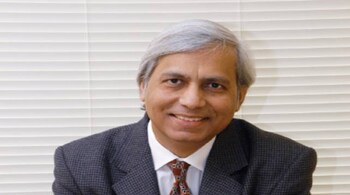
Earlier this January, Neeraj Jain doffed his hat as CFO (Vice President, Finance) at Johnson & Johnson Medical. He now spends his time as an angel investor and mentor to young startups and a guest speaker at business schools.
A supply chain expert, Jain spent close to 37 years in various roles across J&J Medical, Lever Johnson and Hindustan Unilever. Here in this first part of a two-part interview, he talks about the impact of COVID-19 on global supply chains.
Edited excerpts from the interview:
Q: What do you make of the promise of land, labour and law reforms in the PM's speech?
A: Overall, the provision of Rs 20 lakh crore (though a part was already announced) at 10 percent of GDP is a decent package, but is it enough? The focus has been on MSMEs and migrants without giving away free cash, which the government can ill-afford. Credit lines to MSMEs are being intended as an enabler to sustain through the crisis.
Another area of focus has been easing of labour laws (e.g. in case of Uttar Pradesh) to attract FDI but it will be important to ensure that this relaxation is not abused. While the intent has been good, it is the execution which will hold the key. Also, the industry is still hoping to see further relaxation – for instance, can GST be lowered to spur demand? While the supply side has been the focus, we will need more measures on the demand side.
Q: You have worked in MNCs with far flung global supply chains. Do you think companies which have complex global supply chains flung over several countries can unravel these and rejig them as geopolitics changes in the wake of COVID-19?
A: Difficult, but in the long term, yes. We saw this happening in favour of China during the last two decades. However, there have to be very compelling reasons to do so and the current global supply demand gap in many industries may not indicate a favourable move to see India as the next destination.
More importantly, ease of operation, labour reforms, simpler tax laws, a better corruption index and a more disciplined approach to follow strict global guidelines are some of the key determining factors. Here we still need to get better. We might see more of 'India for India manufacturing' but 'India for the World' will take time. The opportunity definitely exists.
Q: There is news that Apple may be considering shifting a fifth of its production from China to India? Will such a news lead to other manufacturers doing the same or are electronic supply chains different?
A: India is one of the largest consumers for mobile phones and it makes sense for Apple to move manufacturing to India. However, as we have seen, there are other countries like Vietnam and Thailand that are more ready to grab similar opportunities.
Electronics supply chain actually does not compel you to move manufacturing unlike many FMCG or food products where the logistics can play a decisive role. Similarly, shifting a highly capital-intensive manufacturing is not easy.
For most other industries, the reason for future movement of manufacturing shall be balancing global capacity with global demand and India shall remain a contender provided we address the issues highlighted earlier.
Q: What exactly will be the future of global supply chains?
A: Highly automated large plants in selected manufacturing locations making standard and global products seamlessly delivered to customers across the World. We will also see more even distribution of plants in countries than concentrating them in one place as has been the case with China.
Q: How do you look at the trend of automation and small batch production? Is that likely to lead many companies to reshore manufacturing?
A: Automation is a reality and it will gain further ground led by robotics which will bring in more efficiency and precision. Small batch production will entirely depend upon the ability to be nimble and with our infrastructure still not the best, we may continue to see more of large batches being produced to optimize overall cost. I think, reshoring production is independent of this, more driven by the government policy and the push with some fiscal benefits offered.
Q: What would be the role of technology in the configuration of supply chains in the coming years?
A: Technological innovation is here to stay and it will keep redefining the supply chains. Whether it was RFIDs earlier or robots now or possibly drones tomorrow, we will see technology in every aspect of the supply chain (i.e. in manufacturing, logistics or warehousing). We will possibly see robots manufacturing in the plants, more and more vertical storage in the warehouses and logistics powered by driverless vehicles. In healthcare, robotic surgery is already the preferred alternative.
Q: As an angel investor, where would you put your money in India?
A: The tech-based startups, powered by digital and apps continue to attract investments and will remain strong candidates for funding. Fintech, ed-tech, med-tech and consumer health are very exciting areas with a lot of innovative ideas that the young entrepreneurs have in this field. In addition, agri-based startups are likely to draw attention as this still is an under explored area.
Read the second part of the interview here.
Follow our full coverage of the coronavirus outbreak here
Discover the latest Business News, Sensex, and Nifty updates. Obtain Personal Finance insights, tax queries, and expert opinions on Moneycontrol or download the Moneycontrol App to stay updated!





