

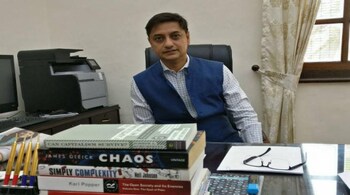
Flexible and dynamic policy regimes are robust and work best for the industry, according to Principal Economic Adviser Sanjeev Sanyal in an interview to Network18.
Sanyal, is also an economist with enormous experience under his belt, stressed on the importance reacting quickly to any situation. “When you make a policy, you don’t try and work out every outcome and pre-empt them, because you don’t know what they are. The emphasis is on flexibility: It’s more important to react fast to an evolving situation,” he said in the interview, his first since he took charge as Principal Economic Adviser.
Complex laws eventually make systems opaque and rigid, he said, adding: “Flexibility is important and this is the most important driving principle for me.” Complex adaptive systems work best for policies, he said.
“The English language is a complex adaptive system; Hinduism is a complex adaptive system; a successful city like London is a complex adaptive system. There is enormous flexibility in the English language, that’s why it’s a robust system, what Nicholas Nassim Taleb calls ‘anti-fragile’,” Sanyal said
Sanyal pointed out to cities like Chandigarh where plans have been “strictly adhered to” and such cities have gone sterile, he said.
Elaborating on the tenets of Hinduism and drawing parallels with complex adaptive systems, Sanyal said: “In most other religions, the terms ‘religion’, ‘faith’ and ‘belief’ are interchangeable. In Hinduism, they are not. Hindus are seekers, they are not believers. Hinduism is a religion, which is concerned with the meaning of life, ethics and so on, like other religions. But it does not give you one particular belief.”
“It is perfectly fine for a Hindu to believe in one god, many gods, or to be an atheist or an agnostic. If you can think of a new way of doing it, Hinduism allows you to add to it. It provides tradition and community, and it is a living religion. Hinduism allows you to write new texts,” Sanyal said.
Sanyal, whose books include the Land of the Seven Rivers: A Brief History of India’s Geography, The Indian Renaissance: India’s Rise After a Thousand Years of Decline, The Incredible History of India’s Geography and The Ocean of Churn, serve as the deputy to Chief Economic Advisor Arvind Subramanian.
Discover the latest Business News, Sensex, and Nifty updates. Obtain Personal Finance insights, tax queries, and expert opinions on Moneycontrol or download the Moneycontrol App to stay updated!





