

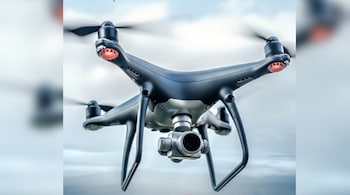
India has notified the National Unmanned Aircraft System (UAS) Traffic Management (UTM) policy framework for “seamless operations of drones in the airspace”, a release from the Drone Federation of India (DFI) said.
The framework will allow private and public service providers in India to manage drone traffic and unlock complex scenarios for operations such as flying multiple drones in close proximity or flying alongside manned aircraft, the release said.
The development follows a government approval liberalising drone regulations and a Production Linked Incentive (PLI) Scheme for drone and drone components.
DFI said the framework has “boosted morale of the Indian drone industry” and they anticipate “mass adoption of drones” across sectors such as agriculture, mining, infrastructure, geospatial mapping, transportation, emergency response, and defence and law enforcement.
Smit Shah, Director of DFI and member of the National UTM Committee, constituted under the Ministry of Civil Aviation (MoCA), in a statement said the air traffic controller system (ATCS) service provided for manned aircraft cannot be scaled for managing drone traffic – which is expected to increase 100 times.
“This policy framework shall allow third-party service providers to deploy highly automated, algorithm-driven software services for managing drone traffic across the country" he said.
Shah noted that the vision for “outcome-based, time-bound UTM experiment as the key next step of the policy framework” will allow India to engage in public-private partnership for development of safety and separation standards for drones will allow for quick scale up of drone operations in the country.
Here are the 15 key takeaways from National UTM Policy Framework:
– The central government shall soon on board public and private third-party service providers known as Unmanned Traffic Management Service Providers (UTMSPs) for managing drone traffic in the Very Low Level (VLL) airspace below 1,000 feet in India.
– The central government, Directorate General of Civil Aviation (DGCA), Bureau of Civil Aviation Security (BCAS), Airports Authority of India (AAI) and Indian Air Force (IAF) shall be the key government stakeholders of the UTM ecosystem.
– Supplementary Service Providers (SSPs) sharing data about terrain, weather, manned aircraft location and providing services such as insurance, data analytics, drone fleet management shall support the UTM ecosystem.
– UTMSPs and SSPS shall be allowed to integrate with DigitalSky Platform to enable seamless and secure exchange of information while allowing them to provide value-added services to users.
– Law enforcement and security agencies may be provided access to some information from the UTM Ecosystem from time to time on a need-to-know basis.
– UTMSPs shall provide services for registration, flight planning, exemption processing, strategic and dynamic deconfliction, conformance monitoring and shall also provide access to supplementary data like weather, terrain, and manned aircraft.
– DigitalSky platform shall continue to be the interface for government stakeholders to provide approvals and permissions wherever required.
– All drones (except Nano drones operating in the green zone) shall be required to mandatorily share their real-time location through the network to the central government either directly or through UTMSPs.
– The flight plan and real-time location of manned aircraft shall be brought into the UTM ecosystem via UTM-ATM integration. This shall be crucial to continuously separate manned and unmanned aircraft from each other.
– Other airspace users like manned and unmanned balloons, model aircraft, gliders, paramotors and airships may voluntarily participate in the UTM ecosystem to improve the overall air safety.
– UTMSPs shall need to locate and host all hardware, software, and data in India and shall be required to adhere to the guidelines of the Ministry of Electronics and Information Technology (MeitY) and other relevant cyber security and audit standards mandated from time to time.
– UTMSPs shall be deployed in small areas to begin with and their geographic presence may be increased subsequently.
– UTMSPs shall be allowed to charge users a service fee, however, may be required to share a small portion of the fee with the Airports Authority of India.
– The central government shall soon conduct time-bound, outcome-based UTM experiments in India
– The UTM experiments shall allow the government to publish evidence-based safety and security standards crucial for managing drone traffic in the UTM ecosystem.
Discover the latest Business News, Sensex, and Nifty updates. Obtain Personal Finance insights, tax queries, and expert opinions on Moneycontrol or download the Moneycontrol App to stay updated!





