

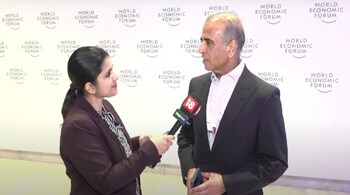
Despite concerns voiced at the World Economic Forum (WEF) about global geopolitical uncertainties, there is considerable optimism regarding India and its growth potential, Bharti Enterprises chairperson Sunil Mittal said on January 17.
In an interview with Moneycontrol on the sidelines of the WEF meeting at Davos, Mittal said India is a "bright spot" amid conflicts in Europe and the Middle East. "People are getting a lot of relief that at least a large part of the world is growing at 6-7 percent and is likely to continue to do that in the next 10 years."
During his conversation with Moneycontrol's Chandra R Srikanth, Mittal, whose Bharti Enterprises controls telecom operator Bharti Airtel, also commented on subjects including India's upcoming general elections, Vodafone Idea, artificial intelligence and Ram Mandir. Edited excerpts:
First, give us a sense of the mood you're getting from global clients and Indian executives you've met here. What's on top of their minds? Because this is a crucial year. I think 60 percent of the world's population is going to be voting. Many people are talking about how that is a critical factor this election year.
That's certainly the topic of discussion that is coming up in almost all the key meetings. There are lots of elections this year, and I think India's upcoming one in May is also attracting everybody's attention. Although, it's pretty much a deal where everybody recognises where this election is likely to go. People are very excited about India's future growth in the next 10 years. The foundation that has been laid out in the last 10 years is now going to see a very beautiful edifice building on top of this.
So, I think everybody's excited about India, but there are concerns here in Davos around geopolitical issues. The Ukraine-Russia situation still is hogging the limelight. The Middle East war is hogging the limelight. There are certain people who are being called pessimists, but equally, there are bright spots like India, which is full of optimism. People are getting a lot of relief that at least a large part of the world is growing at 6-7 percent and is likely to continue to do that in the next 10 years.
So, it's a mixed bag. I think from last year, the overhang of the war has only got more acute with the Middle Eastern situation, but everybody's working towards sorting it out.
Also read: Davos 2024: Sunil Mittal says 3rd term for Modi govt looks likely, pitches for business continuity
You mentioned that elections are not so much of a concern because, more or less, people expect continuity there. So, is that the sense that there will be a third term for the current government? And if that is, there will be a certain sense of policy continuity and stability if Mr. Modi is voted back?
What do investors or the business community, both domestic and international, like? Continuity is very important. Continuity of reform, continuity of investments in infrastructure, ease of doing business, and all that has been very well demonstrated in the last 10 years, increasing with every year.
More importantly, what people are recognising is that the sheer scale and ambition of India is so much different from the previous decades that that is what is catching everyone's attention. And if that was the case in the last 10 years, I think the hope and promise of India that there will be continuity, that there will be strong momentum towards acceleration of infrastructure growth and economic development is there.
And that's palpable. And you can see, we don't have to sell in India anymore. People are drawing and getting attracted to us. People want to talk about business in India. 'How should we invest? Where should we invest? What all do we need to do?' So there's a lot of excitement out there. And that gives you a very clear signal of where people's minds are in terms of where the next election is going.
Will Airtel buy more spectrum in the upcoming auctions?
Let's see. We have very small chunks of spectrum getting renewed. So, I think a large part of our spectrum pool was bought last time. This is a big chunk of spectrum we bought, including very large chunks for 5G. So, barring minor participation in some renewal spectrum, there doesn't seem to be much need from our side.
How are OneWeb's launch plans panning out?
Well, we are ready. The northern part of India has been ready for some time. The southern preparations are going on, but we are still waiting for the market access and spectrum allocation to be finalised. Thankfully, the government has decided to give spectrum on an administrative basis, and rightly so, because where are we going to connect? You know, in the oceans, high seas, deserts, mountains, forests, and deep rural areas where terrestrial networks can never reach.
In terms of the overall telecom market structure, with Vodafone Idea still in the red and no relief funding in sight, what do you make of it?
It's a very, very capital-intensive industry. We have spent over Rs 30,000 crore this year on 5G. We have spent large amounts of money on 4G in the past. So a lot of investment is required. And they need to shore up their capital base.
They need to get some investors. They need to get some more debt. You need serious capital to be in this business. And that— sadly, it has not been the case for the last two or three years. Although they have bought some 5G spectrum, you need to roll out networks.
So that could be an overhang on the third operator. I wish them well. I've always said India, the size of a market in India, should have three operators. But BSNL is coming up, thankfully, and the government is doing a lot to roll out 4G there now. Plans for 5G are afoot.
So India will be served well. There will be enough competition. There will be choices for customers. The good news is India's tariffs remain one of the lowest in the world.
Also read: Davos 2024: Cash-strapped Vodafone Idea needs 'serious capital', says Sunil Mittal
How aggressively is Airtel pursuing the fair share demand from OTT companies?
Very aggressively. I think that's a legitimate demand that when we are building these very large…
..But it starts the other debate on net neutrality.
No, absolutely not. That is where some people get mixed up. It's got nothing to do with net neutrality. Net neutrality is that the access to the net by the customer on the other side should be neutral. It will remain neutral. That's mandated in the law. You can't even break it. Nobody's saying fair share at the cost of net neutrality. Net neutrality is a given. On top of that, we're talking about fair share. That's got nothing to do with net neutrality.
So you're pursuing it aggressively?
Yeah, aggressively is wherever we can talk, we talk about it. The large four or five big consumers or guzzlers of the network capacity need to step up. And contribute towards India's rural burden. Why should the telecom operators who have a much lower ROC (return on capital) at lower ARPU's (average revenue per user) be obligated to do everything?
One thing that you're looking forward to in 2024, macro trend, micro trend?
Well, I think 5G industrial monetisation is yet to pick up anywhere in the world. I hope by 2024, before the end of this year, some solid use cases should come up. And these are not selling pure bandwidth or ARPU games; it's selling solutions—industrial solutions where low latency and large capacity are required.
So, we'll be able to get some use cases in Indian hospitals, especially the rural ones, where you could do live robotic surgeries; you could manage the drones for agriculture, surveys, and monitor springs. So, a lot of work is going on globally. I hope something strikes where you start to see the benefit of 5G.
With AI being the theme this time at Davos, how are you leveraging it across your company? And how do you plan to use it?
Well, it's a standard protocol that we have always followed: tie up with the best, have partnerships, deep partnerships. We are talking about AI almost all the time. In the company, five internal products have already been launched, and 15 are underway.
Will you look at building your own LLM?
I don't think so. There's an alliance being built among operators. We are a part of that alliance. Eight to ten of us are joining hands. In the LLM model, India actually contributes a lot because, given the population, the diversity. But we work with Google. We are working with Microsoft. We are working with all the leading AI companies to ensure we embed them for our use and our customers' use.
Ultimately, what do we want from it? Efficiency, accuracy, getting networks better, response time faster, call centres, chatbots, and, importantly, tuning of networks as the demand rises and falls in various parts of the country.
We are actively engaged in those areas. Do we need to develop our own AI to compete with the other AI providers? No, that's not the ambition.
Why do you think there is so much excitement around Ram Mandir? Is it something that you will go for as well?
Well, I'm planning to be there. I think it has been an aspiration of India to see the completion of the Ram Temple, Ram Mandir. And I think all cutting across religions should be participating in it, should be looking forward to it. There's no comparison between where we are, and that comes from the heart. You have to be there because you have your belief.
Importantly, the Ram Mandir also represents the goodness of India, the Ram Rajya, which really is not necessarily pure religion itself, but everything that can be captured in a good way for the country, for the people who live there, and for everyone.
That's what that particular symbol represents. And apni, apni aastha (everyone has their own beliefs) and our own devotion towards it, everybody will go with their own kind of attraction towards Ram. For me, I've grown up praying in a temple every morning when I wake up and go to work. And this is just an extension of that.
Discover the latest Business News, Sensex, and Nifty updates. Obtain Personal Finance insights, tax queries, and expert opinions on Moneycontrol or download the Moneycontrol App to stay updated!





