

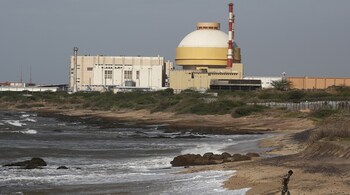
The proposed Atomic Energy Bill, 2025, also known as the SHANTI Bill (Sustainable Harnessing of Advancement of Nuclear Energy for Transforming India), aims to widen participation in India’s nuclear power sector, but a close reading of its provisions shows that the strategic core of the nuclear programme — exploration, mining and ownership of atomic minerals — remains firmly under the control of the Central government. The Bill permits private sector participation primarily in the construction, ownership, operation, and manufacturing of components for nuclear power plants.
Senior officials in the Department of Atomic Energy (DAE) told Moneycontrol that the Bill draws hard red lines around the nuclear fuel cycle, with no dilution of government control over uranium and thorium. Nuclear fuel cycle is the entire process of generating power, from mining raw uranium or thorium, processing it into reactor fuel, generating electricity in the reactor, and finally, safely disposing of or reprocessing the spent fuel.
“While reactor construction and operation can be separated and opened to licensed private participation, fuel ownership and management remain sovereign, because nuclear fuel and associated materials can be diverted for weapons use if left outside state control,” said one of the officials requesting anonymity.
Mining stays sovereign
The Bill states that “the working of mines and minerals in onshore or offshore areas containing uranium and thorium and decommissioning of such mines shall be carried out only by the Government, a Government company, or a corporation owned or controlled by the Government”, overriding all other laws. This leaves no room for private sector entry into mining of atomic minerals.
Given their dual-use nature—serving both civilian energy production and strategic applications—their ownership and management are held under government control to ensure accountability and meet global nuclear security standards, officials said.
The Bill also introduces a threshold value for uranium and thorium, below which the material is not automatically mined by the Government. Officials said this does not open the door to private mining, as handling and disposal remain tightly regulated and the Centre can step in if extraction becomes possible.
A threshold value is the minimum concentration of the atomic mineral in the ore, distinguishing economically usable fuel from trace material. Officials said the government will specify these thresholds later to avoid imposing regulatory burdens on non-atomic industries.
Even discovery is tightly regulated. The legislation requires that “any person who discovers or has reason to believe that uranium or thorium is available at any place in India shall inform the Central Government forthwith”, ensuring that atomic mineral finds cannot be retained or exploited by private or non-atomic miners.
Moneycontrol reported on December 11 that the government is pushing its atomic minerals agency to fast-track exploration due to a projected surge in uranium demand.
Ownership clearly defined
Ownership of atomic minerals is vested entirely in the Centre. The Bill provides that “all uranium or thorium mined, isolated or extracted… shall vest in that Government and shall not be sold, transferred, or otherwise disposed of except with its prior permission”.
Residues or tailings containing atomic substances below notified thresholds, if deemed unusable, must be treated as hazardous waste under environmental law, it stated.
The law also shuts the door on indirect access. Where uranium or thorium can be isolated as a by-product from mineral processing or metallurgical activity, the Central government may impose licensing conditions or “prohibit carrying out of such activities”, with compensation payable where applicable, read the Bill.
What is allowed for civilian use?
The Bill allows “any person” to manufacture, possess, use, import, export, transport or dispose of radioactive substances and radiation-generating equipment, subject to safety authorisation and licensing. Officials clarified that this provision is aimed at regulating civilian and industrial use — including medical isotopes, industrial radiation equipment and reactor components — not nuclear fuel.
Besides, the Centre shall retain sweeping powers to inspect consignments, maintain a national registry of radioactive substances and, if required to prevent radiation hazards. It stated that it can “assume control of any radioactive substance or radiation generating equipment”.
How will private plants operate without fuel control?
Under the Bill, private companies are expected to build and operate nuclear power plants under a custodial fuel model, in which nuclear fuel remains under the ownership and control of the Central government.
Officials said the government will supply fuel to licensed operators, who can use it only within approved facilities and must return spent fuel after a prescribed cooling period with associated costs borne by the licensee. This model allows private participation in construction and operations while ensuring that strategic materials linked to national security remain firmly under sovereign control.
The Bill specifies that “the enrichment or isotopic separation of prescribed substance, the management of spent fuel including reprocessing, and the production of heavy water” shall be undertaken only by the Central government or entities wholly owned by it.
Global parallels
Japan and South Korea allow private utilities to operate nuclear plants, but fuel procurement and back-end management remain under strong government oversight. Fuel leasing and take-back arrangements are also common globally.
Discover the latest Business News, Sensex, and Nifty updates. Obtain Personal Finance insights, tax queries, and expert opinions on Moneycontrol or download the Moneycontrol App to stay updated!





