

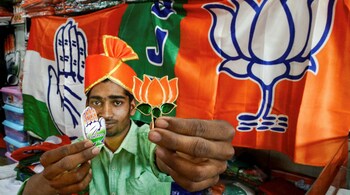
The past week turned the focus in Karnataka towards the choice of candidates by different political parties for the upcoming elections. Each party has had its share of agonising challenges, unending anxieties and long-winding negotiations, both when finalising their lists and also dealing with the fallout of the announcement.
The three major players – BJP, Congress and JDS, have had their fair share of being on the edge, for vastly different reasons. How have they each dealt with the nitty-gritty of ticket distribution and what is its likely impact on party unity? A meaningful analysis would require an independent assessment of the strategies followed by each of the parties.
BJP: Troubles Mount
First, the ruling BJP. They were the last among the three players to announce their first list. The party has always followed the practice of the names of its candidates being announced soon after the meeting of its central decision making body. This time around, the party had to hold further discussions among key leaders to iron out differences prior to the announcement of the first list.
BJP faced multiple challenges. There was a demand for a Gujarat-style overhaul with new faces dominating the list. Yet, given the nature of the party in Karnataka, this seemed an unlikely possibility. The legislators who crossed over to the party after the last elections and helped it form the government had to be accommodated on priority.
Legislators who formed part of the frontal organisations associated with the party could not be sidelined and legislators who were steadfast party loyalists had to be rewarded. Even as all these factions were suitably balanced, the need for fresh blood (a visible trademark of the BJP selection process in recent years) had to be addressed.
The BJP retained close to 85 percent of its sitting legislators. A little less than one-fourth of its nominees were fresh faces. The bulk of these were in seats that the party had not won the last time around. The announcement of the party list led to a spate of negative reactions within the party.
Operation Kamala’s Blowback
A few sitting MLAs of the party resigned their membership of both the House and the party and decided to contest the elections from their seats. This included a former Chief Minister and Deputy Chief Minister and other senior leaders. This is the first time in the state that the party has faced such a strong reaction from those denied a ticket.
The tussle between the different factions within the party has come out in the open, with those denied tickets openly accusing their opponents within the party of having been responsible. Some have even made serious allegations against the state leadership. The rise of dissidents within the party is a natural corollary to the pathway that the party chose in order to secure a majority in the assembly.
For a cadre-based party that emphasises party discipline, this development poses a serious new challenge. With a state government already on the back-foot on account of its inability to meaningfully and convincingly address some of the challenges it faced in recent times, this unrest within the party is an added headache. Much will now depend on how effectively the central leadership of the party is able to steer the election campaign away from the controversies of the past.
Congress: Torn Between Factions
Congress, too, has had its share of irritants and tight-rope walking as it finalised its candidates. The principal rivalry was between the supporters of its two leaders - Siddaramaiah and DK Shivakumar. The first list did not evoke as much controversy as did the subsequent lists. The first list had seats and contestants on which there was a general consensus.
The list which followed had two types of challenges. Those who came to the party from the BJP and JDS, on being denied tickets, were accommodated, causing some heartburn to party loyalists. Secondly, many of the seats announced after the first list, involved an intense competition between the followers of the two key leaders mentioned earlier.
As the last date for filing nominations approaches, it will be interesting to see how many disgruntled candidates enter the fray as rebels. In past elections, this has always been the undoing of the Congress party. Siddaramaiah finally being assigned only one seat has also caused unhappiness among his supporters in Kolar district.
JD(S): Courting The Rejects
The JDS, after declaring its first list of candidates as early as in December last year, has been accommodating those who switched sides from the BJP and the Congress. There has been little internal rebellion as, in most of these seats, the party did not have a strong candidate. The real challenge that the party faced was the `shadow-boxing` within the “first family”.
The patriarch, HD Deve Gowda, had to ultimately intervene in the fight between his two sons on whether his daughter-in-law should be assigned the Hassan seat. The issue was resolved with her being offered an alternate seat in Mysuru district. One still awaits the final outcome of this family tussle. The development has undoubtedly weakened the party on the ground and taken energy away from the contest towards settling internal battles.
Thus, all three major players have had their share of political convulsions in determining and deciding their party candidates. They have sought to resolve it through intense negotiations and appealing to party unity. At the end of the day, between the BJP and the Congress, whichever party is able to better handle factionalism and ensure visible party unity in the last leg of the campaign would surely have the upper hand.
Sandeep Shastri is vice-chancellor, Jagran Lakecity University, and national coordinator of the Lokniti Network. Views are personal and do not represent the stand of this publication.
Discover the latest Business News, Sensex, and Nifty updates. Obtain Personal Finance insights, tax queries, and expert opinions on Moneycontrol or download the Moneycontrol App to stay updated!





